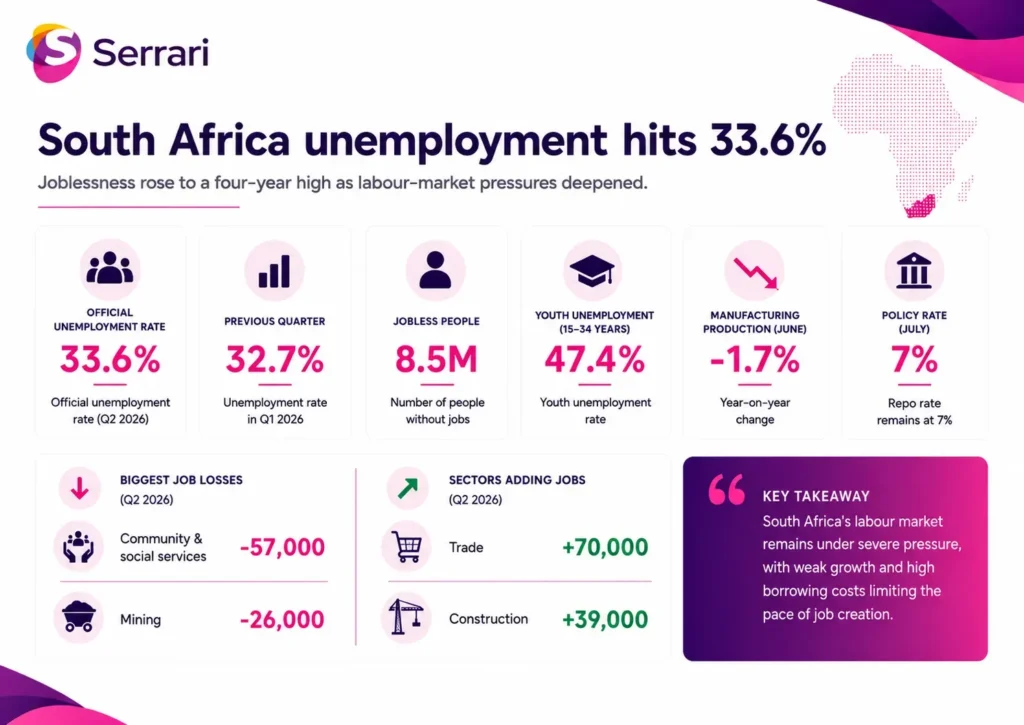
South Africa’s unemployment rate climbed to 33.6% in the second quarter of 2026, up from 32.7% in the previous three months, pushing the official number of unemployed people to approximately 8.5 million.
The latest Quarterly Labour Force Survey showed that unemployment increased by about 345,000 people, while the number of employed people declined slightly to around 16.7 million. The deterioration highlights the difficulty South Africa faces in translating economic reforms and modest output growth into sustained job creation.
Key Overview
- Official unemployment increased from 32.7% to 33.6% in Q2 2026.
- The number of unemployed people rose to approximately 8.5 million.
- Total employment declined slightly to around 16.7 million.
- Youth unemployment remained extremely elevated at 47.4%.
- Community and social services lost 57,000 jobs, while mining shed 26,000.
- Trade added 70,000 jobs, with construction gaining 39,000.
- Manufacturing production declined 1.7% year-on-year in June.
- The benchmark policy interest rate remained at 7% in July.
Joblessness Rises as Labour Force Expands
The deterioration in unemployment reflected both job losses and an increase in the number of people actively participating in the labour market.
South Africa’s labour force expanded during the quarter while employment declined slightly, pushing the official unemployment rate up by 0.9 percentage points, from 32.7% in the first quarter to 33.6% in the second.
The broader picture of labour underutilisation remains even more severe, reflecting millions of people who are unemployed, discouraged from actively seeking work or otherwise underutilised within the labour market.
Young South Africans continue to bear a disproportionate share of the employment crisis. The number of unemployed people aged between 15 and 34 increased during the quarter, with the youth unemployment rate reaching 47.4%.
The figures reinforce the structural nature of South Africa’s unemployment challenge, where economic growth has repeatedly failed to expand quickly enough to absorb new entrants into the labour force.
Job Losses Spread Across Major Industries
Employment declined across several important sectors during the second quarter.
Community and social services experienced the largest fall, shedding 57,000 jobs, while mining lost approximately 26,000 positions. Agriculture and manufacturing each recorded declines of about 15,000 jobs.
There were, however, pockets of improvement. Trade recorded the strongest employment increase, adding 70,000 jobs, while construction gained 39,000 workers and finance also recorded modest employment growth.
The contrasting sector performances indicate that employment gains remain uneven rather than broad-based. Stronger hiring in trade and construction was not enough to offset weaker employment conditions elsewhere in the economy.
Agriculture also remained comparatively resilient despite its quarterly decline. Employment in the sector stood at approximately 944,000 people, around 4% higher than during the same period a year earlier, supported by favourable production across several labour-intensive crops.
Manufacturing Weakness Adds Economic Pressure
Industrial data released around the same period reinforced concerns about the strength of South Africa’s economic recovery.
Manufacturing production declined 1.7% year-on-year in June, although the fall was less severe than economists had expected.
Several important manufacturing categories contracted, including food and beverages, wood and paper products, and motor vehicles and transport equipment.
On a seasonally adjusted basis, manufacturing production also declined during the second quarter compared with the first three months of the year.
The weakness matters because manufacturing remains an important source of formal employment, exports and productive investment. Extended weakness in the sector can therefore limit job creation even when service industries and construction perform better.
Context is everything. Stay ahead of shifting trends with today’s market updates, and uncover emerging opportunities using the Serrari Group Market Index and Marketplace. Then, take control of your own financial future by exploring our Money & Life Reset Transformation Blueprint ™ to build stronger habits, create better systems, and design a path toward lasting wealth.
Interest Rates Add to the Employment Challenge
South Africa’s labour market is also navigating elevated borrowing costs, geopolitical uncertainty and persistent inflationary pressure.
The central bank kept its benchmark policy rate at 7% in July, following a rate increase at its previous meeting.
Higher interest rates are intended to contain inflation but can also weigh on household spending, borrowing, business expansion and investment, making the environment more difficult for employment creation.
The economy is expected to grow faster in 2026 than it did in 2025, but projected expansion remains well below the levels generally considered necessary to make a substantial reduction in unemployment.
Geopolitical uncertainty has added to the pressure. Higher energy costs linked to international tensions have affected households and businesses, while uncertainty can delay corporate investment and hiring decisions.
Faster Growth Remains Critical
The latest unemployment figures underline the scale of South Africa’s economic challenge.
Progress in electricity supply, transport infrastructure, logistics and investment reforms could improve the economy’s productive capacity, but the labour market ultimately needs significantly stronger and more labour-intensive growth.
Reducing unemployment from levels above one-third of the labour force will require sustained private investment, higher business confidence, greater industrial activity and an environment in which companies can expand employment at scale.
The second-quarter figures therefore represent more than a temporary deterioration in employment. They demonstrate how South Africa’s modest economic growth continues to struggle against a rapidly expanding need for jobs, making employment creation one of the country’s most pressing economic priorities.
Sources
Statistics South Africa / South African Reserve Bank / Moneyweb / Bloomberg
Your financial future isn’t something you wait for—it’s something you build.
The real question is: when do you begin?
Move beyond simply staying informed.
Navigate the markets with clarity—track trends through the Serrari Group Market Index, uncover opportunities in the Serrari Marketplace, and build practical knowledge with our Curated Wealth Builder Platform.
Stay connected to what truly matters.
Get daily insights on macro trends and financial movements across Kenya, Africa, and global markets—delivered through the Serrari Newsletter.
Growth opens doors.
Advance your career through professional programs including ACCA, HESI A2, ATI TEAS 7 , HESI EXIT , NCLEX – RN and NCLEX – PN, Financial Literacy!🌟—designed to move you forward with confidence.
See where money is flowing—clearly and in real time.
Track Money Market Funds, Treasury Bills, Treasury Bonds, Green Bonds, and Fixed Deposits, alongside global and African indexes, key economic indicators, and the evolving Crypto and stablecoin landscape—all within Serrari’s Market Index.