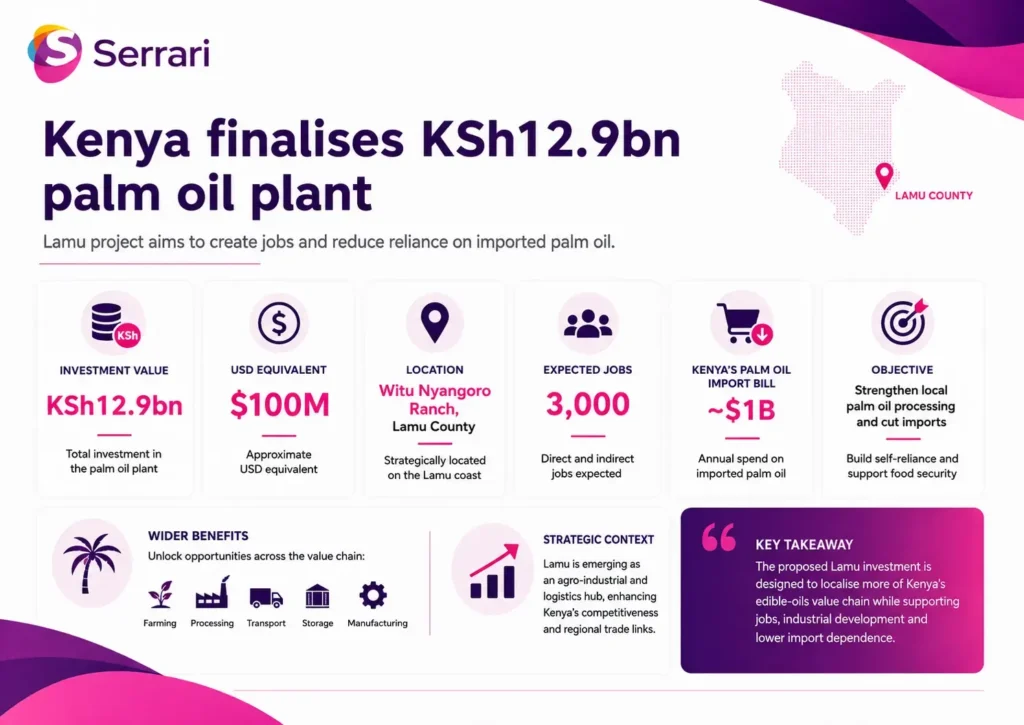
Kenya is finalising discussions for a KSh12.9 billion ($100 million) palm oil investment at Witu Nyangoro Ranch in Lamu County, a project expected to create approximately 3,000 jobs while supporting the government’s efforts to reduce dependence on imported edible oils.
Investment Promotion Principal Secretary Abubakar Hassan said discussions on the investment are in their final stages, positioning Lamu as an increasingly important location for Kenya’s agro-industrial expansion.
The project comes as Kenya remains heavily dependent on overseas palm oil supplies. Hassan said the country spends about $1 billion annually on palm oil imports, placing considerable pressure on foreign exchange while leaving Kenya exposed to movements in international commodity and shipping markets.
Key Overview
- Proposed investment: KSh12.9 billion ($100 million)
- Location: Witu Nyangoro Ranch, Lamu County
- Expected employment: Approximately 3,000 jobs
- Estimated palm oil import bill: Around $1 billion annually
- Strategic objective: Expand domestic production and processing while reducing imports
- Wider opportunities: Farming, transport, storage, processing and manufacturing
- Lamu is also attracting major industrial investment, including a proposed 700,000-barrel-per-day oil refinery
Kenya Targets Its Heavy Edible Oil Import Dependence
The proposed Lamu development addresses one of Kenya’s longstanding agricultural and manufacturing vulnerabilities: its high dependence on imported edible oils.
The Agriculture and Food Authority has highlighted the country’s reliance on imported vegetable oils, with local production supplying only a fraction of national demand. This exposes households and manufacturers to fluctuations in international commodity prices, exchange rates and global supply chains.
Palm oil is particularly important because it is widely used in cooking oils, processed foods, soaps, detergents, cosmetics and other consumer products. International agricultural analysis has also identified Kenya as an important and growing palm oil import market, supported by population growth, urbanisation and expanding consumer demand.
Increasing domestic production could therefore reduce foreign-exchange outflows while allowing more value to be captured within Kenya’s agricultural and manufacturing sectors.
Context is everything. Stay ahead of shifting trends with today’s market updates, and uncover emerging opportunities using the Serrari Group Market Index and Marketplace. Then, take control of your own financial future by exploring our Money & Life Reset Transformation Blueprint ™ to build stronger habits, create better systems, and design a path toward lasting wealth.
Lamu Project Could Build a Wider Agro-Industrial Chain
The proposed investment extends beyond establishing a processing facility. If supported by commercially viable cultivation and reliable local supply, the development could generate opportunities across farming, transportation, storage, processing and distribution.
Hassan said the government is finalising discussions for the $100 million project, which is expected to employ about 3,000 workers at Witu Nyangoro Ranch.
A stronger domestic palm oil industry could also provide raw materials for manufacturers producing cooking oils, processed foods, soaps, detergents and other consumer goods. This would create opportunities for local businesses while reducing the share of Kenya’s demand currently met through imports.
The project also complements wider government efforts to expand domestic oilseed production. Authorities recently launched a sunflower and soybean production initiative aimed at increasing local supply and reducing Kenya’s edible-oil import dependence.
Lamu Emerges as a Major Industrial Investment Hub
The palm oil investment comes as Lamu increasingly attracts large-scale projects spanning agriculture, logistics and energy.
Dangote Group has separately selected the county for a proposed 700,000-barrel-per-day oil refinery intended to supply Kenya and neighbouring East African markets. Current project information shows that site selection, soil testing and engineering work are progressing, although a final construction cost has not been publicly disclosed.
The refinery is expected to be financed through a combination of internally generated cash, bonds and proceeds from a planned initial public offering, potentially making it one of the largest industrial projects ever undertaken in Kenya.
Together with the proposed palm oil facility, these investments could strengthen Lamu’s position as a regional centre for energy, agriculture, manufacturing and logistics.
For the palm oil project, however, its long-term economic impact will depend on execution, including final investment commitments, environmental approvals, development timelines and the extent to which Kenyan farmers and suppliers are integrated into the value chain.
If successfully implemented, the KSh12.9 billion investment could become an important part of Kenya’s strategy to replace imported agricultural commodities with locally produced and processed alternatives while creating employment and supporting regional industrial development.
Sources
People Daily / Investment Promotion State Department / Agriculture and Food Authority / Government Advertising Agency / USDA Foreign Agricultural Service / Reuters
Your financial future isn’t something you wait for—it’s something you build.
The real question is: when do you begin?
Move beyond simply staying informed.
Navigate the markets with clarity—track trends through the Serrari Group Market Index, uncover opportunities in the Serrari Marketplace, and build practical knowledge with our Curated Wealth Builder Platform.
Stay connected to what truly matters.
Get daily insights on macro trends and financial movements across Kenya, Africa, and global markets—delivered through the Serrari Newsletter.
Growth opens doors.
Advance your career through professional programs including ACCA, HESI A2, ATI TEAS 7 , HESI EXIT , NCLEX – RN and NCLEX – PN, Financial Literacy!🌟—designed to move you forward with confidence.
See where money is flowing—clearly and in real time.
Track Money Market Funds, Treasury Bills, Treasury Bonds, Green Bonds, and Fixed Deposits, alongside global and African indexes, key economic indicators, and the evolving Crypto and stablecoin landscape—all within Serrari’s Market Index.