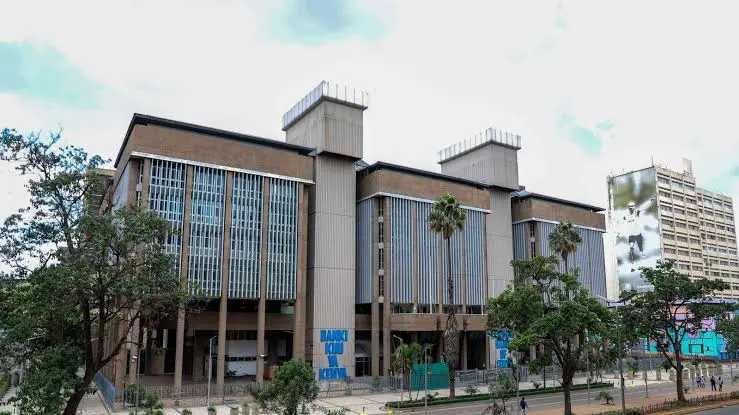
The Central Bank of Kenya has retained its benchmark Central Bank Rate at 8.75% for a third consecutive meeting, balancing improving domestic credit conditions against inflation risks linked to higher global energy prices and continuing conflict in the Middle East.
The August 11 monetary policy decision extends the pause that followed the central bank’s 25-basis-point rate cut in February. Policymakers said the current stance remains appropriate for keeping inflation expectations anchored within the target range while supporting exchange-rate stability.
Kenya’s economy has meanwhile strengthened, with first-quarter growth accelerating to 5.3%, private-sector credit expanding by more than 10% and average bank lending rates continuing to decline. However, elevated fuel costs and geopolitical uncertainty are limiting the central bank’s room to ease policy further.
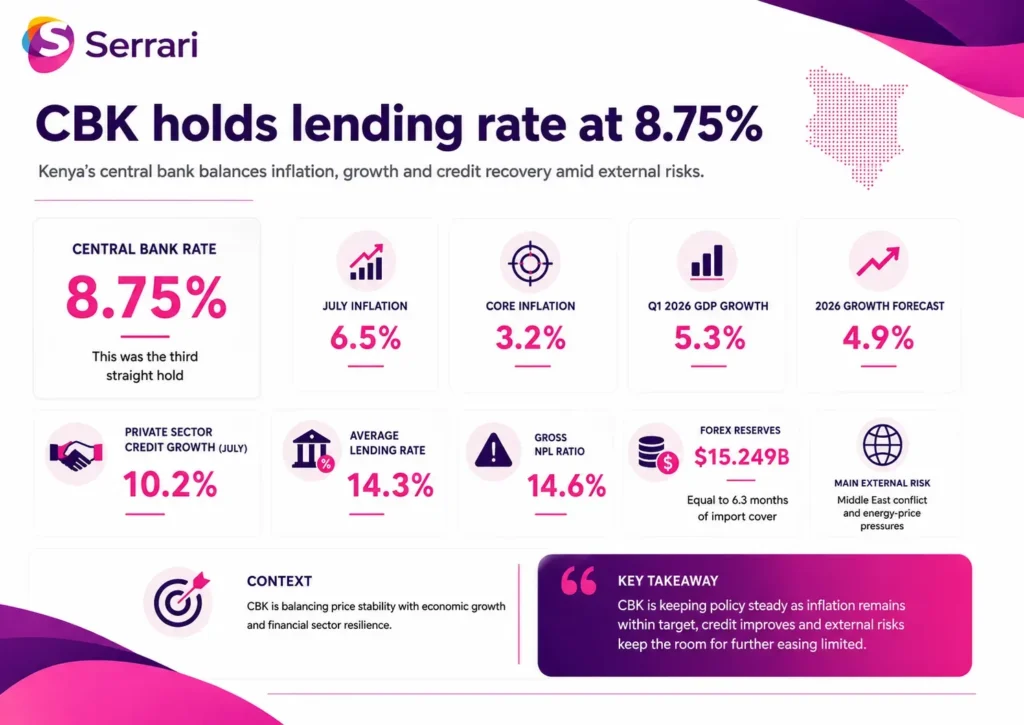
Key Overview
- Central Bank Rate: Maintained at 8.75%
- Third consecutive hold: Following unchanged decisions in April and June
- July inflation: 6.5%, versus 6.4% in June
- Core inflation: 3.2%
- Q1 2026 GDP growth: 5.3%
- 2026 growth forecast: 4.9%
- Private-sector credit growth: 10.2% in July
- Average lending rate: 14.3% in July
- Gross NPL ratio: 14.6%
- Foreign-exchange reserves: $15.249 billion, equivalent to 6.3 months of import cover
CBK Extends Its Monetary Policy Pause
The decision leaves Kenya’s benchmark rate unchanged for a third straight meeting following the April policy hold and a second unchanged decision in June.
The pause follows a prolonged easing cycle that brought the CBR down from 13% in early 2024. The latest reduction came in February 2026, when policymakers cut the rate by 25 basis points from 9% to 8.75%.
Rather than cutting again, policymakers are now assessing how previous reductions are feeding through to borrowing costs while monitoring renewed inflation pressure from international energy markets.
That transmission is becoming increasingly visible. Average commercial bank lending rates fell to 14.3% in July, compared with 14.4% in June and 17.2% in November 2024, providing borrowers with some relief even without an additional policy-rate reduction.
Inflation Stays Within Target but Risks Remain
Kenya’s annual inflation rate reached 6.5% in July, slightly above the 6.4% recorded in June but still inside the central bank’s 2.5%–7.5% target range.
Core inflation increased marginally to 3.2% from 3.1%, while non-core inflation eased to 15.0% from 15.1%, helped by lower energy-price inflation and government measures including subsidies and the temporary reduction of VAT on fuel.
Food prices remain a source of pressure, particularly vegetables such as Irish potatoes, tomatoes, kales, cabbages and onions.
The external environment is creating an additional challenge. Higher energy and transportation costs associated with the Middle East conflict are expected to contribute to stronger global inflation, while weaker international growth could affect trade, investment and external demand.
The central bank expects Kenyan inflation to remain within its target range in the near term, but that outlook partly depends on a de-escalation of geopolitical tensions and greater stability in international oil prices.
Context is everything. Stay ahead of shifting trends with today’s market updates, and uncover emerging opportunities using the Serrari Group Market Index and Marketplace. Then, take control of your own financial future by exploring our Money & Life Reset Transformation Blueprint ™ to build stronger habits, create better systems, and design a path toward lasting wealth.
Economic Growth Strengthens Despite Global Risks
Domestic economic activity has shown stronger momentum. Kenya’s economy expanded by 5.3% in the first quarter, accelerating from 4.9% during the corresponding quarter of 2025.
Growth was broad-based, with particularly strong performance in industrial and service activities. The central bank currently projects the economy to expand by 4.9% in 2026 before accelerating to 5.3% in 2027, compared with growth of 4.6% in 2025.
The outlook is supported by resilient services, industrial activity and relatively stable agricultural growth, although a prolonged Middle East conflict, trade-policy uncertainty and potential El Niño-related disruption remain downside risks.
Credit Conditions Continue to Improve
Private-sector lending has recovered significantly from the contraction recorded in early 2025. Commercial bank credit to businesses and households grew 10.2% in July, following 10.6% growth in June and compared with a 2.9% contraction in January 2025.
Credit growth remained particularly strong in trade, building and construction, agriculture and consumer durables, suggesting previous monetary easing is increasingly reaching the wider economy.
Asset quality has also improved. The ratio of gross non-performing loans to total loans declined to 14.6% in July, from 15.4% in April and 17.6% in August 2025. Improvements were recorded in manufacturing, construction, trade, agriculture and real estate.
Ahead of the meeting, the banking industry had also recommended retaining the 8.75% rate, arguing that maintaining the existing stance would allow earlier rate reductions to continue feeding through into lending conditions without compromising price stability.
Strong Reserves Cushion External Pressures
Kenya’s external buffers remain relatively strong, with foreign-exchange reserves standing at $15.249 billion, equivalent to approximately 6.3 months of import cover.
However, the current-account deficit widened to 3.0% of GDP in the 12 months to June 2026, from 1.9% during the comparable period a year earlier. Goods exports increased by 8.9%, supported by horticulture, tea, machinery and transport equipment, while imports grew faster at 13.1%.
Higher fuel imports, weaker remittance flows and a wider trade deficit could place additional pressure on the external balance if elevated energy prices persist.
For now, holding the CBR at 8.75% gives policymakers room to assess whether falling lending rates and stronger credit growth can support economic activity without allowing external inflation pressures to become embedded domestically.
The next monetary policy meeting is scheduled for October 2026, with global oil prices, inflation, credit conditions and the exchange rate likely to remain central to the next decision.
Sources
Central Bank of Kenya / Kenya National Bureau of Statistics / People Daily
Your financial future isn’t something you wait for—it’s something you build.
The real question is: when do you begin?
Move beyond simply staying informed.
Navigate the markets with clarity—track trends through the Serrari Group Market Index, uncover opportunities in the Serrari Marketplace, and build practical knowledge with our Curated Wealth Builder Platform.
Stay connected to what truly matters.
Get daily insights on macro trends and financial movements across Kenya, Africa, and global markets—delivered through the Serrari Newsletter.
Growth opens doors.
Advance your career through professional programs including ACCA, HESI A2, ATI TEAS 7 , HESI EXIT , NCLEX – RN and NCLEX – PN, Financial Literacy!🌟—designed to move you forward with confidence.
See where money is flowing—clearly and in real time.
Track Money Market Funds, Treasury Bills, Treasury Bonds, Green Bonds, and Fixed Deposits, alongside global and African indexes, key economic indicators, and the evolving Crypto and stablecoin landscape—all within Serrari’s Market Index.