The Saudi real estate market experienced a significant slowdown in transaction activity during the first half of 2026, with the value of property transactions falling by more than 50% compared with the previous year. Despite weaker sales volumes, prices remained relatively resilient, while continued investment under Saudi Vision 2030 and major development projects point to a selective recovery in the Saudi property market over the coming years.
Key Overview
- Property transaction values declined by 51.5% in the first half of 2026.
- The number of real estate transactions fell by 26.4%.
- Average property prices declined by 11.4%.
- Jadwa Investment plans to expand real estate assets under management to SR50 billion.
- New Makkah development projects worth more than SR16.3 billion were awarded.
- Saudi Vision 2030 continues to support long-term housing and commercial property demand.
- Investment in Makkah and Madinah remains a major growth opportunity.
Saudi Real Estate Market Continues to Rebalance Amid Long-Term Growth Plans
The Saudi real estate market recorded a notable slowdown during the first half of 2026, with property transactions falling sharply across several key indicators.
According to data from the Saudi Ministry of Justice’s Real Estate Market, the total value of property transactions dropped significantly compared with the same period in 2025, reflecting softer market activity after several years of strong growth.
Despite weaker transaction volumes, long-term investment commitments, government-backed developments and Saudi Vision 2030 initiatives continue to support optimism for the sector’s future.
Property Transactions Decline Across the Market
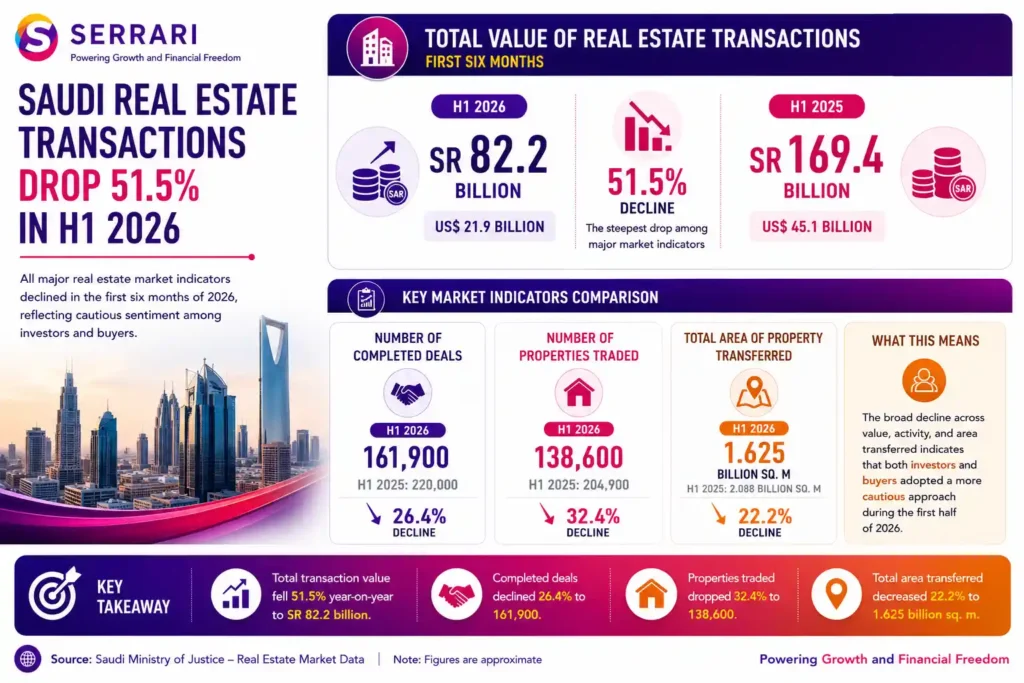
The total value of real estate transactions during the first six months of 2026 reached approximately SR82.2 billion (US$21.9 billion).
This compares with SR169.4 billion (US$45.1 billion) recorded during the first half of 2025, representing a 51.5% decline, the steepest drop among the market’s major performance indicators.
Transaction activity also slowed considerably.
The number of completed property deals declined to approximately 161,900, compared with 220,000 during the corresponding period last year.
Meanwhile, the number of properties traded fell from 204,900 to 138,600, representing a decline of 32.4%.
The total area of property transferred also decreased, falling from 2.088 billion square metres to 1.625 billion square metres, a reduction of 22.2%.
Together, these figures indicate that both investors and buyers became more cautious during the first half of the year.
Property Prices Show Greater Stability
Although transaction volumes weakened significantly, property prices proved relatively more resilient.
Official figures show that the average price per square metre declined from 2,217 Saudi riyals to 1,965 riyals, representing an 11.4% decrease.
The highest recorded price per square metre also fell, dropping from 453,124 riyals to 330,578 riyals, a decline of roughly 27%.
Compared with the sharp fall in transaction activity, the more moderate decline in prices suggests that sellers have generally resisted making substantial price reductions despite softer market conditions.
Context is everything. Stay ahead of shifting trends with today’s market updates, and uncover emerging opportunities using the Serrari Group Market Index and Marketplace. Then, take control of your own financial future by exploring our Money & Life Reset Transformation Blueprint ™ to build stronger habits, create better systems, and design a path toward lasting wealth.
Investment Firms Continue Expanding
Despite the market slowdown, major investment managers remain optimistic about the sector’s long-term prospects.
Jadwa Investment plans to almost double its real estate assets under management over the next five years.
The company aims to increase its real estate portfolio from approximately SR26 billion to around SR50 billion, reflecting continued confidence in Saudi Arabia’s long-term property market.
The planned expansion forms part of broader investment activity across residential, commercial and mixed-use developments throughout the Kingdom.
Vision 2030 Continues to Drive Growth
Saudi Arabia continues implementing ambitious economic diversification plans under Saudi Vision 2030, with real estate identified as one of the country’s key non-oil growth sectors.
The government has set a target of attracting US$100 billion in annual foreign direct investment by 2030.
Real estate development remains central to achieving this objective through large-scale housing, tourism, hospitality and commercial infrastructure projects.
Continued public and private investment is expected to support demand even as the market adjusts following earlier periods of rapid expansion.
Major Projects Focus on Makkah and Madinah
One of the largest recent development initiatives involves the Royal Commission for Makkah City and Holy Sites (RCMC).
The commission recently announced the second phase of its developed neighbourhoods programme, awarding projects valued at more than SR16.3 billion through public-private partnerships.
Jadwa Investment is among the successful consortiums selected to participate.
The company has subsequently launched two real estate development funds worth up to SR10 billion in partnership with:
- Zood Real Estate
- Mohammad Al-Habib Holding
- First Avenue Real Estate Development
- Al-Majdiah
- Rikaz
Beyond these projects, Jadwa also plans to invest an additional SR30 billion across Makkah and Madinah over the next three to five years.
Religious Tourism Supports Long-Term Demand
Demand for property in Saudi Arabia’s holy cities continues to benefit from ambitious tourism targets under Vision 2030.
The Kingdom aims to:
- Welcome 30 million Umrah pilgrims annually.
- Accommodate 5 million Hajj pilgrims each year.
These objectives are expected to increase demand for:
- Residential housing.
- Hotels and hospitality developments.
- Commercial property.
- Supporting urban infrastructure.
According to Jadwa Investment, market analysis indicates that demand for centrally located real estate in Makkah is likely to remain among the strongest and most sustainable in Saudi Arabia over the long term.
Outlook for the Saudi Property Market
The latest figures suggest the Saudi property market is moving through a period of normalisation following exceptionally strong activity in previous years.
While transaction volumes have slowed, continued government investment, expanding tourism, large-scale infrastructure development and private sector participation continue to support long-term fundamentals.
Investors are increasingly focusing on strategically located developments, particularly those aligned with Vision 2030 priorities and supported by growing domestic and international demand.
If these investment programmes continue as planned, the current slowdown may represent a market rebalancing rather than a prolonged downturn.
Conclusion
The Saudi real estate market experienced a significant decline in transaction activity during the first half of 2026, with lower deal values, fewer transactions and reduced trading volumes reflecting a period of market adjustment. However, relatively resilient property prices, substantial investment commitments and continued progress under Saudi Vision 2030 indicate that the sector’s long-term outlook remains positive.
As large-scale developments in Makkah, Madinah and other strategic locations move forward, Saudi Arabia’s property market is expected to continue evolving, supported by population growth, religious tourism and increasing foreign investment.
FAQs
1. Why did Saudi real estate transaction activity decline in the first half of 2026?
The decline reflects a market adjustment following several years of strong growth and elevated transaction activity. Buyers and investors became more cautious amid changing market conditions, resulting in fewer property transactions and lower overall trading values. While activity slowed considerably, property prices remained relatively stable compared with transaction volumes, suggesting that the market is rebalancing rather than experiencing a broad-based collapse.
2. Is Saudi Arabia’s property market expected to recover?
Many analysts remain optimistic about the long-term outlook for the Saudi property market because of ongoing government investment, Vision 2030 reforms and increasing private sector participation. Major developments in residential housing, commercial real estate, tourism and infrastructure continue to attract capital, while ambitious economic diversification plans are expected to support sustained demand over the coming years despite short-term fluctuations in transaction activity.
3. Why are Makkah and Madinah important to Saudi real estate investment?
Makkah and Madinah are central to Saudi Arabia’s long-term real estate strategy because Vision 2030 aims to significantly increase the number of religious visitors each year. Expanding Umrah and Hajj capacity creates growing demand for hotels, residential developments, retail centres, transportation infrastructure and commercial property. This makes the holy cities some of the country’s most attractive long-term real estate investment destinations.
4. What role does Saudi Vision 2030 play in the property market?
Saudi Vision 2030 serves as the primary driver of long-term growth across the Kingdom’s real estate sector. The strategy seeks to diversify the economy beyond oil by encouraging private investment, attracting foreign capital, expanding tourism and developing modern urban infrastructure. These initiatives support residential, commercial and mixed-use developments while creating new opportunities for domestic and international real estate investors.
Sources: Arab News, Asharq Al-Awsat
Your financial future isn’t something you wait for—it’s something you build.
The real question is: when do you begin?
Move beyond simply staying informed.
Navigate the markets with clarity—track trends through the Serrari Group Market Index, uncover opportunities in the Serrari Marketplace, and build practical knowledge with our Curated Wealth Builder Platform.
Stay connected to what truly matters.
Get daily insights on macro trends and financial movements across Kenya, Africa, and global markets—delivered through the Serrari Newsletter.
Growth opens doors.
Advance your career through professional programs including ACCA, HESI A2, ATI TEAS 7 , HESI EXIT , NCLEX – RN and NCLEX – PN, Financial Literacy!🌟—designed to move you forward with confidence.
See where money is flowing—clearly and in real time.
Track Money Market Funds, Treasury Bills, Treasury Bonds, Green Bonds, and Fixed Deposits, alongside global and African indexes, key economic indicators, and the evolving Crypto and stablecoin landscape—all within Serrari’s Market Index.