Indian fixed-deposit pricing continues to move even though the Reserve Bank of India kept its policy repo rate unchanged at 5.25% on August 5. Axis Bank’s current domestic FD schedule is effective August 13 and offers up to 6.50% for general customers and 7.00% for senior citizens on deposits below ₹3 crore.
Other banks have also repriced during August. DCB Bank offers as much as 7.50% to general customers and 8.00% to senior citizens on selected terms, while its 70-plus category can reach 8.05%. Union Bank reaches 6.55%, while Indian Bank’s selected 500-day deposit pays up to 6.65% for general customers, 7.15% for seniors and 7.40% for super-seniors.
Key Overview
- RBI repo rate: 5.25%
- Axis general maximum below ₹3 crore: 6.50%
- Axis senior maximum: 7.00%
- DCB general maximum: 7.50%
- DCB senior maximum: 8.00%
- DCB age-70-plus maximum: 8.05%
- Union Bank maximum: 6.55%
- Indian Bank selected 500-day rate: 6.65% general / 7.15% senior / 7.40% super-senior
- DICGC insurance: up to ₹5 lakh per depositor per bank in the same right and capacity.
India Fixed Deposit Rates Shift as Axis Updates Retail FDs
Indian banks are still changing fixed-deposit rates even after the Reserve Bank of India left its benchmark policy rate unchanged in August.
The Axis Bank current deposit-rate schedule now shows domestic fixed-deposit rates effective August 13, 2026. For deposits below ₹3 crore, the bank’s key rate table offers 6.25% for one year to one year and 10 days and 6.50% for 18 months to less than two years. Senior citizens receive 6.75% and 7.00%, respectively.
Moneycontrol had reported the latest Axis repricing as effective August 12, illustrating why investors should always refresh the bank’s own rate page immediately before opening a deposit.
Why Are Rates Moving if RBI Held?
The RBI August monetary-policy decision kept the repo rate unchanged at 5.25%, with a neutral policy stance.
But deposit rates do not have to move on the same day as the repo rate.
Banks price deposits according to their funding requirements, existing liquidity, competition for customer money and expectations for future interest rates. Earlier monetary-policy changes can therefore continue feeding through individual bank rate cards even when the RBI pauses.
For savers, this creates a more useful question than simply asking which bank advertises the highest percentage:
How long must I lock my money away to earn it?
Axis Versus Other August Offers
The Moneycontrol August deposit comparison reported Axis offering roughly 3.00%–6.50% to general customers below ₹3 crore, with senior citizens reaching about 7.00%.
Other banks currently offer higher headline rates on selected maturities.
The Economic Times August FD comparison shows:
- DCB Bank: 7.50% general and 8.00% senior on selected 24–25 month, 34–35 month and 60–61 month tenures.
- DCB 70+ customers: up to 8.05% on those same selected maturities.
- Union Bank: up to 6.55%, with its highest listed rate on 555 days.
- Indian Bank: 6.65% general, 7.15% senior and 7.40% super-senior on its 500-day IND GROW product.
The highest number is therefore rarely available across every tenure.
Context is everything. Stay ahead of shifting trends with today’s market updates, and uncover emerging opportunities using the Serrari Group Market Index and Marketplace. Then, take control of your own financial future by exploring our Money & Life Reset Transformation Blueprint ™ to build stronger habits, create better systems, and design a path toward lasting wealth.
Should Savers Lock Rates Now?
Locking a longer maturity protects today’s agreed rate if deposit rates fall later.
The trade-off is flexibility.
If rates rise after the deposit is opened, the saver cannot automatically move into the better rate without waiting for maturity or considering premature withdrawal.
That creates reinvestment risk in both directions.
A saver choosing a very short FD may later have to reinvest at lower rates. A saver locking for several years may miss higher rates if the interest-rate cycle turns upward.
One practical approach is FD laddering: dividing money across several maturity dates rather than committing the entire balance at once.
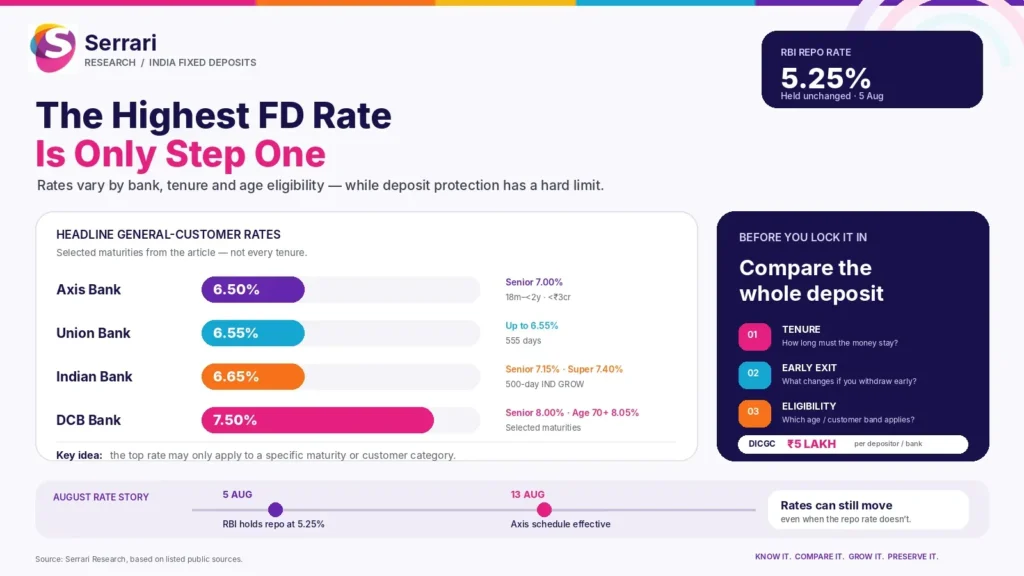
India fixed-deposit rates compared across Axis Bank, DCB Bank, Union Bank and Indian Bank. The infographic highlights maximum headline rates but then shows the factors that determine the real decision: tenure, age eligibility, premature-withdrawal terms, deposit amount and DICGC insurance protection.
Premature Withdrawal Changes the Calculation
Liquidity matters as much as yield.
Axis says its deposits can range from seven days to ten years, while its Fixed Deposit Plus product specifically does not permit premature withdrawal.
Other deposit structures may allow early exit but can apply reduced interest or penalties.
That means a 7.50% FD may be less useful than a 6.50% deposit if the investor is likely to need the money before maturity.
Investors should therefore compare expected usable return rather than headline rate alone.
Deposit Insurance Has a Limit
India’s official DICGC deposit-insurance guide covers eligible fixed, savings, current and recurring deposits up to ₹5 lakh per depositor per bank, including principal and interest, when held in the same right and capacity.
Multiple FDs at different branches of the same bank are aggregated for this limit.
Deposits at separate insured banks receive separate coverage limits.
For larger savers, that makes diversification between banks a risk-management consideration rather than simply a hunt for the highest rate.
What Investors Should Compare
Before choosing an FD, investors should check:
- Exact tenure attached to the advertised rate;
- General, senior or super-senior eligibility;
- Deposit-size thresholds;
- Premature-withdrawal rules;
- Callable versus non-callable structure;
- Bank financial strength;
- DICGC coverage; and
- Expected rate available when the FD matures.
Conclusion
Axis Bank’s latest repricing adds another move to an active August for Indian deposits.
But the current market also demonstrates why “highest FD rate” is an incomplete comparison.
DCB may advertise as much as 7.50%, while Axis currently peaks around 6.50% for general retail deposits below ₹3 crore. Yet those rates come with different tenures, eligibility rules and liquidity conditions.
For investors, the better decision is to match the maturity with the date the money will actually be needed.
The strongest FD is not necessarily the one with the highest percentage.
It is the one whose rate, tenure, liquidity and protection fit the investor’s cash-flow needs.
FAQs
1. What is Axis Bank’s highest current retail FD rate?
Axis Bank’s current official rate table shows up to 6.50% for general customers and 7.00% for senior citizens on deposits below ₹3 crore, with the highlighted maximum applying to 18 months to less than two years.
2. Which of these banks has the highest headline FD rate?
DCB currently offers up to 7.50% for general customers, 8.00% for senior citizens and 8.05% for customers aged 70 and above on specific maturities. These rates should not be assumed to apply to every tenure.
3. Are fixed deposits completely risk-free?
No. Bank deposits avoid daily market-price volatility, but investors still need to consider bank risk, liquidity restrictions, inflation, taxation and the limits of deposit insurance.
4. How much does DICGC insure?
DICGC generally covers eligible deposits up to ₹5 lakh per depositor per insured bank in the same right and capacity, combining principal and interest. Multiple accounts at the same bank do not automatically create separate ₹5 lakh limits.
Sources: Axis Bank current deposit-rate schedule, RBI August monetary-policy decision, DICGC official deposit-insurance guide, Moneycontrol August deposit comparison, Economic Times August FD comparison.
Your financial future isn’t something you wait for—it’s something you build.
The real question is: when do you begin?
Move beyond simply staying informed.
Navigate the markets with clarity—track trends through the Serrari Group Market Index, uncover opportunities in the Serrari Marketplace, and build practical knowledge with our Curated Wealth Builder Platform.
Stay connected to what truly matters.
Get daily insights on macro trends and financial movements across Kenya, Africa, and global markets—delivered through the Serrari Newsletter.
Growth opens doors.
Advance your career through professional programs including ACCA, HESI A2, ATI TEAS 7 , HESI EXIT , NCLEX – RN and NCLEX – PN, Financial Literacy!🌟—designed to move you forward with confidence.
See where money is flowing—clearly and in real time.
Track Money Market Funds, Treasury Bills, Treasury Bonds, Green Bonds, and Fixed Deposits, alongside global and African indexes, key economic indicators, and the evolving Crypto and stablecoin landscape—all within Serrari’s Market Index.