
The City of Atlanta is bringing about $1.1 billion of Hartsfield-Jackson Atlanta International Airport revenue bonds to market, with roughly $700 million designated as Green Bonds. The deal combines green-use-of-proceeds rules with airport revenue credit and U.S. municipal-bond tax treatment.
Current market coverage puts the transaction at roughly $699 million of AMT bonds and $391 million of non-AMT bonds. KBRA rates the 2026 airport bonds AA+ with a Stable outlook.
Key Overview
- Overall financing: about $1.1 billion
- Green-designated portion: roughly $700 million
- AMT bonds: about $699 million
- Non-AMT bonds: about $391 million
- Selected preliminary 2036 AMT pricing: 5% coupon, about 3.84% yield
- 2025 passengers: about 106.3 million
- Green designation addresses use of proceeds, not repayment risk.
Atlanta Airport Green Bonds Anchor $1.1B Muni Sale
Hartsfield-Jackson Atlanta International Airport is tapping the municipal market with an approximately $1.1 billion revenue-bond financing, with roughly $700 million expected to carry a Green Bond designation.
The official Atlanta airport bond notice said the city expected a mix of AMT and non-AMT tax-exempt debt. KBRA has since identified Series 2026A-1, a non-AMT tranche, and Series 2026B-1, an AMT tranche, as Green Bonds. Both sit within the same senior airport general-revenue credit.
What Makes the Bonds Green?
The revised Atlanta airport Green Bond Framework requires eligible projects to be in the capital plan, improve sustainability and contribute toward 100% clean energy by 2035 and net-zero emissions by 2050. It explicitly excludes runways, fuel tanks and airfield improvements.
Eligible categories include energy efficiency, green buildings, renewable energy, clean transportation, climate adaptation and electrification.
The Concourse D widening project, for example, is designed for LEED Silver and is expected to cut energy costs by about 20.13% and water use by 37% versus the stated baseline. The South Domestic Terminal Parking Deck includes 163 EV charging spaces, with capacity to add another 866.
Green Label Does Not Change Credit Risk
The bonds are repaid from airport finances, not environmental benefits.
They are Airport General Revenue Bonds secured by a senior lien on net general revenues. The KBRA rating on 2026 bonds assigns AA+ with a Stable outlook, citing strong air-travel demand and financial performance while flagging the growing debt burden, large capital programme and reliance on Delta Air Lines and connecting passengers.
Atlanta handled about 106.3 million passengers in 2025. That traffic supports revenue, but investors still face aviation-demand, airline-concentration and capital-plan execution risk.
Context is everything. Stay ahead of shifting trends with today’s market updates, and uncover emerging opportunities using the Serrari Group Market Index and Marketplace. Then, take control of your own financial future by exploring our Money & Life Reset Transformation Blueprint ™ to build stronger habits, create better systems, and design a path toward lasting wealth.
What Does AMT Mean?
“Tax exempt” should not be simplified into “tax free for everyone.”
The IRS private activity bond guidance says interest on qualified private-activity bonds can be exempt from regular federal income tax, while interest on certain specified private-activity bonds can enter the Alternative Minimum Tax calculation.
That is why this financing separates AMT and non-AMT tranches.
A common comparison is:
Tax-equivalent yield = tax-exempt yield ÷ (1 − applicable marginal tax rate)
But investors affected by AMT cannot assume the same benefit on an AMT-designated bond, and state or local tax treatment may differ.
Coupon Is Not Yield
Bloomberg-syndicated Atlanta bond market coverage reported selected preliminary pricing on a 2036 AMT maturity at about a 3.84% yield with a 5% coupon.
The coupon determines stated interest based on face value. Yield reflects the price paid and future cash flows.
The 3.84% figure applies only to that selected preliminary maturity, not the entire deal. Investors should use the final official statement for final pricing.
Can Green Bonds Price Better?
Because Atlanta is selling green and non-green bonds under the same airport credit, investors may eventually compare similar tranches.
A lower yield on a truly comparable green tranche could suggest a “greenium,” or financing advantage for the issuer. But maturity, AMT status, coupon and structure must be comparable before attributing a pricing difference to the green label.
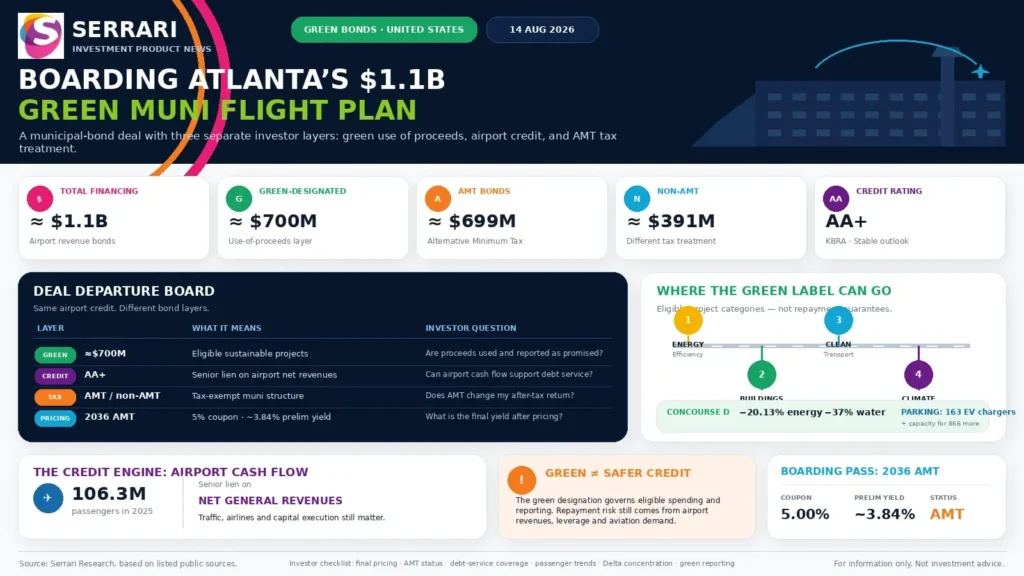
A $1.1 billion Atlanta airport financing split between roughly $700 million of Green Bonds and other airport revenue bonds. The graphic compares AMT and non-AMT tranches, tax treatment, ratings, yields and project uses, while stressing that green designation addresses use of proceeds rather than credit risk.
What Investors Should Watch
Investors should focus on final pricing, tax status, debt-service coverage, passenger trends, Delta concentration and post-issuance green reporting.
Atlanta’s framework says green proceeds will be tracked in dedicated accounts, with reporting on allocation and environmental benefits. Kestrel is expected to provide an independent second-party opinion.
Conclusion
Atlanta’s financing shows why a municipal green bond has several layers.
Investors are buying airport-revenue credit, not simply a sustainability label. They must assess tax treatment, yield, duration and airport fundamentals while separately asking whether green proceeds are allocated and reported as promised.
The green designation improves transparency around project use. It does not remove credit, interest-rate, liquidity or passenger-traffic risk.
FAQs
1. Is the entire $1.1 billion deal green?
No. Roughly $700 million is expected to carry the Green Bond designation.
2. What secures the bonds?
The Airport General Revenue Bonds are secured by a senior lien on airport net general revenues.
3. Are the bonds tax-free?
They are structured as tax-exempt municipal debt, but AMT tranches can have different federal tax consequences for affected investors. Individual tax circumstances matter.
4. Does the green label make them safer?
No. It governs eligible use of proceeds and reporting; credit risk still depends on airport revenues, passenger traffic, leverage and financial strength.
Sources: Official Atlanta airport bond notice, Atlanta revised Green Bond Framework, Atlanta Airport Investor Relations page, KBRA 2026 airport bond rating, IRS private activity bond guidance, Bloomberg coverage via Insurance Journal.
Your financial future isn’t something you wait for—it’s something you build.
The real question is: when do you begin?
Move beyond simply staying informed.
Navigate the markets with clarity—track trends through the Serrari Group Market Index, uncover opportunities in the Serrari Marketplace, and build practical knowledge with our Curated Wealth Builder Platform.
Stay connected to what truly matters.
Get daily insights on macro trends and financial movements across Kenya, Africa, and global markets—delivered through the Serrari Newsletter.
Growth opens doors.
Advance your career through professional programs including ACCA, HESI A2, ATI TEAS 7 , HESI EXIT , NCLEX – RN and NCLEX – PN, Financial Literacy!🌟—designed to move you forward with confidence.
See where money is flowing—clearly and in real time.
Track Money Market Funds, Treasury Bills, Treasury Bonds, Green Bonds, and Fixed Deposits, alongside global and African indexes, key economic indicators, and the evolving Crypto and stablecoin landscape—all within Serrari’s Market Index.