S&P 500 futures strengthened after July U.S. inflation largely matched expectations.
The Consumer Price Index increased 0.1% in July and 3.4% over the previous 12 months, down from 3.5% annual inflation in June. Core CPI rose 0.2% for the month and 2.5% annually. The official July CPI release from BLS confirms the figures.
After the report, S&P 500 futures were about 0.4% higher, Nasdaq 100 futures gained roughly 0.9% and Dow futures rose around 0.3%.
The investor question now becomes whether moderating inflation is enough to support already-high equity valuations without forcing the Federal Reserve back toward tighter monetary policy.
Key Overview
- July CPI: +0.1% month-on-month
- Annual CPI: 3.4%
- June annual CPI: 3.5%
- Core CPI: +0.2% monthly
- Core annual CPI: 2.5%
- S&P 500 futures: approximately +0.4%
- Nasdaq 100 futures: approximately +0.9%
- Dow futures: approximately +0.3%
- Fed target range: 3.50%–3.75%
- Treasury yields moved modestly higher after the data.
S&P 500 Futures Rise as July Inflation Eases to 3.4%
U.S. equity futures moved higher after July inflation came almost exactly where investors expected, reducing the immediate risk of a major inflation shock.
The official July CPI release from BLS showed consumer prices rising 0.1% during July after falling 0.4% in June. Annual inflation slowed from 3.5% to 3.4%.
Core inflation, which excludes food and energy, rose 0.2% for the month and eased to 2.5% annually from 2.6%.
That was enough to give stock futures a modest lift.
The Barron’s post-CPI futures market update showed S&P 500 futures around 0.4% higher, Nasdaq 100 futures up approximately 0.9% and Dow futures gaining about 0.3% after the release.
Inflation Did Not Deliver a Shock
The most important feature of July CPI is that the headline figures broadly matched expectations.
That matters because markets were positioned for annual inflation around 3.4% and a 0.1% monthly increase.
A materially hotter number could have revived fears that the Federal Reserve would need to raise interest rates again.
Instead, inflation moderated slightly on a year-on-year basis.
However, 3.4% inflation remains above the Fed’s longer-term 2% objective, so the data do not remove monetary-policy risk completely.
Shelter Drove Much of July’s Increase
The inflation details also matter.
Shelter prices rose 0.1% and accounted for roughly two-thirds of the overall monthly CPI increase.
Food prices increased 0.1%, while energy prices declined 1.5%.
The BLS detailed July inflation breakdown also showed increases in medical care, airline fares, communication, education and recreation within core inflation.
That mix suggests inflation pressure has moderated but has not disappeared across the economy.
Why Technology Stocks React More
The Nasdaq’s stronger futures gain is important.
Growth companies, particularly technology stocks, are often more sensitive to interest-rate expectations because a large part of their valuation depends on profits expected many years into the future.
Higher interest rates increase the discount rate applied to those future earnings, reducing their present value.
Lower rate expectations can have the opposite effect.
That helps explain why Nasdaq 100 futures gained about 0.9%, more than twice the S&P 500 futures move immediately after CPI.
Context is everything. Stay ahead of shifting trends with today’s market updates, and uncover emerging opportunities using the Serrari Group Market Index and Marketplace. Then, take control of your own financial future by exploring our Money & Life Reset Transformation Blueprint ™ to build stronger habits, create better systems, and design a path toward lasting wealth.
The Fed Still Has a Decision
The Federal Reserve kept its policy rate at 3.50%–3.75% on July 29.
The Federal Reserve July policy statement also showed disagreement within the committee, with three members preferring a 25-basis-point increase.
That makes today’s inflation result encouraging for equity investors without making the September policy decision obvious.
Current Fed Chair Kevin Warsh and the wider committee will receive additional inflation, labour-market and economic data before deciding their next move. The Federal Reserve’s current leadership records identify Warsh as chair in 2026.
Treasury Yields Did Not Collapse
The bond market reaction provides another useful clue.
Treasury yields edged slightly higher after the CPI release even as stock futures improved.
That suggests investors did not interpret the report as a decisive signal that interest rates are heading sharply lower.
For stocks, that creates a balanced outcome.
Inflation was not hot enough to generate an immediate valuation shock, but bond yields remain high enough to compete with equities for investor capital.
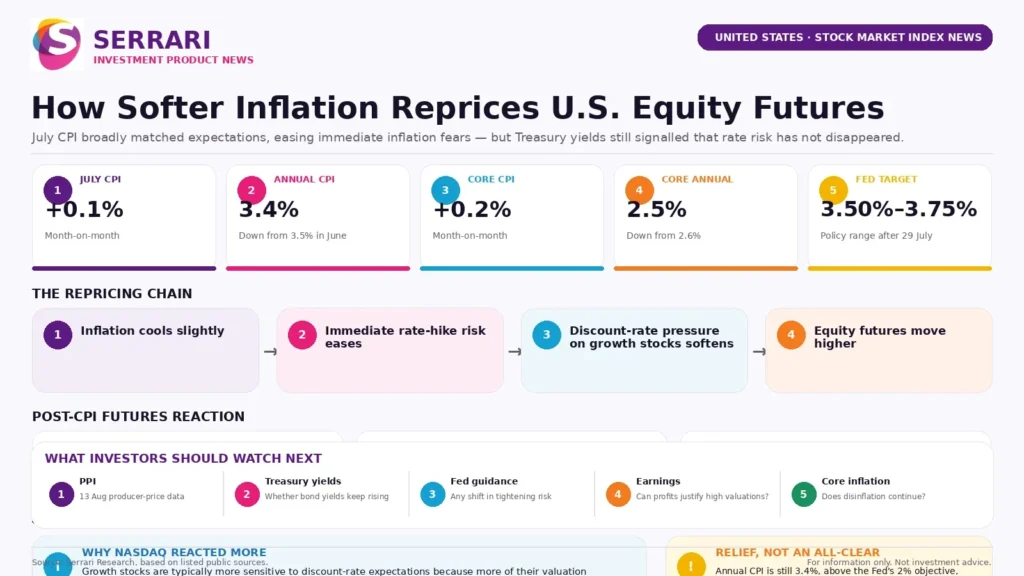
July U.S. CPI increased 0.1% month-on-month and slowed to 3.4% annually, while core inflation increased 0.2% monthly and 2.5% annually. Following the release, S&P 500 futures gained approximately 0.4%, Nasdaq 100 futures rose about 0.9% and Dow futures added around 0.3%. The graphic shows how softer inflation can reduce rate-hike risk and support equity valuations, while persistent inflation can keep Treasury yields and discount rates elevated.
Valuation Still Matters
The official S&P 500 index overview describes the benchmark as covering 500 leading U.S. companies and approximately 80% of available U.S. equity market capitalisation.
With U.S. indexes trading near record territory, investors are paying higher prices for future earnings than they would after a major market decline.
That makes interest rates particularly important.
If earnings continue growing while inflation eases, elevated valuations can receive fundamental support.
If inflation forces interest rates higher while earnings disappoint, high valuations become more difficult to justify.
What Investors Should Watch Next
Today’s CPI does not end the inflation debate.
The next immediate test is July Producer Price Index data on August 13.
Investors should also monitor:
- Treasury yields;
- Federal Reserve guidance;
- Corporate earnings;
- Labour-market data;
- Energy prices; and
- Core inflation trends.
The relationship between earnings growth and bond yields may matter more than any single daily index move.
Conclusion
July CPI delivered something close to the outcome equity investors wanted: inflation moderated slightly without producing a major upside surprise.
S&P 500 futures rose about 0.4%, while technology-heavy Nasdaq futures gained approximately 0.9%.
But the report does not remove interest-rate risk.
Annual inflation remains at 3.4%, above the Federal Reserve’s objective, while Treasury yields remain elevated.
The market therefore received relief rather than an all-clear.
For investors, the next question is whether inflation continues easing enough to support high equity valuations without requiring another period of tighter monetary policy.
FAQs
1. What was July U.S. inflation?
Headline CPI increased 0.1% during July and 3.4% over 12 months. Core CPI increased 0.2% monthly and 2.5% annually.
2. How did S&P 500 futures react?
S&P 500 futures rose approximately 0.4% after the inflation report, compared with gains of about 0.9% for Nasdaq 100 futures and 0.3% for Dow futures.
3. Why does CPI affect stock valuations?
Inflation influences expected Federal Reserve policy and Treasury yields. Higher rates increase the discount rate applied to future corporate earnings, which can particularly affect expensive growth stocks.
4. Does 3.4% inflation mean the Fed will hold rates?
Not necessarily. The Federal Reserve will consider inflation alongside employment, economic growth and other data before its next decision. Today’s CPI reduced immediate inflation fears but did not eliminate the possibility of future tightening.
Sources: official July CPI release from BLS, Federal Reserve July policy statement, Barron’s post-CPI futures market update, MarketWatch post-CPI market coverage, official S&P 500 index overview, Federal Reserve current leadership record.
Your financial future isn’t something you wait for—it’s something you build.
The real question is: when do you begin?
Move beyond simply staying informed.
Navigate the markets with clarity—track trends through the Serrari Group Market Index, uncover opportunities in the Serrari Marketplace, and build practical knowledge with our Curated Wealth Builder Platform.
Stay connected to what truly matters.
Get daily insights on macro trends and financial movements across Kenya, Africa, and global markets—delivered through the Serrari Newsletter.
Growth opens doors.
Advance your career through professional programs including ACCA, HESI A2, ATI TEAS 7 , HESI EXIT , NCLEX – RN and NCLEX – PN, Financial Literacy!🌟—designed to move you forward with confidence.
See where money is flowing—clearly and in real time.
Track Money Market Funds, Treasury Bills, Treasury Bonds, Green Bonds, and Fixed Deposits, alongside global and African indexes, key economic indicators, and the evolving Crypto and stablecoin landscape—all within Serrari’s Market Index.