Nigeria’s Central Bank has opened Cohort 2 of its Regulatory Sandbox with a dedicated track for Virtual Asset Service Providers, including stablecoin issuers and payment infrastructure.
Applications run from August 12 to August 31, 2026. Stablecoin applicants may be required to demonstrate reserve management, reserve attestations, redemption arrangements, liquidity policies and governance controls.
The crucial distinction is that participation in the sandbox is not a licence. It is controlled live testing under CBN supervision.
Key Overview
- Two Cohort 2 regulatory tracks.
- Applications: August 12–31.
- Stablecoins have a dedicated VASP route.
- Eligible activities include issuance, payments, wallets, custody and fiat on/off-ramps.
- The CBN publishes 39 sandbox FAQs.
- No fixed minimum capital is specified.
- Stablecoin applicants may face five core evidence requirements.
- Sandbox admission does not equal licensing.
Nigeria Stablecoin Sandbox Opens Dedicated CBN VASP Track
Nigeria has created a dedicated regulatory testing route for stablecoin businesses after the Central Bank of Nigeria opened Cohort 2 of its Regulatory Sandbox Programme.
The official CBN Cohort 2 sandbox portal divides the programme into two tracks: Virtual Asset and Stablecoin Financial Services, and Data-Enabled Financial Services.
The VASP track explicitly covers fiat-backed stablecoin payments, stablecoin issuance models, digital wallets, custody, fiat on/off-ramps and stablecoin or payment-token exchanges.
Applications opened on August 12 and close on August 31. Successful firms proceed to controlled live testing under conditions agreed with the CBN. The BusinessDay report on Cohort 2 confirms the application window and supervised-testing structure.
What Must a Stablecoin Prove?
For investors, the most useful part of the programme is not simply that stablecoins can apply.
It is what the regulator expects them to prove.
The CBN says stablecoin projects may be required to provide evidence covering:
- Reserve management;
- Attestations of reserves;
- Redemption mechanisms;
- Liquidity-management policies; and
- Stablecoin governance.
Those five areas address some of the biggest risks in stablecoins.
Reserves answer what assets actually support the token.
Attestations provide evidence that reported reserves exist.
Redemption mechanisms determine whether holders can exchange tokens for fiat currency when they want to exit.
Liquidity management becomes important when many users seek redemption simultaneously.
Governance determines who controls reserves, operational decisions and changes to the stablecoin system.
This turns the sandbox into more than a technology experiment. It gives the CBN an opportunity to test whether the financial structure behind a stablecoin works with real users.
Controlled Testing Is Not Licensing
This distinction is essential.
The CBN official regulatory sandbox programme states that admission does not constitute a licence, authorisation or approval to operate outside the agreed testing parameters.
A stablecoin company entering Cohort 2 therefore should not be described as “CBN licensed” merely because it has been accepted into the sandbox.
The programme is better understood as a supervised bridge between product development and a possible future regulatory pathway.
The Punch coverage of sandbox opening says successful participants will operate within defined safeguards covering consumer protection, cybersecurity, operational resilience and regulatory reporting.
Context is everything. Stay ahead of shifting trends with today’s market updates, and uncover emerging opportunities using the Serrari Group Market Index and Marketplace. Then, take control of your own financial future by exploring our Money & Life Reset Transformation Blueprint ™ to build stronger habits, create better systems, and design a path toward lasting wealth.
Who Can Enter the Sandbox?
The programme is relatively broad.
Eligible applicants include:
- CBN-regulated institutions;
- Firms licensed by other Nigerian regulators;
- Regulated foreign institutions;
- Virtual Asset Service Providers;
- Fintech startups; and
- Technology companies.
But an idea alone is not enough.
Applicants should have a working minimum viable product, suitable technical infrastructure, AML and counter-terrorism-financing controls, consumer safeguards, testing plans and identified compliance personnel.
The CBN lists four application stages: access the portal, register and upload documentation, assessment and approval, and onboarding for successful applicants.
No Fixed Minimum Capital
Another important feature is what the CBN does not prescribe.
Its current FAQ says no fixed minimum capital requirement applies across the sandbox.
Applicants must instead demonstrate sufficient financial resources, liquidity and operational sustainability for their proposed test.
That allows requirements to reflect different business models.
A stablecoin issuer, wallet provider, exchange and digital custodian do not create identical financial risks.
No fixed capital figure therefore does not mean there is no financial scrutiny.
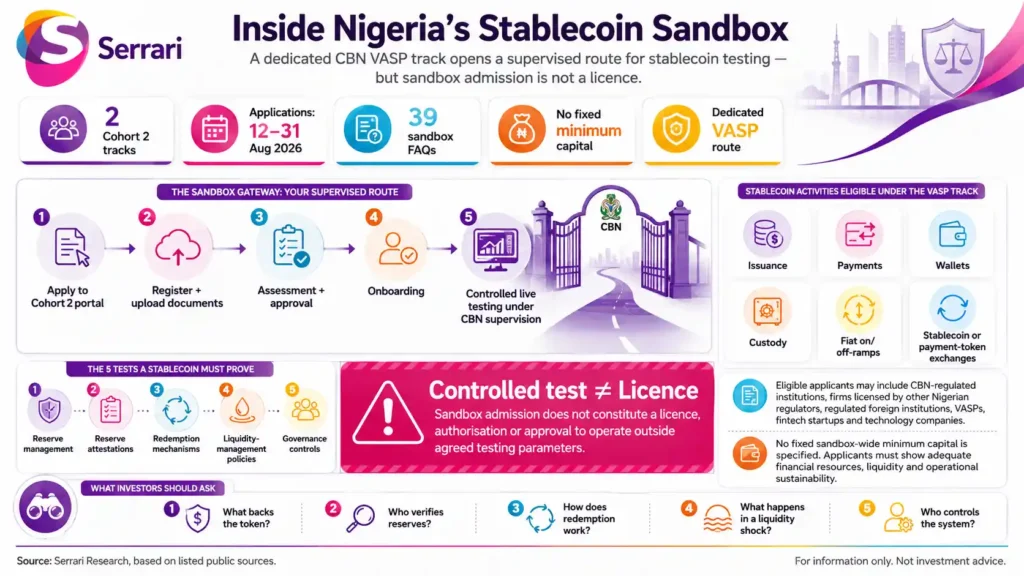
A Nigerian stablecoin applicant sits at the centre of five CBN regulatory tests: reserves, reserve attestations, redemption, liquidity management and governance. The infographic shows the applicant moving into controlled live testing under CBN supervision while clearly stating: Controlled test does not equal licence.
Why This Matters to Investors
Stablecoin value depends on more than maintaining a token price close to its stated currency peg.
A stablecoin can operate technically while still becoming difficult to use if its reserves are weak, redemptions stop working or market liquidity disappears during stress.
Nigeria’s new sandbox provides investors with a practical checklist.
Before relying on a stablecoin, investors can ask:
What backs it?
Who verifies those reserves?
How does redemption work?
What happens during a liquidity shock?
Who controls the system?
These questions are more useful than simply counting how many blockchains, exchanges or wallets support a token.
What Happens After Testing?
Sandbox participation may eventually help the CBN determine the appropriate regulatory route for successful companies.
But completion does not guarantee licensing.
The CBN says post-sandbox pathways remain subject to legal, prudential, conduct and supervisory requirements. Other Nigerian authorities may also remain relevant where activities involve securities, financial intelligence, taxation or data protection.
That means Cohort 2 does not finalise Nigeria’s stablecoin regulatory framework.
It gives regulators evidence that can help shape it.
Conclusion
Nigeria has moved beyond simply debating how stablecoins should fit into its financial system.
The CBN now has a dedicated supervised route where stablecoin issuers, wallets, payment businesses, exchanges and related VASPs can test functioning products with real users.
For investors, the strongest signal is the regulator’s five-part stablecoin checklist:
Reserves. Attestations. Redemption. Liquidity. Governance.
Those are the same factors investors should examine even after a stablecoin eventually receives broader regulatory approval.
The sandbox can help credible firms prove that their infrastructure works.
But admission itself is not a licence.
The real test will be what those companies demonstrate once supervised live testing begins.
FAQs
1. What is the Nigeria Stablecoin Sandbox?
It is the VASP track of Cohort 2 of the CBN Regulatory Sandbox, which allows eligible stablecoin, wallet, custody, payment and related digital-asset businesses to test products under controlled regulatory supervision.
2. Does sandbox admission mean a stablecoin is licensed?
No. The CBN explicitly states that admission is not a licence, authorisation or permission to operate commercially beyond approved testing parameters.
3. What must stablecoin applicants prove?
The CBN may require reserve-management arrangements, reserve attestations, redemption mechanisms, liquidity-management policies and stablecoin-governance documentation.
4. Is there a minimum capital requirement?
There is no fixed sandbox-wide minimum. Applicants must instead demonstrate adequate financial resources, liquidity and operational sustainability for their proposed test.
Sources: official CBN Cohort 2 sandbox portal, Central Bank of Nigeria official website, BusinessDay report on Cohort 2, Punch coverage of sandbox opening, Matrix News Cohort 2 coverage.
Your financial future isn’t something you wait for—it’s something you build.
The real question is: when do you begin?
Move beyond simply staying informed.
Navigate the markets with clarity—track trends through the Serrari Group Market Index, uncover opportunities in the Serrari Marketplace, and build practical knowledge with our Curated Wealth Builder Platform.
Stay connected to what truly matters.
Get daily insights on macro trends and financial movements across Kenya, Africa, and global markets—delivered through the Serrari Newsletter.
Growth opens doors.
Advance your career through professional programs including ACCA, HESI A2, ATI TEAS 7 , HESI EXIT , NCLEX – RN and NCLEX – PN, Financial Literacy!🌟—designed to move you forward with confidence.
See where money is flowing—clearly and in real time.
Track Money Market Funds, Treasury Bills, Treasury Bonds, Green Bonds, and Fixed Deposits, alongside global and African indexes, key economic indicators, and the evolving Crypto and stablecoin landscape—all within Serrari’s Market Index.