Kenya Eurobond yields increased by an average of 20.89 basis points during the week ending July 2, 2026, even as bond market turnover in the domestic secondary market fell by 22.66%. Despite weaker secondary market activity, demand for government securities remained strong, while easing inflation, a stable shilling, and higher foreign exchange reserves continued to support the broader Kenya fixed income market.
LIVEKenya MMF rates: Average 9.15% across 27 funds · top fund 11.01% · 21 OctCompare funds →Key Overview
- Kenya Eurobond yields rose by an average of 20.89 basis points.
- Domestic bond market turnover declined by 22.66%.
- Treasury bill auction recorded 146.6% subscription.
- Inflation eased to 6.4% in June 2026.
- The Kenya shilling remained stable against the U.S. dollar.
- Foreign exchange reserves increased to six months of import cover.
- Liquidity remained strong despite slower interbank trading.
Kenya Eurobond Yields Rise as Bond Market Turnover Declines
Kenya Eurobond yields moved higher during the week ending July 2, 2026, while activity in the domestic secondary bond market slowed, according to the latest Central Bank of Kenya (CBK) Weekly Bulletin.
Although bond market turnover declined by more than one-fifth, investor appetite for newly issued government securities remained robust. At the same time, easing inflation, stable exchange rates and strong foreign exchange reserves continued to provide support for the country’s broader fixed-income market.
The mixed performance highlights the differing dynamics between Kenya’s domestic government securities market and international sovereign debt markets.
Secondary Bond Market Records Lower Trading Activity
The Kenya fixed income market experienced weaker trading activity in the secondary market during the review period.
According to the Central Bank, turnover in the domestic secondary bond market declined by 22.66% compared with the previous week.
Lower trading volumes often reflect reduced investor activity, profit-taking or a wait-and-see approach as investors assess changing market conditions.
Despite the decline in turnover, the broader government securities market remained well supported by healthy liquidity and continued demand for newly issued debt.
Kenya Eurobond Yields Move Higher
In the international market, Kenya Eurobond yields increased by an average of 20.89 basis points during the week.
Higher sovereign bond yields generally indicate that investors are demanding greater returns to hold government debt, which can reflect changing global interest rate expectations, shifts in investor sentiment or broader movements in international fixed-income markets.
The Central Bank also noted differing movements across other African sovereign issuers:
- Côte d’Ivoire’s Eurobond yields increased.
- Angola’s Eurobond yields declined.
These variations demonstrate that international investors continue to assess African sovereign issuers individually based on domestic and global economic developments.
Treasury Bill Auction Attracts Strong Investor Demand
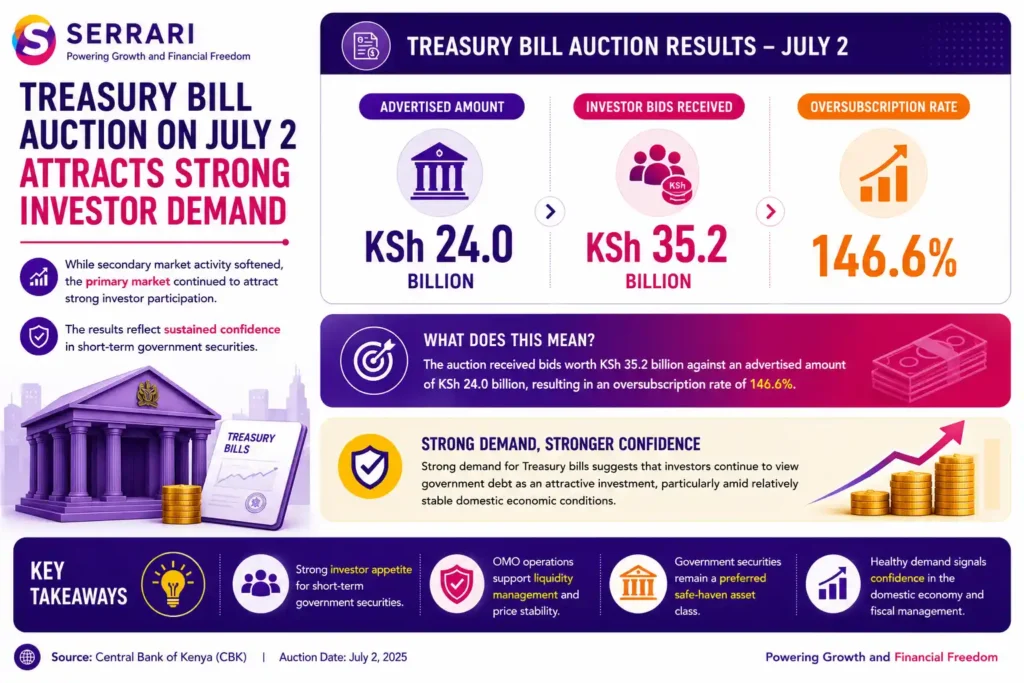
While secondary market activity softened, the primary market continued to attract strong investor participation.
The Treasury bill auction conducted on July 2 received bids worth KSh35.2 billion against an advertised amount of KSh24.0 billion.
This resulted in an oversubscription rate of 146.6%, highlighting sustained investor confidence in short-term government securities.
Strong demand for Treasury bills suggests that investors continue to view government debt as an attractive investment, particularly amid relatively stable domestic economic conditions.
Inflation Continues to Ease
Kenya’s inflation environment improved further during June.
Headline inflation declined to 6.4% from 6.7% recorded in May, supported by:
- Lower food prices.
- Declining global oil prices.
Meanwhile, core inflation eased slightly to 3.1%, indicating continued moderation in underlying price pressures.
Lower inflation generally supports fixed-income investments because it helps preserve the real value of future interest payments while reducing pressure for higher interest rates.
Context is everything. Stay ahead of shifting trends with today’s market updates, and uncover emerging opportunities using the Serrari Group Market Index and Marketplace. Then, take control of your own financial future by exploring our Money & Life Reset Transformation Blueprint ™ to build stronger habits, create better systems, and design a path toward lasting wealth.
Kenya Shilling Remains Stable
The Kenyan shilling continued to demonstrate resilience during the review period.
The currency traded at approximately KSh129.30 per U.S. dollar on July 2, compared with KSh129.63 one week earlier.
Exchange rate stability remains an important factor for both domestic and international investors, particularly those holding Kenya’s sovereign debt.
A stable currency also helps moderate imported inflation while improving confidence in financial markets.
Foreign Exchange Reserves Improve
Kenya’s foreign exchange reserves strengthened during the week.
LIVEKenya Eurobond yieldsSee yields →Official reserves increased to approximately KSh1.82 trillion, providing the equivalent of six months of import cover.
This remains comfortably above the statutory minimum requirement of four months, reinforcing the country’s external financial position.
Healthy reserve levels provide additional confidence for investors by strengthening the country’s ability to meet external payment obligations and manage periods of market volatility.
Liquidity Remained Comfortable
The domestic money market continued to maintain adequate liquidity.
Commercial banks held average excess reserves of approximately KSh32.8 billion above the required Cash Reserve Ratio (CRR) of 3.25%.
The Kenya Shilling Overnight Interbank Average Rate (KESONIA) remained unchanged at 8.75%, indicating stable short-term funding costs across the banking sector.
However, overall interbank activity slowed during the week.
The number of interbank transactions declined from 28 to 19, while total trading volumes fell from KSh16.1 billion to KSh8.8 billion.
Despite lower activity, available liquidity remained sufficient to support normal banking operations.
Equity Market Continues to Rally
Alongside developments in the bond market, Kenya’s equity market posted another week of gains.
The Nairobi Securities Exchange recorded positive performance across its major indices:
- NSE All Share Index (NASI): +3.08%
- NSE 25 Share Index: +3.38%
- NSE 20 Share Index: +2.69%
The continued rally reflects improving investor confidence across Kenya’s capital markets despite higher Eurobond yields internationally.
Outlook for Kenya’s Fixed Income Market
Kenya’s fixed-income market continues to benefit from several supportive domestic fundamentals, including easing inflation, stable exchange rates, strong banking sector liquidity and healthy investor demand for government securities.
However, rising Kenya Eurobond yields demonstrate that international borrowing costs remain sensitive to global market conditions and investor risk appetite.
Going forward, market participants will continue monitoring inflation trends, government borrowing requirements, global interest rate developments and investor sentiment to assess the direction of both domestic and international sovereign bond markets.
Conclusion
Kenya Eurobond yields increased during the week ending July 2, even as bond market turnover in the domestic secondary market declined. Despite weaker trading activity, investor demand for Treasury bills remained strong, supported by stable macroeconomic conditions, easing inflation and ample banking system liquidity.
With healthy foreign exchange reserves, a resilient shilling and continued confidence in government securities, Kenya’s fixed-income market remains supported, although international sovereign yields will continue responding to changing global financial conditions.
FAQs
1. Why did Kenya Eurobond yields increase while domestic bond turnover declined?
Kenya Eurobond yields and domestic bond market turnover are influenced by different factors. Eurobond yields are largely driven by international investor sentiment, global interest rates and sovereign risk perceptions, while domestic secondary market turnover reflects local trading activity. It is therefore possible for Eurobond yields to rise even as trading volumes in Kenya’s domestic bond market decline, particularly when global market conditions change while domestic liquidity remains stable.
2. What does lower bond market turnover mean?
Lower bond market turnover indicates that fewer government bonds were traded in the secondary market during the review period. This does not necessarily signal weak investor confidence, as investors may simply be holding bonds for longer periods or waiting for new economic data before increasing trading activity. Strong demand in primary Treasury bill auctions suggests that investor appetite for government securities remains healthy despite slower secondary market transactions.
3. Why is strong Treasury bill demand important?
Strong demand for Treasury bills demonstrates investor confidence in Kenya’s government securities and helps the government finance its borrowing requirements efficiently. An oversubscribed auction, such as the 146.6% subscription recorded during the week, indicates that investors continue to view short-term government debt as an attractive investment, supported by stable macroeconomic conditions and competitive yields.
4. How do inflation and exchange rate stability affect Kenya’s bond market?
Lower inflation helps preserve the purchasing power of fixed-income investments and can reduce pressure for higher interest rates, making government bonds more attractive. Meanwhile, a stable Kenya shilling reduces currency risk for both domestic and international investors while supporting broader economic stability. Together, easing inflation and exchange rate stability strengthen investor confidence in Kenya’s fixed-income market and government securities.
Your financial future isn’t something you wait for—it’s something you build.
The real question is: when do you begin?
Move beyond simply staying informed.
Navigate the markets with clarity—track trends through the Serrari Group Market Index, uncover opportunities in the Serrari Marketplace, and build practical knowledge with our Curated Wealth Builder Platform.
Stay connected to what truly matters.
Get daily insights on macro trends and financial movements across Kenya, Africa, and global markets—delivered through the Serrari Newsletter.
Growth opens doors.
Advance your career through professional programs including ACCA, HESI A2, ATI TEAS 7 , HESI EXIT , NCLEX – RN and NCLEX – PN, Financial Literacy!🌟—designed to move you forward with confidence.
See where money is flowing—clearly and in real time.
Track Money Market Funds, Treasury Bills, Treasury Bonds, Green Bonds, and Fixed Deposits, alongside global and African indexes, key economic indicators, and the evolving Crypto and stablecoin landscape—all within Serrari’s Market Index.