
The CLARITY Act is emerging as one of the most significant proposals for U.S. crypto regulation, aiming to establish clear rules for digital assets while dividing oversight between the Securities and Exchange Commission (SEC) and the Commodity Futures Trading Commission (CFTC). Senator Cynthia Lummis has described the legislation as a critical step toward modernizing the U.S. financial system, although its progress now depends on Senate approval before the August recess.
Key Overview
- The CLARITY Act seeks to establish a comprehensive regulatory framework for digital assets.
- The bill would divide crypto oversight between the SEC and CFTC.
- Senator Cynthia Lummis has called the legislation a major modernization of financial markets.
- Lawmakers are aiming for Senate consideration before the August recess.
- The bill includes stronger investor protections and funding for crypto fraud investigations.
- Stablecoin regulation, decentralized finance (DeFi), and ethics provisions remain key debate areas.
- Delays could push final consideration into 2027.
CLARITY Act Advances as U.S. Senate Weighs Landmark Crypto Regulation
The CLARITY Act is moving closer to becoming one of the most significant pieces of cryptocurrency legislation in the United States, with lawmakers racing to advance the bill before Congress begins its August recess.
Supporters argue the legislation would replace years of regulatory uncertainty with a comprehensive legal framework governing digital assets. If enacted, the bill would clarify how cryptocurrencies are regulated, strengthen investor protections, and provide greater certainty for businesses operating within the digital asset industry.
However, despite clearing important legislative milestones, the bill still requires approval by the full Senate before it can move forward.
CLARITY Act Aims to Define U.S. Crypto Regulation
At its core, the CLARITY Act crypto proposal seeks to resolve one of the industry’s longest-running challenges: determining which federal agency should regulate different types of digital assets.
For years, overlapping authority between the Securities and Exchange Commission (SEC) and the Commodity Futures Trading Commission (CFTC) has created uncertainty for cryptocurrency exchanges, investors and blockchain companies.
Under the proposed legislation:
- The SEC would continue overseeing digital assets classified as securities.
- The CFTC would regulate qualifying digital commodities and related trading markets.
- Cryptocurrency exchanges would operate under clearer regulatory requirements.
- Investor protection measures would be strengthened across digital asset markets.
Supporters believe these changes would encourage innovation while improving regulatory consistency.
Cynthia Lummis Pushes for Senate Action
One of the bill’s strongest supporters, Senator Cynthia Lummis, has continued urging lawmakers to complete work on the legislation.
Speaking about the proposal, Lummis described the CLARITY Act as an opportunity to modernize the American financial system.
She stated:
“The CLARITY Act is this generation’s contribution to that legacy. Let’s finish the job.”
Lummis has also argued that comprehensive digital asset legislation could help position the United States as a global leader in blockchain innovation rather than allowing regulatory uncertainty to slow industry growth.
Senate Timing Remains the Biggest Challenge
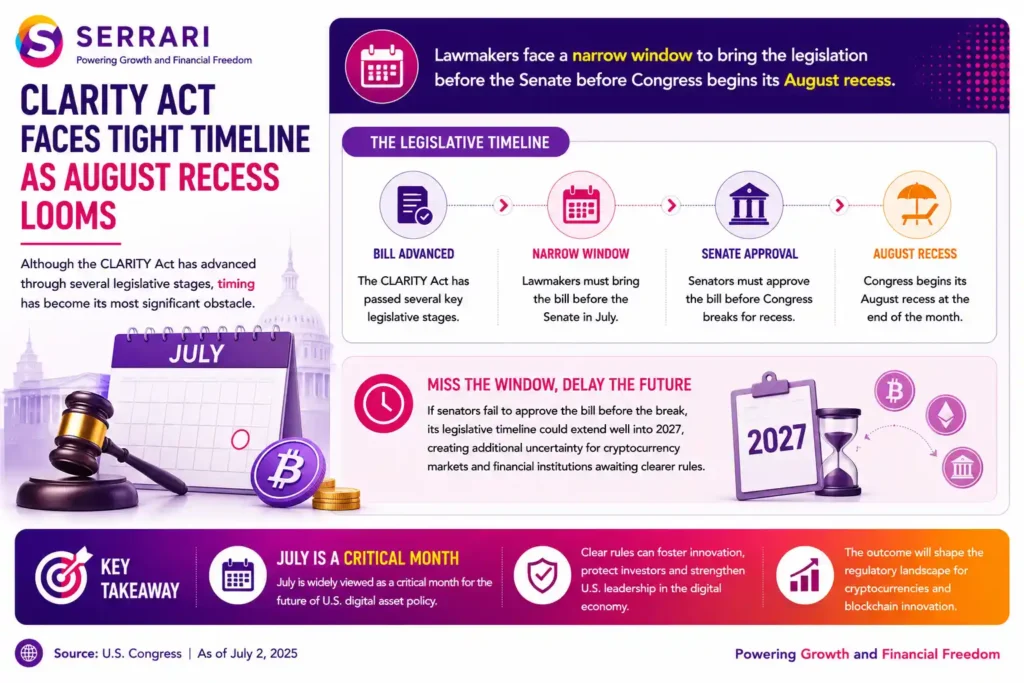
Although the bill has advanced through several legislative stages, timing has become its most significant obstacle.
Lawmakers face a narrow window to bring the legislation before the Senate before Congress begins its August recess.
If senators fail to approve the bill before the break, its legislative timeline could extend well into 2027, creating additional uncertainty for cryptocurrency markets and financial institutions awaiting clearer rules.
For this reason, July is widely viewed as a critical month for the future of U.S. digital asset policy.
Context is everything. Stay ahead of shifting trends with today’s market updates, and uncover emerging opportunities using the Serrari Group Market Index and Marketplace. Then, take control of your own financial future by exploring our Money & Life Reset Transformation Blueprint ™ to build stronger habits, create better systems, and design a path toward lasting wealth.
Proposed Rules Cover More Than Market Oversight
Beyond defining regulatory responsibilities, the CLARITY Act introduces several additional reforms aimed at strengthening the cryptocurrency ecosystem.
Among the proposed measures are:
- Clear operating standards for cryptocurrency exchanges.
- Enhanced consumer and investor protections.
- Updated rules governing stablecoin-related financial products.
- Oversight of decentralized finance (DeFi) activities.
- Approximately $150 million allocated for crypto fraud investigations.
Supporters argue these measures would replace an enforcement-driven regulatory approach with clearly written legislation that provides certainty for both regulators and industry participants.
Stablecoins and DeFi Continue to Generate Debate
While broad support exists for improving regulatory clarity, several provisions remain under discussion.
Lawmakers continue debating how stablecoin products should be regulated, particularly products that may function similarly to traditional bank deposits.
Recent revisions to Section 301 were introduced to address concerns raised by banks regarding stablecoin issuers offering yield-generating products that resemble deposit accounts.
The legislation also continues to attract debate over:
- Ethics rules for public officials.
- Regulation of decentralized finance platforms.
- Consumer protections for stablecoin users.
- Appropriate oversight for emerging blockchain technologies.
These discussions may influence the bill’s final wording before any Senate vote.
Potential Impact on Financial Markets
Supporters believe the CLARITY Act could have significant implications for institutional cryptocurrency adoption.
Senator Lummis recently suggested that clearer regulation could allow banks to hold Bitcoin and other digital assets more freely, potentially increasing institutional participation across cryptocurrency markets.
Greater regulatory certainty may also encourage financial institutions, asset managers and payment providers to expand blockchain-related products and services.
However, broader market conditions continue to influence cryptocurrency prices.
At the time of the latest discussions surrounding the legislation, global cryptocurrency markets were trading approximately 2.8% lower, with Bitcoin falling to around $60,000 amid broader market weakness.
While short-term price movements remain driven by multiple factors, many industry participants view regulatory clarity as an important long-term catalyst for market development.
Outlook for U.S. Digital Asset Policy
The CLARITY Act represents one of the most comprehensive attempts to establish a permanent legal framework for cryptocurrencies in the United States.
If approved, the legislation could significantly reshape how digital assets are supervised by creating clearer responsibilities for regulators while providing businesses and investors with greater certainty.
Although important legislative work has already been completed, the bill’s ultimate success now depends on whether the Senate can act before its legislative calendar becomes more constrained.
Conclusion
The CLARITY Act could become a defining milestone for U.S. crypto regulation, replacing years of regulatory uncertainty with a structured legal framework for digital assets. By clarifying the roles of the SEC and CFTC, strengthening investor protections and establishing clearer rules for exchanges and stablecoins, the legislation has the potential to modernize the country’s digital asset industry.
With the Senate facing limited time before the August recess, the coming weeks are likely to determine whether the bill advances this year or faces delays that could push final consideration into 2027.
FAQs
1. What is the CLARITY Act?
The CLARITY Act is proposed U.S. legislation designed to establish a comprehensive regulatory framework for digital assets. Its primary objective is to clarify which cryptocurrencies fall under the jurisdiction of the Securities and Exchange Commission (SEC) and which are regulated by the Commodity Futures Trading Commission (CFTC). The bill also introduces investor protections, exchange regulations and provisions covering stablecoins and other emerging areas of the cryptocurrency industry.
2. Why is the CLARITY Act important for the cryptocurrency industry?
The cryptocurrency industry has long operated under regulatory uncertainty because multiple federal agencies have claimed oversight over different digital assets. The CLARITY Act aims to replace this uncertainty with clearly defined rules, making it easier for exchanges, investors, financial institutions and blockchain companies to understand their legal obligations. Supporters believe this clarity could encourage innovation, improve investor confidence and attract greater institutional participation.
3. What changes would the CLARITY Act introduce?
If enacted, the legislation would divide regulatory responsibilities between the SEC and CFTC, establish operational standards for cryptocurrency exchanges, strengthen consumer protections and provide funding for investigations into crypto-related fraud. It also addresses issues involving stablecoins, decentralized finance (DeFi) and digital asset market oversight, creating a more structured regulatory environment for the rapidly evolving crypto sector.
4. What happens if the Senate does not pass the CLARITY Act this year?
If the Senate is unable to approve the legislation before its August recess, the bill’s progress could be delayed until 2027. Such a delay would extend the current period of regulatory uncertainty facing the U.S. cryptocurrency industry, leaving businesses, investors and financial institutions without the comprehensive legal framework many have been seeking. The timing of Senate action is therefore considered one of the most important factors determining the bill’s future.
Sources: Crypto News, Binance Square, Yahoo Finance, Whale Alert
Your financial future isn’t something you wait for—it’s something you build.
The real question is: when do you begin?
Move beyond simply staying informed.
Navigate the markets with clarity—track trends through the Serrari Group Market Index, uncover opportunities in the Serrari Marketplace, and build practical knowledge with our Curated Wealth Builder Platform.
Stay connected to what truly matters.
Get daily insights on macro trends and financial movements across Kenya, Africa, and global markets—delivered through the Serrari Newsletter.
Growth opens doors.
Advance your career through professional programs including ACCA, HESI A2, ATI TEAS 7 , HESI EXIT , NCLEX – RN and NCLEX – PN, Financial Literacy!🌟—designed to move you forward with confidence.
See where money is flowing—clearly and in real time.
Track Money Market Funds, Treasury Bills, Treasury Bonds, Green Bonds, and Fixed Deposits, alongside global and African indexes, key economic indicators, and the evolving Crypto and stablecoin landscape—all within Serrari’s Market Index.