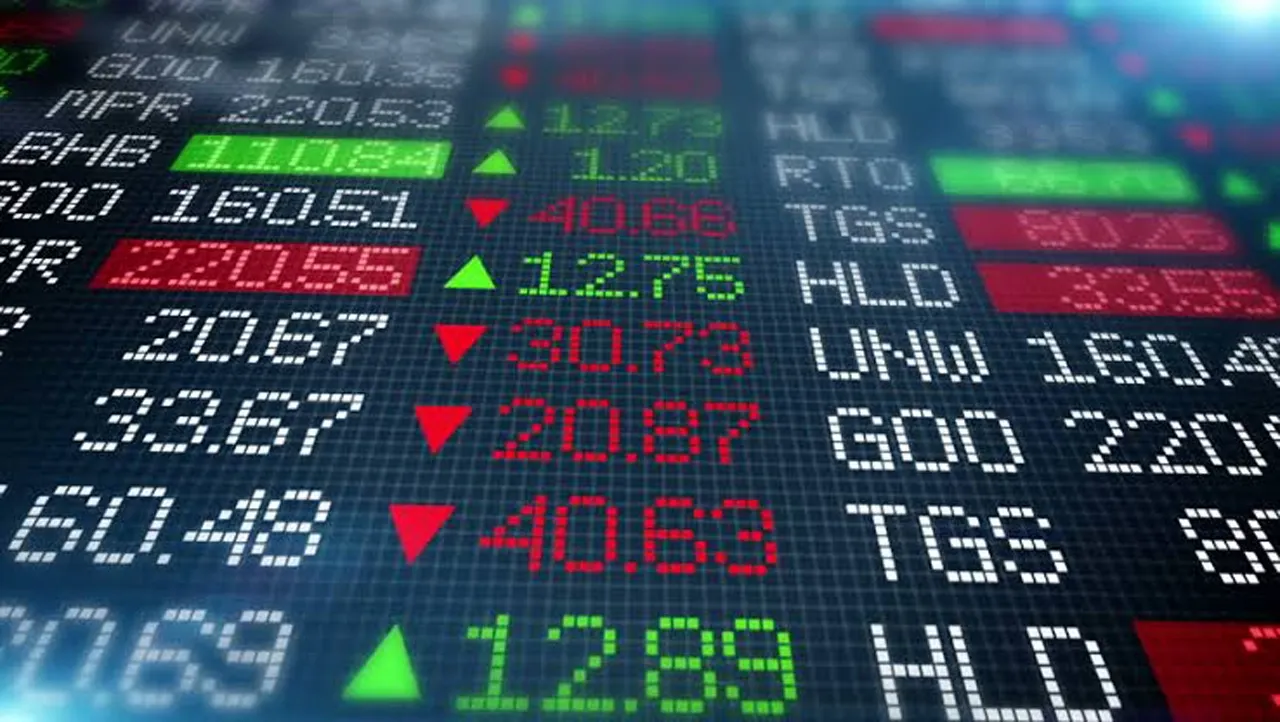
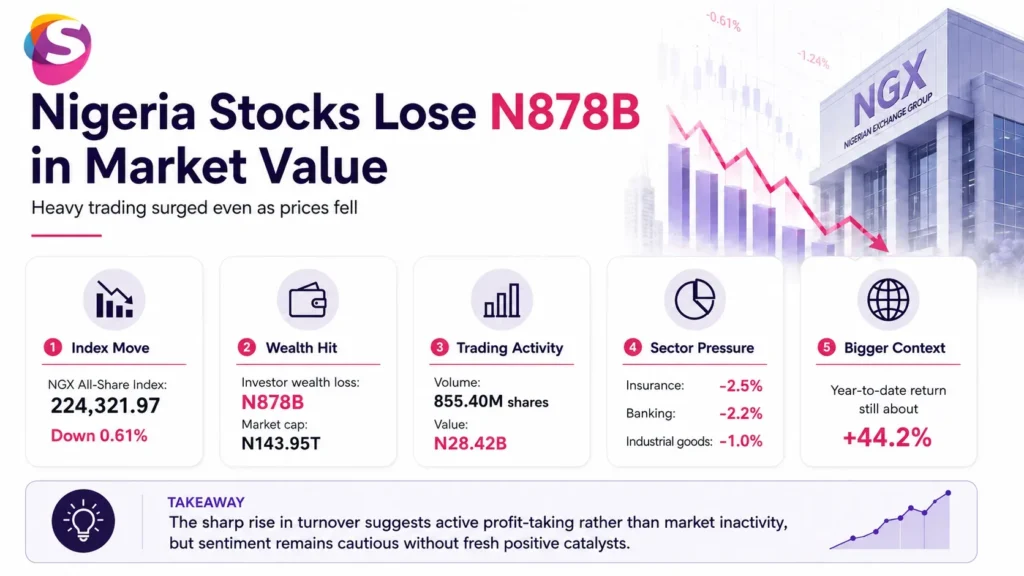
Nigeria’s equities market extended its decline on Thursday, July 2, 2026, as profit-taking across banking, industrial, insurance and other heavyweight stocks erased about N878 billion in market value.
The Nigerian Exchange All-Share Index fell 0.61% to 224,321.97 points from 225,690.07, while total market capitalization dropped from N144.824 trillion to N143.946 trillion.
Yet the weakness in prices came alongside a sharp increase in investor activity. Total trading volume rose to 855.40 million shares, while transaction value more than doubled to N28.42 billion, creating a striking contrast between falling prices and heavier market participation.
Key Overview
- All-Share Index: Down 0.61% to 224,321.97 points.
- Investor wealth lost: About N878 billion.
- Market capitalisation: Fell to N143.946 trillion.
- Year-to-date return: Moderated to about 44.15%.
- Trading volume: Rose to 855.40 million shares.
- Transaction value: Increased to N28.42 billion.
- Main pressure points: Banking, insurance and industrial stocks.
- Market signal: Stronger liquidity, but continued profit-taking.
Heavyweight Stocks Extend the Market Selloff
The latest decline reflects continued pressure on some of the market’s largest and previously strongest-performing companies.
According to details of the July 2 trading session, sustained selling pushed the benchmark lower and wiped almost N878 billion from market capitalisation in a single session.
Stocks under pressure included Lafarge Africa, First HoldCo, Zenith Bank and International Energy Insurance, along with a number of smaller counters.
The decline in large-cap shares mattered because heavyweight companies exert a significant influence on the All-Share Index. Even where buying interest appears in selected stocks, losses in major banking and industrial names can still drag the entire market lower.
The session also continued a wider correction that has followed one of the strongest rallies in the exchange’s recent history.
Profit-Taking Follows Months of Exceptional Gains
Despite the latest losses, the Nigerian market remained up more than 44% for the year.
That strong year-to-date performance helps explain why investors have continued to lock in gains.
The market entered June after an extraordinary five-month rally that had pushed capitalisation to about N160.5 trillion. By the end of June, however, the market had lost N13.29 trillion in value, marking its largest monthly destruction of shareholder wealth on record in absolute terms.
The All-Share Index fell 8.28% during June, cutting sharply into earlier gains.
That correction was broad rather than limited to one industry. Banks, industrial companies, consumer stocks and other large counters all came under pressure as investors rebalanced portfolios and took profits.
The July 2 decline therefore fits into a broader pattern of consolidation after months of rapid market appreciation.
Context is everything. Stay ahead of shifting trends with today’s market updates, and uncover emerging opportunities using the Serrari Group Market Index and Marketplace. Then, take control of your own financial future by exploring our Money & Life Reset Transformation Blueprint ™ to build stronger habits, create better systems, and design a path toward lasting wealth.
Trading Activity Surges Despite Falling Prices
The most notable feature of the session was the strength of investor participation.
Total volume climbed to 855.40 million shares, while transaction value rose to N28.42 billion. The number of deals also increased to 51,609.
Sterling Financial Holdings dominated the volume chart after investors exchanged 459.59 million shares, while Aradel Holdings led by transaction value with N4.51 billion traded.
This combination of falling prices and stronger turnover suggests investors were not abandoning the market.
Instead, trading remained active as shareholders sold into the correction and other investors selectively took positions.
Heavy turnover during a falling market can indicate continued liquidity, but it can also show that sellers remain willing to exit at lower prices.
Sector Losses Show Broad Risk Reduction
Selling pressure spread across all the major sector groups highlighted in the session.
The insurance index recorded the steepest decline, falling 2.5%, while the banking index dropped 2.2%.
Industrial goods declined 1.0%, while oil and gas and consumer goods also closed lower.
The broad nature of the losses suggests that investors were reducing exposure across several sectors rather than simply rotating money from one industry into another.
A similar pattern was visible during June, when all major market indices tracked in a broader review ended the month lower.
That makes the current correction more significant than a temporary decline concentrated in a small number of stocks.
Liquidity Remains Strong, but Sentiment Is Cautious
The sharp rise in turnover provides one positive signal for the market.
Higher trading activity can improve liquidity and make it easier for investors to enter or exit positions. It also shows that there is still significant participation despite weaker prices.
However, liquidity alone may not be enough to reverse the decline.
The market is now waiting for fresh catalysts, including corporate earnings, policy developments and changes in domestic interest rates.
Investors are also balancing equities against fixed-income instruments, where attractive yields can pull capital away from stocks.
For now, the Nigerian market remains caught between two powerful forces: a strong longer-term rally that has generated substantial gains and a correction driven by investors seeking to protect those profits.
The N878 billion loss shows that selling pressure remains serious. But the surge in turnover also suggests the market is still highly active rather than simply losing investor interest.
Sources: Nigerian Tribune / APA News / Nairametrics
Your financial future isn’t something you wait for—it’s something you build.
The real question is: when do you begin?
Move beyond simply staying informed.
Navigate the markets with clarity—track trends through the Serrari Group Market Index, uncover opportunities in the Serrari Marketplace, and build practical knowledge with our Curated Wealth Builder Platform.
Stay connected to what truly matters.
Get daily insights on macro trends and financial movements across Kenya, Africa, and global markets—delivered through the Serrari Newsletter.
Growth opens doors.
Advance your career through professional programs including ACCA, HESI A2, ATI TEAS 7 , HESI EXIT , NCLEX – RN and NCLEX – PN, Financial Literacy!🌟—designed to move you forward with confidence.
See where money is flowing—clearly and in real time.
Track Money Market Funds, Treasury Bills, Treasury Bonds, Green Bonds, and Fixed Deposits, alongside global and African indexes, key economic indicators, and the evolving Crypto and stablecoin landscape—all within Serrari’s Market Index.