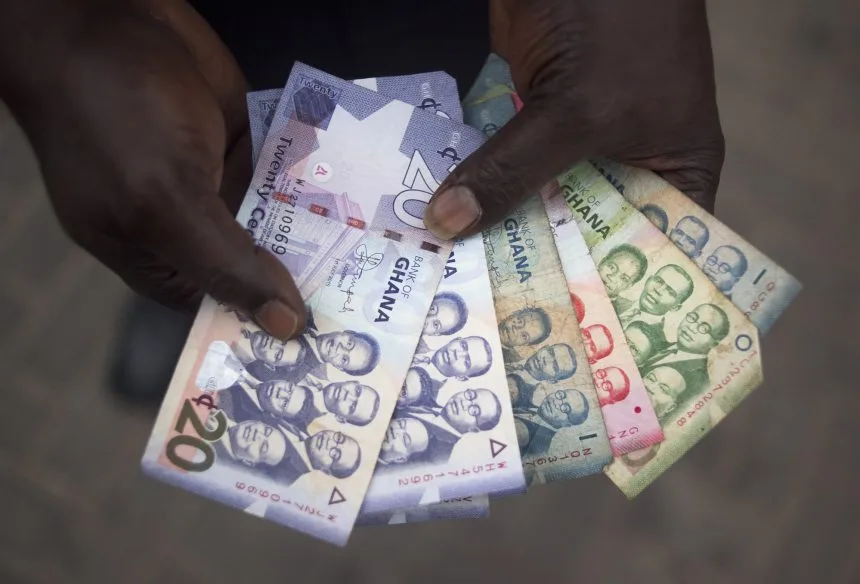
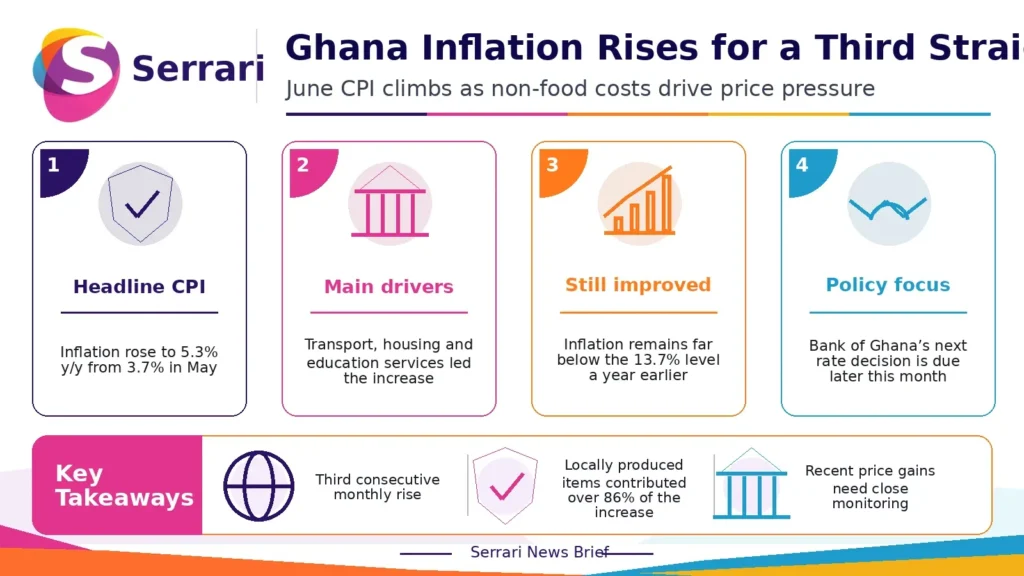
Ghana’s consumer inflation rose for a third consecutive month in June, climbing to 5.3% year-on-year from 3.7% in May, as non-food prices pushed cost pressures higher across transport, housing and education services.
The increase remains far below the 13.7% inflation rate recorded in June 2025, but the latest data suggests Ghana’s rapid disinflation may be losing momentum. That makes the Bank of Ghana’s next interest rate decision more sensitive, after policymakers paused easing in May due to concerns that inflation risks were returning.
Key Overview
Ghana’s latest Consumer Price Index showed inflation increasing by 1.6 percentage points in June, with government statistician Alhassan Iddrisu saying the rise was mainly driven by non-food prices such as bus fares, rent and school fees.
The Ghana Statistical Service had reported May inflation at 3.7% year-on-year, up from 3.4% in April, meaning June marked the third straight monthly acceleration. Reuters previously reported that inflation had risen in April for the first time since December 2024, ending a long period of disinflation.
Non-Food Prices Drive the June Increase
The June rise was largely linked to services and locally produced items rather than imported food shocks. Ghana’s statistics service said locally produced items accounted for more than 86% of the inflation increase, showing that domestic cost pressures are playing a larger role.
Transport, housing and education are particularly important because they affect both households and businesses. Higher transport costs can feed into distribution expenses, while rent and school fees put direct pressure on household budgets.
This is why the latest figure deserves attention even though headline inflation remains low by Ghana’s recent standards. Inflation is still much lower than the levels seen during the country’s severe economic crisis, but the direction of travel has shifted from steady cooling to renewed pressure.
Context is everything. Stay ahead of shifting trends with today’s market updates, and uncover emerging opportunities using the Serrari Group Market Index and Marketplace. Then, take control of your own financial future by exploring our Money & Life Reset Transformation Blueprint ™ to build stronger habits, create better systems, and design a path toward lasting wealth.
Bank of Ghana Faces a More Delicate Rate Decision
The inflation increase comes just before the Bank of Ghana’s next monetary policy decision later in July. In May, the central bank left its policy rate unchanged at 14%, pausing an easing cycle after earlier rate cuts.
That decision reflected caution. Policymakers had been able to reduce rates as inflation fell sharply, but the latest data could make further easing harder to justify in the near term. If inflation continues to rise, the central bank may prefer to hold rates steady until it sees clearer evidence that price pressures are contained.
The Bank of Ghana has been trying to balance two priorities: supporting economic recovery while keeping inflation expectations anchored. The June number complicates that balance because it suggests price pressures may be broadening beyond food and imported goods.
Ghana’s Recovery Still Has Momentum
Despite the inflation uptick, Ghana’s macroeconomic picture has improved significantly compared with the crisis period. Reuters reported earlier this year that inflation fell to 5.4% in December 2025, down from 23.8% a year earlier, as the country continued recovering from its deepest economic crisis in decades.
The central bank also cut rates aggressively when inflation was falling. In January, it reduced the policy rate to 15.50%, citing improved macroeconomic conditions, stronger reserves and fiscal consolidation.
Ghana’s economy remains supported by gold, oil and cocoa production, but the recovery is still vulnerable to renewed inflation, currency pressures and imported cost shocks. The latest inflation figure therefore does not erase the progress made, but it does signal that policy discipline remains important.
Market Takeaway
Ghana’s June inflation rise is a warning sign rather than a crisis signal. At 5.3%, inflation remains far below last year’s level, but the third consecutive increase shows that the disinflation trend has weakened.
For investors and policymakers, the key issue is whether June’s acceleration is temporary or the start of a broader rebound in price pressures. The Bank of Ghana’s July rate decision will now be watched closely for signs of whether policymakers still see room to support growth, or whether inflation caution will remain the priority.
Sources used: Reuters / Ghana Statistical Service / Graphic Online / Bank of Ghana
Your financial future isn’t something you wait for—it’s something you build.
The real question is: when do you begin?
Move beyond simply staying informed.
Navigate the markets with clarity—track trends through the Serrari Group Market Index, uncover opportunities in the Serrari Marketplace, and build practical knowledge with our Curated Wealth Builder Platform.
Stay connected to what truly matters.
Get daily insights on macro trends and financial movements across Kenya, Africa, and global markets—delivered through the Serrari Newsletter.
Growth opens doors.
Advance your career through professional programs including ACCA, HESI A2, ATI TEAS 7 , HESI EXIT , NCLEX – RN and NCLEX – PN, Financial Literacy!🌟—designed to move you forward with confidence.
See where money is flowing—clearly and in real time.
Track Money Market Funds, Treasury Bills, Treasury Bonds, Green Bonds, and Fixed Deposits, alongside global and African indexes, key economic indicators, and the evolving Crypto and stablecoin landscape—all within Serrari’s Market Index.