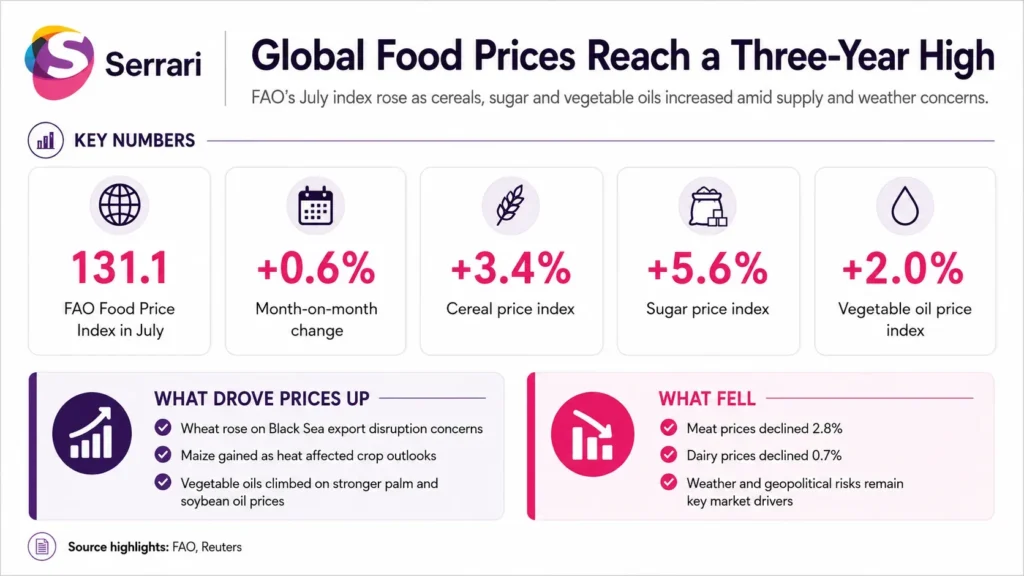
Global food commodity prices climbed to their highest level in more than three years in July 2026 as higher cereal, sugar and vegetable oil prices outweighed declines in meat and dairy.
The FAO Food Price Index rose to 131.1 points in July, up 0.6% from June’s 130.3 points and its highest reading since January 2023. The index was also 1.0% higher than a year earlier, although it remained 18.2% below the record reached in March 2022.
Key Overview
- FAO Food Price Index: 131.1 points in July, up 0.6% month-on-month.
- Cereals: Up 3.4%, led by rising wheat and maize prices.
- Vegetable oils: Up 2.0% to their highest level since June 2022.
- Sugar: Up 5.6%, the sharpest increase among the major categories.
- Meat: Down 2.8% after reaching a record high in June.
- Dairy: Down 0.7%, extending a decline that began in April.
- Overall index: Still 18.2% below the March 2022 historic peak. Cereals Lead July’s Food Price Increase
Cereal markets were the largest contributor to July’s increase. The FAO Cereal Price Index climbed 3.4% from June to 113.8 points and stood 6.9% above its level a year earlier.
International wheat prices rose particularly sharply, increasing 5.8% during the month amid concerns over disruptions to Black Sea exports, damage to export infrastructure and heatwaves affecting crop yields in several major producing regions.
The renewed pressure marks a reversal from June, when wheat prices had fallen as harvesting progressed and stronger Black Sea supply prospects eased market concerns. July’s geopolitical and weather risks quickly shifted sentiment again.
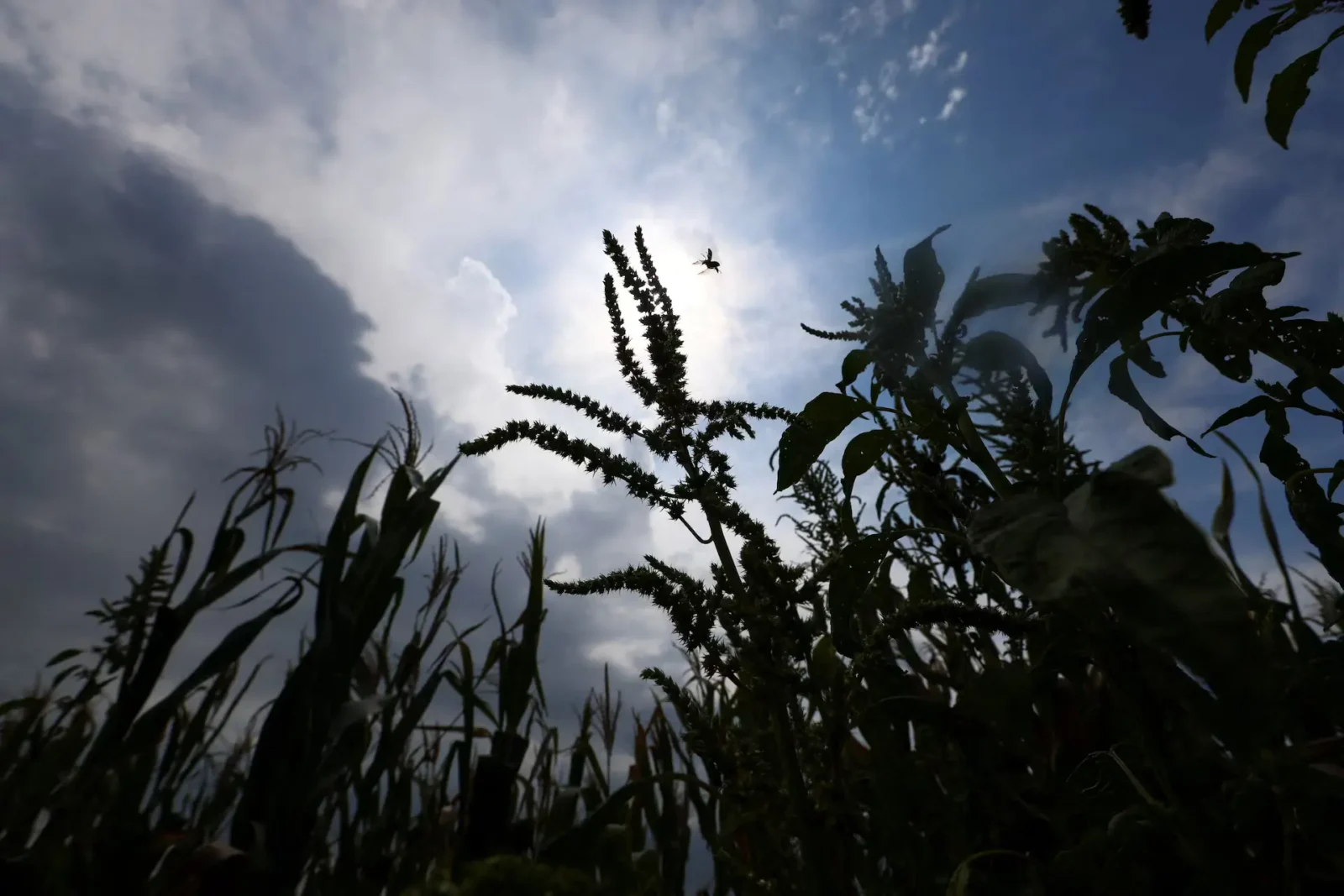
Maize prices also advanced 3.6%, supported by hot and dry conditions across parts of the U.S. Corn Belt alongside firmer energy markets. By contrast, barley prices fell 1.9%, while international rice prices were broadly stable.
The combination of Black Sea disruptions and extreme weather has consequently renewed concerns over the resilience of global grain supplies after several months of fluctuating agricultural-market conditions.
Vegetable Oil Prices Reach Four-Year High
Vegetable oils provided another source of upward pressure.
The Vegetable Oil Price Index increased 2.0% to 195.7 points, its highest level since June 2022. Higher palm and soybean oil prices more than offset declines in sunflower and rapeseed oil.
Palm oil prices increased for a second consecutive month, supported by strong demand from Indonesia’s biodiesel industry and higher crude oil prices. Soybean oil also strengthened as demand for biofuel feedstock remained robust in the United States and international import demand increased.
Sunflower and rapeseed oil prices moved in the opposite direction as expectations of larger supplies during the 2026/27 season weighed on quotations.
Sugar Jumps as Weather Risks Intensify
Sugar recorded the strongest monthly increase among the five major food groups tracked by the index.
The Sugar Price Index surged 5.6% to 95.0 points as persistent hot and dry conditions created concerns about crop yields in the European Union, while El Niño-related weather risks raised uncertainty around production in major Asian producers.
Prices were also supported by expectations of stronger Brazilian demand for ethanol following a temporary increase in the country’s mandatory ethanol blend in gasoline. Greater diversion of sugarcane into ethanol production could reduce the quantity available for sugar manufacturing.
However, improving harvesting conditions in Brazil’s key Center-South producing region helped limit the overall rise.
Context is everything. Stay ahead of shifting trends with today’s market updates, and uncover emerging opportunities using the Serrari Group Market Index and Marketplace. Then, take control of your own financial future by exploring our Money & Life Reset Transformation Blueprint ™ to build stronger habits, create better systems, and design a path toward lasting wealth.
Meat and Dairy Prices Provide Some Relief
Not every food category became more expensive in July.
The Meat Price Index declined 2.8% from June to 127.7 points, marking its first monthly decline of 2026 after reaching a record high the previous month. Poultry, pork and bovine meat prices all weakened, while sheep meat prices moved higher and reached a new record as export supplies remained tight.
Dairy prices declined 0.7% as cheaper butter, skim milk powder and whole milk powder offset a modest recovery in cheese prices. The dairy index was almost 25% below its July 2025 level, highlighting the sharp correction that has taken place in that category.
Global Food Inflation Risks Remain Elevated
July’s increase leaves international food commodity prices at their highest level since January 2023, but the broader picture remains well below the extreme conditions experienced after Russia’s full-scale invasion of Ukraine in 2022.
The current risks are increasingly concentrated around weather disruption, geopolitical instability, energy markets and agricultural input costs. Higher crude oil prices can raise transportation and production expenses while also increasing demand for crops used in biofuels, creating additional links between energy and food markets.
The FAO index measures international commodity prices rather than the prices consumers pay directly in supermarkets, meaning changes do not translate immediately or equally into national food inflation. However, sustained increases in major commodities such as wheat, maize, sugar and vegetable oils can eventually put greater pressure on import costs and consumer prices, particularly in countries heavily dependent on food imports.
For now, the July data indicate that global agricultural markets have entered another period of heightened price pressure, with weather and geopolitical conditions likely to remain central to the direction of food costs over the coming months.
Sources: Food and Agriculture Organization of the United Nations / Reuters
Your financial future isn’t something you wait for—it’s something you build.
The real question is: when do you begin?
Move beyond simply staying informed.
Navigate the markets with clarity—track trends through the Serrari Group Market Index, uncover opportunities in the Serrari Marketplace, and build practical knowledge with our Curated Wealth Builder Platform.
Stay connected to what truly matters.
Get daily insights on macro trends and financial movements across Kenya, Africa, and global markets—delivered through the Serrari Newsletter.
Growth opens doors.
Advance your career through professional programs including ACCA, HESI A2, ATI TEAS 7 , HESI EXIT , NCLEX – RN and NCLEX – PN, Financial Literacy!🌟—designed to move you forward with confidence.
See where money is flowing—clearly and in real time.
Track Money Market Funds, Treasury Bills, Treasury Bonds, Green Bonds, and Fixed Deposits, alongside global and African indexes, key economic indicators, and the evolving Crypto and stablecoin landscape—all within Serrari’s Market Index.