
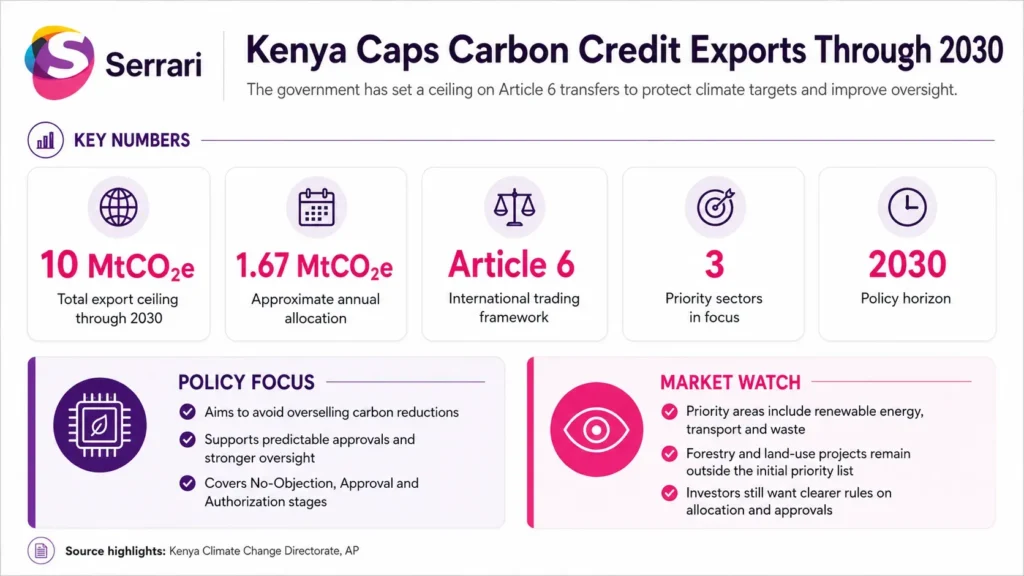
Kenya has imposed a 10 million-tonne carbon dioxide equivalent (MtCO2e) ceiling on carbon credits it will authorize for international transfer under Article 6 of the Paris Agreement through 2030, introducing one of Africa’s more structured frameworks for international carbon trading.
The country’s new carbon-market rule book sets annual allocations at 1.67 MtCO2e and establishes a national carbon budget against which requests for international authorization will be assessed. The measure is designed to prevent Kenya from transferring too many emission reductions abroad and leaving itself short of the reductions needed to meet its own climate commitments.
Importantly, the ceiling specifically concerns government-authorized international carbon-market transactions under Article 6 rather than acting as a blanket prohibition on every carbon credit generated or sold through voluntary markets.
Key Overview
- International transfer ceiling: 10 MtCO2e through 2030.
- Annual allocation: Up to 1.67 MtCO2e.
- Framework: Article 6 of the Paris Agreement.
- Priority activities: Renewable energy, transportation and waste, alongside qualifying activities within covered sectors.
- Currently excluded from the priority list: Forestry and other land-use projects while stronger baselines and permanence safeguards are developed.
- Approval process: No-Objection, Approval and Authorization.
- Primary objective: Attract carbon finance without undermining Kenya’s own Nationally Determined Contribution.
- Key investor concern: Greater clarity is still needed over how the limited authorization budget will be allocated between projects and markets.
Kenya Puts a Ceiling on International Carbon Transfers
Kenya’s policy marks a shift from encouraging carbon-market growth with relatively open-ended expectations towards actively managing how many emission reductions can leave the country.
Under the 2026 strategic carbon-market framework, the government is seeking to make authorization decisions more predictable while protecting the emissions reductions required for Kenya’s domestic climate targets. The framework operationalizes the country’s participation in Article 6 and introduces clearer criteria for determining which mitigation activities can receive government authorization.
Article 6 allows countries to cooperate in meeting their climate commitments, including by transferring mitigation outcomes internationally. Once Kenya authorizes an emission reduction for use by another country towards its climate target, accounting rules can require a corresponding adjustment, preventing both countries from claiming the same reduction.
This is why the 10 MtCO2e ceiling matters. Carbon credits can bring foreign capital into renewable energy, clean transport, waste management and other climate projects, but excessive authorization could reduce the pool of mitigation outcomes Kenya can count towards its own climate commitments.
Renewable Energy, Transport and Waste Gain Priority
The framework introduces a conditional priority list intended to give developers a clearer indication of the types of projects the government is currently more willing to consider for Article 6 authorization.
According to the published international trading framework, renewable energy, transport and waste projects are among the priority activities, while the broader carbon budget covers eligible reductions from energy, transportation, industrial processes and waste.
Forestry and other land-use projects are not currently on the priority list. Officials have indicated that stronger emissions baselines, monitoring systems and safeguards against reversal risk are needed before these activities can be incorporated more fully.
The distinction is significant because Kenya has attracted substantial carbon-project activity around forest conservation, mangrove restoration and other nature-based projects. Their absence from the initial priority list does not necessarily mean permanent exclusion; instead, the government says the underlying measurement and permanence framework must first be strengthened.
Context is everything. Stay ahead of shifting trends with today’s market updates, and uncover emerging opportunities using the Serrari Group Market Index and Marketplace. Then, take control of your own financial future by exploring our Money & Life Reset Transformation Blueprint ™ to build stronger habits, create better systems, and design a path toward lasting wealth.
Investors Want More Clarity on Allocation
Although the new framework reduces some regulatory uncertainty, questions remain over how Kenya will distribute its limited annual authorization capacity.
Leon Martin, Business Development Manager at conservation asset firm InvestConservation, told the publication reporting on the policy that greater clarity is needed on which projects will qualify, whether authorizations will predominantly support compliance or voluntary-market transactions, and how allowances will be distributed among developers.
That issue could become increasingly important if demand for Article 6 authorization exceeds the annual 1.67 MtCO2e allocation.
The government could face decisions over whether to concentrate authorizations among a small number of large projects or distribute capacity across a wider range of developers. For investors, knowing those allocation rules in advance could materially affect project financing and expected carbon-credit revenues.
Past uncertainty around authorization letters has already demonstrated the commercial importance of government approvals for projects whose business models depend heavily on internationally transferred carbon credits.
National Registry Strengthens Carbon-Market Oversight
The export ceiling forms part of a wider effort by Kenya to build more formal carbon-market infrastructure.
In February 2026, Kenya launched its national carbon registry, designed to centrally record projects, track emission reductions and carbon-credit transfers, and reduce the risk of double counting. More than 80 project concept notes had already been submitted around the time of its launch, demonstrating considerable developer interest.
The registry complements Kenya’s existing Carbon Markets Regulations, 2024, which created the legal framework governing carbon-market activities and established procedures for project development, approvals and oversight.
Together, the regulations, registry and 2026 strategic guide are creating a progressively more centralized carbon-market governance system.
Protecting Kenya’s Own Climate Targets
The policy also reflects a fundamental tension facing countries that are rich in potential carbon projects: selling emission reductions can mobilize valuable climate finance, but governments must ensure they do not export reductions needed to fulfil their own climate commitments.
Kenya’s longer-term climate strategy explicitly anticipates continued participation in carbon markets. Its 2031–2035 climate commitment says the country intends to periodically review an eligible-project whitelist and establish annual targets governing participation in Article 6 mechanisms. It also states that part of mitigation outcomes from carbon-market activities will be retained for domestic use towards Kenya’s NDC.
That approach suggests Kenya is not retreating from international carbon markets. Instead, it is attempting to place a scarcity value on the right to transfer nationally generated emissions reductions abroad.
If implementation becomes predictable and transparent, the 10 MtCO2e cap could improve investor confidence by providing clearer boundaries around what Kenya is prepared to authorize. If allocation rules remain uncertain, however, developers may continue to face difficulty determining whether projects can ultimately access the international markets on which their economics depend.
Sources: Kenya Climate Change Directorate / Kenya Law / United Nations Framework Convention on Climate Change / Associated Press / Forbes Africa
Your financial future isn’t something you wait for—it’s something you build.
The real question is: when do you begin?
Move beyond simply staying informed.
Navigate the markets with clarity—track trends through the Serrari Group Market Index, uncover opportunities in the Serrari Marketplace, and build practical knowledge with our Curated Wealth Builder Platform.
Stay connected to what truly matters.
Get daily insights on macro trends and financial movements across Kenya, Africa, and global markets—delivered through the Serrari Newsletter.
Growth opens doors.
Advance your career through professional programs including ACCA, HESI A2, ATI TEAS 7 , HESI EXIT , NCLEX – RN and NCLEX – PN, Financial Literacy!🌟—designed to move you forward with confidence.
See where money is flowing—clearly and in real time.
Track Money Market Funds, Treasury Bills, Treasury Bonds, Green Bonds, and Fixed Deposits, alongside global and African indexes, key economic indicators, and the evolving Crypto and stablecoin landscape—all within Serrari’s Market Index.