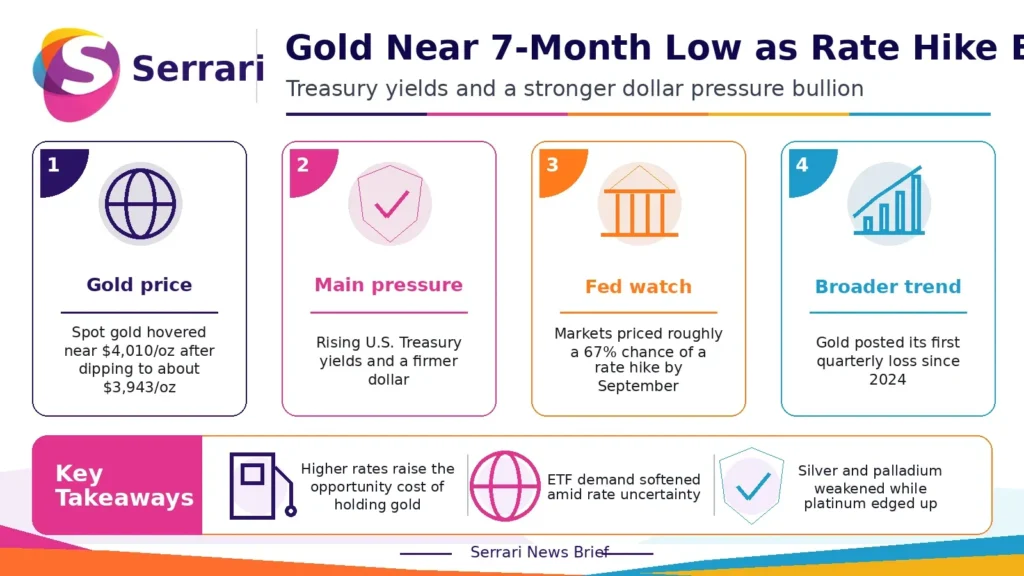
Gold steadied on Wednesday but remained close to its lowest level in seven months as higher U.S. Treasury yields, a firmer dollar and renewed expectations of Federal Reserve rate hikes reduced appetite for the non-yielding metal.
Spot gold had touched its weakest level since November in the previous session, while U.S. gold futures also moved lower. The pressure reflected a broader shift in investor expectations as markets reassessed the path of U.S. interest rates after hawkish comments from Federal Reserve officials.
Key Overview
Spot gold was trading near $4,010 per ounce after touching its lowest level since November, while August U.S. gold futures slipped around 0.4%. Reuters reported that gold had recorded its first quarterly loss since 2024, underscoring how quickly sentiment has cooled after earlier gains.
The latest weakness came as U.S. Treasury yields rose for a third straight session and the dollar strengthened. A stronger dollar makes bullion more expensive for buyers using other currencies, while higher yields raise the opportunity cost of holding gold because it does not pay interest.
Fed Rate Expectations Pressure Gold
Gold’s near-term direction is being shaped heavily by expectations for U.S. monetary policy. Cleveland Fed President Beth Hammack said in a CNBC interview that further rate hikes might be necessary if inflation pressures remain too high.
Her comments added to market concerns that the Federal Reserve may keep policy tighter for longer. According to Reuters, traders were pricing in a nearly 67% chance of a rate hike by September, a shift that weighed on precious metals and reduced demand from exchange-traded funds.
The Cleveland Fed has also published Hammack’s earlier remarks, where she said it may soon be appropriate for policy to act if recent inflation trends continue. In that speech, she argued that the Fed must remain focused on returning inflation to its 2% target.
Why Yields and the Dollar Matter
Gold often benefits when investors expect lower interest rates, weaker real yields or rising economic uncertainty. The current setup is more difficult. Rising Treasury yields make bonds more attractive relative to bullion, while a stronger dollar can reduce overseas demand.
The pressure has been visible across recent trading sessions. A Reuters report from late June noted that gold was already heading for a fourth straight weekly loss as hawkish Fed expectations supported the dollar and reduced demand for safe-haven assets.
Investors are now watching U.S. jobs data closely. The ADP employment report and nonfarm payrolls figures could influence whether the Fed sees enough resilience in the labour market to justify another rate increase. Strong jobs data would likely reinforce rate hike expectations, while weaker numbers could ease pressure on gold.
Context is everything. Stay ahead of shifting trends with today’s market updates, and uncover emerging opportunities using the Serrari Group Market Index and Marketplace. Then, take control of your own financial future by exploring our Money & Life Reset Transformation Blueprint ™ to build stronger habits, create better systems, and design a path toward lasting wealth.
Other Precious Metals Also Weaken
The pressure was not limited to gold. Silver slipped to around $58.33 per ounce, while platinum briefly hit its lowest level since November before edging higher. Palladium also declined, reflecting a broader pullback across precious metals.
Platinum and palladium often respond to both investment flows and industrial demand expectations, especially from the automotive sector. Their decline suggests that the market is not only reacting to gold-specific factors, but also to broader concerns about rates, currency strength and risk appetite.
Geopolitics Offers Limited Support
Geopolitical uncertainty remained in the background, particularly after reports that Iran would not meet senior U.S. envoys following recent hostilities. Such tensions can usually support gold, but in this session the effect was outweighed by monetary policy expectations and yield pressure.
That balance matters for the market outlook. If geopolitical risk rises sharply, gold may regain safe-haven demand. But as long as the dominant story remains higher yields and possible Fed rate hikes, rallies may face resistance.
Market Takeaway
Gold’s weakness reflects a market being driven more by interest rates than by geopolitical uncertainty. The metal remains near a seven-month low because investors are focusing on higher Treasury yields, a stronger dollar and the possibility that the Federal Reserve may raise rates again.
The next major trigger will be U.S. labour market data. If employment remains strong and inflation concerns persist, gold could remain under pressure. If the data weaken, expectations for tighter policy may ease, giving bullion room to recover.
Sources used: Reuters / Federal Reserve Bank of Cleveland / CME Group
Your financial future isn’t something you wait for—it’s something you build.
The real question is: when do you begin?
Move beyond simply staying informed.
Navigate the markets with clarity—track trends through the Serrari Group Market Index, uncover opportunities in the Serrari Marketplace, and build practical knowledge with our Curated Wealth Builder Platform.
Stay connected to what truly matters.
Get daily insights on macro trends and financial movements across Kenya, Africa, and global markets—delivered through the Serrari Newsletter.
Growth opens doors.
Advance your career through professional programs including ACCA, HESI A2, ATI TEAS 7 , HESI EXIT , NCLEX – RN and NCLEX – PN, Financial Literacy!🌟—designed to move you forward with confidence.
See where money is flowing—clearly and in real time.
Track Money Market Funds, Treasury Bills, Treasury Bonds, Green Bonds, and Fixed Deposits, alongside global and African indexes, key economic indicators, and the evolving Crypto and stablecoin landscape—all within Serrari’s Market Index.