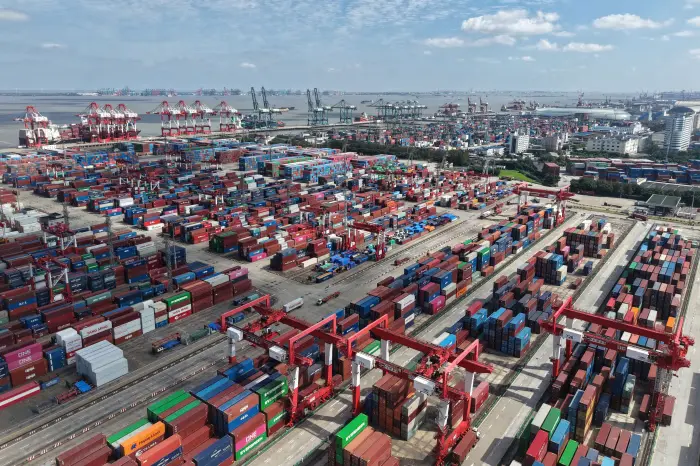
The United States estimates that illegal transshipment could be costing the federal government between $19 billion and $26 billion annually in lost tariff revenue. A new assessment of tariff evasion (The White House) uses a central case of $75 billion in annual transshipped goods and argues that Chinese-origin products are increasingly being routed through third countries before entering the US.
The report identifies more than 40 countries as potential transshipment-risk jurisdictions and highlights Mexico, India and Vietnam in particular. However, the estimates measure potential or alleged illegal transshipment rather than customs violations proven shipment by shipment, an important distinction as governments and trade groups contest parts of the methodology.
Key Overview
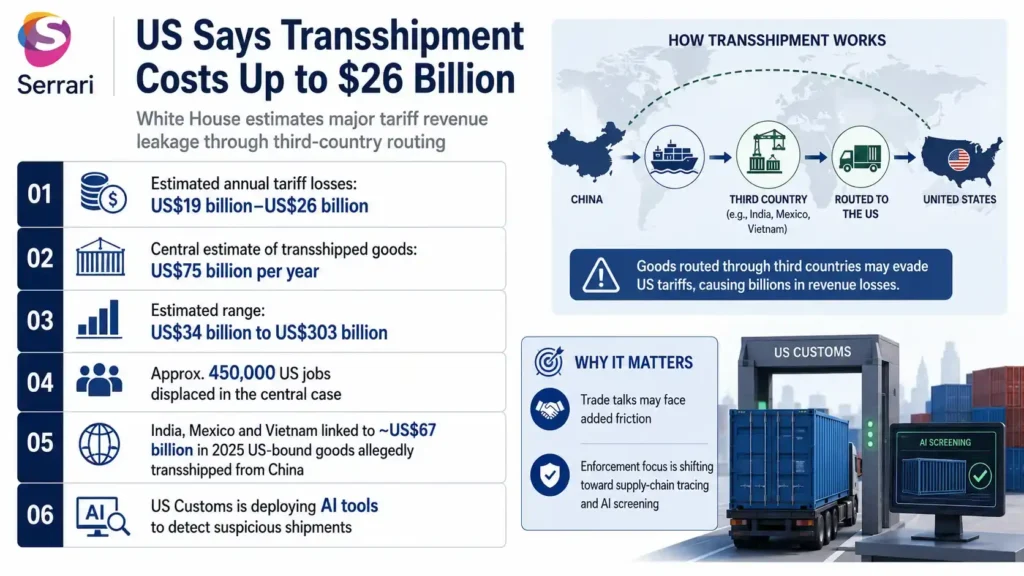
- The central estimate assumes $75 billion in annual illegal transshipment.
- Estimated lost federal revenue ranges from $19 billion to $26 billion annually.
- The central case estimates approximately 450,000 US jobs displaced, directly and indirectly.
- Mexico, India and Vietnam were linked to an estimated $67 billion of US-bound goods allegedly transshipped from China in 2025.
- That three-country estimate was associated with roughly $28 billion in potential lost tariff revenue.
- US customs authorities are expanding the use of AI-based tools to identify suspicious routing and origin declarations.
- Critics argue aggregate trade patterns alone cannot prove individual cases of customs fraud.
US Estimates Show a Wide Range of Potential Evasion
Estimating the scale of transshipment is difficult because legitimate manufacturing, supply-chain diversification and deliberate tariff evasion can produce similar patterns in trade data.
The official assessment draws on several methodologies that produce estimates ranging from approximately $34.2 billion to $303 billion in potentially affected annual trade. The report explicitly states that these figures are not additive or directly comparable because they rely on different datasets, definitions and analytical methods.
For its main economic calculation, officials use a $75 billion central estimate. Applying assumed economic effects to that figure produces an estimated 450,000 displaced jobs, $113 billion to $150 billion in reduced annual GDP and $19 billion to $26 billion in federal revenue losses. These are modelled estimates rather than independently verified realised losses.
The report argues that tariff differentials create an incentive to route products through lower-tariff jurisdictions using practices including relabelling, repackaging, re-invoicing or limited processing before shipment to the US.
Context is everything. Stay ahead of shifting trends with today’s market updates, and uncover emerging opportunities using the Serrari Group Market Index and Marketplace. Then, take control of your own financial future by exploring our Money & Life Reset Transformation Blueprint ™ to build stronger habits, create better systems, and design a path toward lasting wealth.
India, Mexico and Vietnam Face Greater Scrutiny
A narrower trade-transfer analysis estimates that approximately $67 billion of US-bound goods were transshipped from China through Mexico, India and Vietnam during 2025, generating an estimated $28 billion tariff loss.
India was placed in the report’s highest transshipment-risk tier alongside Canada, the European Union, Israel, Japan, Mexico, South Korea and Taiwan. Vietnam was placed in the second tier of economies described as having substantial integration with China-linked manufacturing and supply chains.
The accusations have drawn scrutiny because the report does not provide a breakdown showing how much of the $67 billion figure is attributable specifically to India. A challenge to the methodology (The Economic Times) argues that Chinese components used in legitimate manufacturing do not automatically make finished goods illegally transshipped Chinese products.
That distinction matters because rules of origin can recognise a product as originating from another country when sufficient manufacturing or substantial transformation occurs there. Rising imports of Chinese inputs alongside rising exports to the US can therefore indicate either legitimate supply-chain integration or evasion, depending on the facts of individual shipments.
Falling China Imports Add to the Trade Debate
Direct US goods imports from China fell sharply during 2025. Annual trade figures (Bureau of Economic Analysis) show imports from China dropping by about $130 billion to roughly $308.4 billion, while the US goods deficit with China narrowed to $202.1 billion.
At the same time, imports from countries including Vietnam and Mexico have expanded significantly, strengthening the administration’s argument that some China-linked production may have shifted through third-country supply chains.
However, trade diversion alone does not establish illegal transshipment. Manufacturers have also shifted assembly and sourcing outside China in response to tariffs, geopolitical risks and efforts to diversify supply chains.
The issue is also becoming increasingly sensitive diplomatically. During ongoing US-India trade discussions, official accusations involving India (Reuters) have added another potential point of friction, while China has warned against agreements that it believes damage its economic interests or disrupt established industrial supply chains.
AI Becomes Part of Customs Enforcement
US authorities are increasingly turning to artificial intelligence to distinguish genuine manufacturing from suspicious routing. The proposed AI-enabled detection system is designed to analyse declared origins, routing histories, component content and production capacity to identify anomalies for further investigation.
Machine-learning and computer-vision systems can also examine container markings, packaging patterns and X-ray imagery for inconsistencies between documentation and physical cargo. Existing customs operations have already used AI to identify higher-risk shipments earlier in the import process.
The enforcement challenge will be applying those tools without treating legitimate global manufacturing as tariff fraud. With tens of billions of dollars potentially at stake, transshipment is likely to become an increasingly important issue in US customs enforcement and future trade negotiations.
Sources: White House / Reuters / Associated Press / U.S. Bureau of Economic Analysis / U.S. Customs and Border Protection / The Economic Times
Your financial future isn’t something you wait for—it’s something you build.
The real question is: when do you begin?
Move beyond simply staying informed.
Navigate the markets with clarity—track trends through the Serrari Group Market Index, uncover opportunities in the Serrari Marketplace, and build practical knowledge with our Curated Wealth Builder Platform.
Stay connected to what truly matters.
Get daily insights on macro trends and financial movements across Kenya, Africa, and global markets—delivered through the Serrari Newsletter.
Growth opens doors.
Advance your career through professional programs including ACCA, HESI A2, ATI TEAS 7 , HESI EXIT , NCLEX – RN and NCLEX – PN, Financial Literacy!🌟—designed to move you forward with confidence.
See where money is flowing—clearly and in real time.
Track Money Market Funds, Treasury Bills, Treasury Bonds, Green Bonds, and Fixed Deposits, alongside global and African indexes, key economic indicators, and the evolving Crypto and stablecoin landscape—all within Serrari’s Market Index.