Kenya’s growing circular-fashion sector is showing how discarded clothing and agricultural residues can become sources of employment, new materials and income. Textile recovery businesses are collecting unwanted garments, sorting reusable clothing and converting damaged material into products such as rugs, baskets, bags and yarn, while other innovators are developing biodegradable materials from agricultural waste.
The opportunity is particularly relevant in a country where 39.8% of the population was below the national poverty line in 2022. Official household poverty data (Kenya National Bureau of Statistics) also show rural households experiencing higher poverty than urban households, strengthening the case for circular businesses that can create income opportunities across both urban waste systems and agricultural communities.
Key Overview
- Kenya’s textile-recovery businesses are turning discarded clothing into reusable and upcycled products.
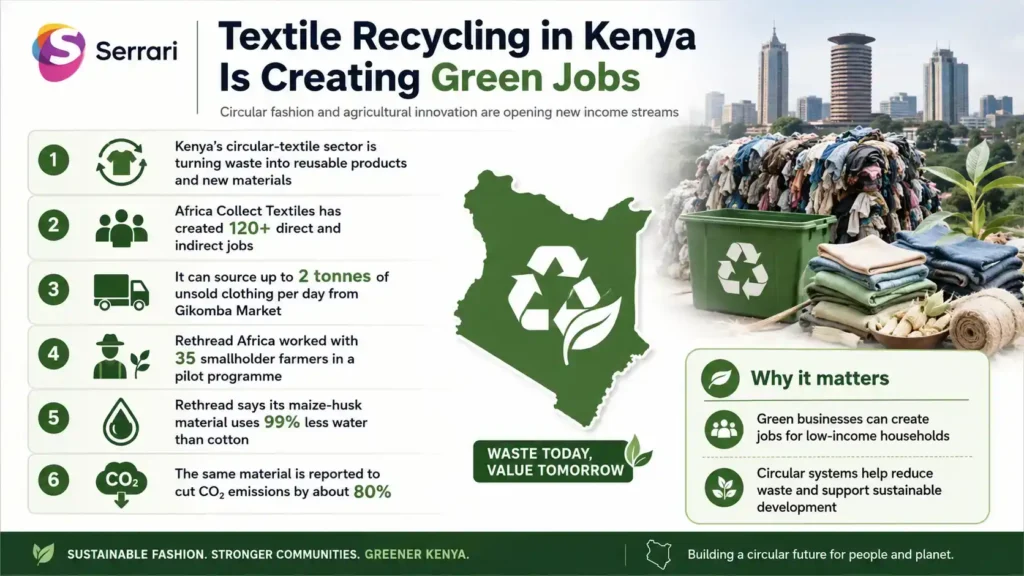
- Africa Collect Textiles had created more than 120 direct and indirect jobs by May 2025, mainly for women.
- The organisation can source up to two tonnes of unsold clothing per day from Nairobi’s Gikomba Market.
- Rethread Africa worked with 35 smallholder farmers in a Homa Bay pilot and aims to expand beyond 100.
- Rethread says its maize-husk-derived material uses 99% less water than cotton and reduces CO2 emissions by 80%.
- Circular business models could connect environmental gains with employment, skills development and additional household income.
Textile Waste Becomes a Source of Employment
Kenya is an important market for second-hand clothing, but garments eventually reach the end of their usable lives, creating a need for collection, sorting and recycling infrastructure. A circular textile initiative in Kenya (UNEP – UN Environment Programme) highlights how unwanted textiles can instead be transformed into products including rugs, toys and yarn and returned to the economy.
Africa Collect Textiles has built one of the country’s most visible textile-recovery models. The organisation collects used clothing and footwear, separates wearable products for redistribution and directs unsuitable textiles toward upcycling and recycling.
A May 2025 industry profile (AMI Plastics Events) reported that ACT had created more than 120 direct and indirect jobs, mainly for women, while operating more than 60 collection points across Kenya and Nigeria.
Its supply network also reaches Gikomba Market in Nairobi, where ACT can source up to two tonnes of unsold clothing daily, including uniforms, textile off-cuts and other materials that could otherwise be dumped or burned. The organisation has been working toward installing mechanical recycling equipment, which would allow more discarded fabric to be recovered into fibre rather than relying primarily on manual upcycling.
That shift matters because textile-to-textile recycling remains limited globally. A 2025 assessment of fashion waste (UNEP – UN Environment Programme) found that only about 1% of fibres available for new apparel, footwear and related products came from recycled textiles, illustrating how much material still leaves the fashion system after use.
Context is everything. Stay ahead of shifting trends with today’s market updates, and uncover emerging opportunities using the Serrari Group Market Index and Marketplace. Then, take control of your own financial future by exploring our Money & Life Reset Transformation Blueprint ™ to build stronger habits, create better systems, and design a path toward lasting wealth.
Farm Waste Opens Another Circular Fashion Path
Kenya’s circular-textile opportunity extends beyond old clothes. Rethread Africa is developing biomaterials from agricultural residues, connecting the country’s farming economy with emerging sustainable-material markets.
Its Homa Bay pilot programme (Impact Hub) worked with 35 smallholder farmers, sourcing agricultural waste that previously had limited commercial value. The company has stated that it plans to expand the programme to more than 100 farmers and has a longer-term goal of supporting 300 new jobs.
The business is also experimenting with maize husks as a textile feedstock. In its circular-design project profile (Make It Circular), Rethread reports that its biodegradable fabric uses 99% less water than cotton, reduces carbon dioxide emissions by about 80% and has increased participating farmers’ incomes by around 40%.
These figures are project-reported impact estimates rather than national industry averages, but they illustrate the potential economic model: agricultural residues that once had little value can become purchased inputs, providing farmers with an additional income stream without requiring more farmland.
That opportunity is significant given Kenya’s poverty profile. The 2022 national household survey (Kenya National Bureau of Statistics) found an overall individual poverty rate of 39.8%, while household-level poverty stood at roughly 38% in rural areas compared with 26% in urban areas.
Recycling Can Support a Wider Green Jobs Economy
Textiles form only one part of Kenya’s growing waste-recovery economy. Other recycling businesses show how collecting, separating and processing materials can generate employment alongside environmental benefits.
A Kenyan waste-management case study (UNFCCC) highlights a model designed to combine affordable waste collection with recycling, composting and employment for people from lower-income communities.
The wider employment potential is substantial. Global modelling on the transition toward a circular economy (International Labour Organization) estimates that greater recycling, reuse and resource efficiency can create millions of net additional jobs, although achieving those gains depends on investment, skills development and appropriate labour policies.
Kenya’s emerging textile businesses provide a local example of that transition. Recycling alone cannot solve poverty or the country’s broader waste-management challenges, but converting discarded clothes and agricultural residues into commercial inputs creates value where little existed before.
With greater investment in collection networks, mechanical recycling, local manufacturing and skills development, Kenya could turn more of its textile waste problem into a circular industry that creates employment, supports small businesses and keeps valuable materials in use for longer.
Sources: United Nations Environment Programme / Africa Collect Textiles / AMI / Impact Hub Network / What Design Can Do / Kenya National Bureau of Statistics / United Nations Framework Convention on Climate Change / International Labour Organization
Your financial future isn’t something you wait for—it’s something you build.
The real question is: when do you begin?
Move beyond simply staying informed.
Navigate the markets with clarity—track trends through the Serrari Group Market Index, uncover opportunities in the Serrari Marketplace, and build practical knowledge with our Curated Wealth Builder Platform.
Stay connected to what truly matters.
Get daily insights on macro trends and financial movements across Kenya, Africa, and global markets—delivered through the Serrari Newsletter.
Growth opens doors.
Advance your career through professional programs including ACCA, HESI A2, ATI TEAS 7 , HESI EXIT , NCLEX – RN and NCLEX – PN, Financial Literacy!🌟—designed to move you forward with confidence.
See where money is flowing—clearly and in real time.
Track Money Market Funds, Treasury Bills, Treasury Bonds, Green Bonds, and Fixed Deposits, alongside global and African indexes, key economic indicators, and the evolving Crypto and stablecoin landscape—all within Serrari’s Market Index.