Japan is preparing another sovereign Climate Transition Bond as part of its multi-year Green Transformation financing programme.
The new 10-year security is expected to raise approximately ¥250 billion, with the auction scheduled for August 24, issuance on August 25 and maturity on June 20, 2036.
Unlike a conventional green bond focused mainly on activities already considered environmentally green, Japan’s transition framework also supports technologies and industries that need significant investment to move toward lower-carbon operations.
Key Overview
- Planned issue size: approximately ¥250 billion.
- Auction date: August 24, 2026.
- Issue date: August 25, 2026.
- Maturity: June 20, 2036.
- FY2026 Climate Transition Bond issuance plan: approximately ¥1 trillion.
- Wider GX Economy Transition Bond programme: approximately ¥20 trillion.
- Targeted public-private GX investment: more than ¥150 trillion.
- JCR preliminary evaluation: Green 1(T).
Japan Climate Transition Bond Sets ¥250B 10-Year Sale Terms
Japan is preparing to sell another ¥250 billion of sovereign climate-transition debt as it builds one of the world’s largest government-backed experiments in transition finance.
The Ministry of Finance auction calendar schedules the 10-year Japan Climate Transition Bond for August 24. The new security is expected to be issued the following day and mature on June 20, 2036.
The auction will use a Dutch-style yield-competitive format with bids submitted in 0.1-basis-point increments, consistent with Japan’s FY2026 issuance design.
But the more interesting investor question is not the auction mechanics.
It is what makes this a transition bond rather than an ordinary green bond.
Green Bond Versus Transition Bond
Traditional green bonds generally direct proceeds toward clearly defined environmental activities such as renewable power, green buildings or clean transportation.
Transition finance has a wider challenge.
It can help finance industries or technologies that are not yet fully green but are considered necessary to move a high-emissions economy toward lower-carbon production.
The Japan climate transition bond portal explains that the government developed a dedicated framework, external assessments and allocation reporting for these securities rather than issuing them simply as ordinary JGBs.
That distinction is especially important in Japan, where industrial decarbonisation involves sectors that cannot switch to zero emissions overnight.
What Can Investors Actually Fund?
Japan’s eligible FY2026 projects go considerably beyond wind and solar.
The JCR preliminary bond assessment identifies spending areas including energy efficiency, renewable energy, electricity storage, clean vehicles, sustainable aviation fuel, zero-emission shipping, hydrogen and ammonia supply chains and support for manufacturing-process conversion in hard-to-abate industries.
It also includes emerging technologies such as perovskite solar cells and next-generation advanced reactors.
That breadth demonstrates why the word transition matters.
Some financed activities are already conventionally green. Others are intended to help difficult sectors progressively reduce emissions.
Japan Is Building a Much Bigger Programme
The ¥250 billion auction is small beside the policy it supports.
The METI transition finance programme says Japan estimates that more than ¥150 trillion of public and private GX investment will be required over approximately 10 years.
The government plans roughly ¥20 trillion of GX Economy Transition Bonds to help catalyse that investment.
For FY2026 alone, the Ministry bond issuance plan provides for approximately ¥1 trillion of GX Economy Transition Bond issuance.
The August bond is therefore one piece of a multi-year financing strategy rather than a one-off labelled debt transaction.
Context is everything. Stay ahead of shifting trends with today’s market updates, and uncover emerging opportunities using the Serrari Group Market Index and Marketplace. Then, take control of your own financial future by exploring our Money & Life Reset Transformation Blueprint ™ to build stronger habits, create better systems, and design a path toward lasting wealth.
What Does Green 1(T) Mean?
Japan Credit Rating Agency has assigned the FY2026 bond programme its highest preliminary Green 1(T) assessment.
The JCR sovereign assessment register confirms that the 5- and 10-year FY2026 Climate Transition Bonds received that preliminary evaluation.
JCR says the bonds satisfy requirements covering use of proceeds, project selection, management of proceeds and reporting and align with transition-finance and green-bond guidelines.
That evaluation concerns the environmental and transition framework.
It is not the same thing as a credit rating and does not eliminate interest-rate or sovereign-market risk.
Investors Still Need the Auction Yield
The biggest missing number today is the actual yield.
That will not be determined until the August 24 auction.
Japan’s previous five-year Climate Transition Bond auction in May provides a reference point. The MOF May auction result shows ¥250 billion accepted at a highest accepted yield of 1.941%, after ¥1.156 trillion of bids were submitted.
The new bond has roughly twice the maturity.
Its pricing will therefore reflect the 10-year JGB curve, interest-rate expectations, demand for labelled assets and investors’ willingness to hold transition debt.
The environmental label does not guarantee a pricing advantage.
To establish a genuine “greenium” or transition premium, investors would need to compare the auction yield with a genuinely comparable conventional Japanese government bond.
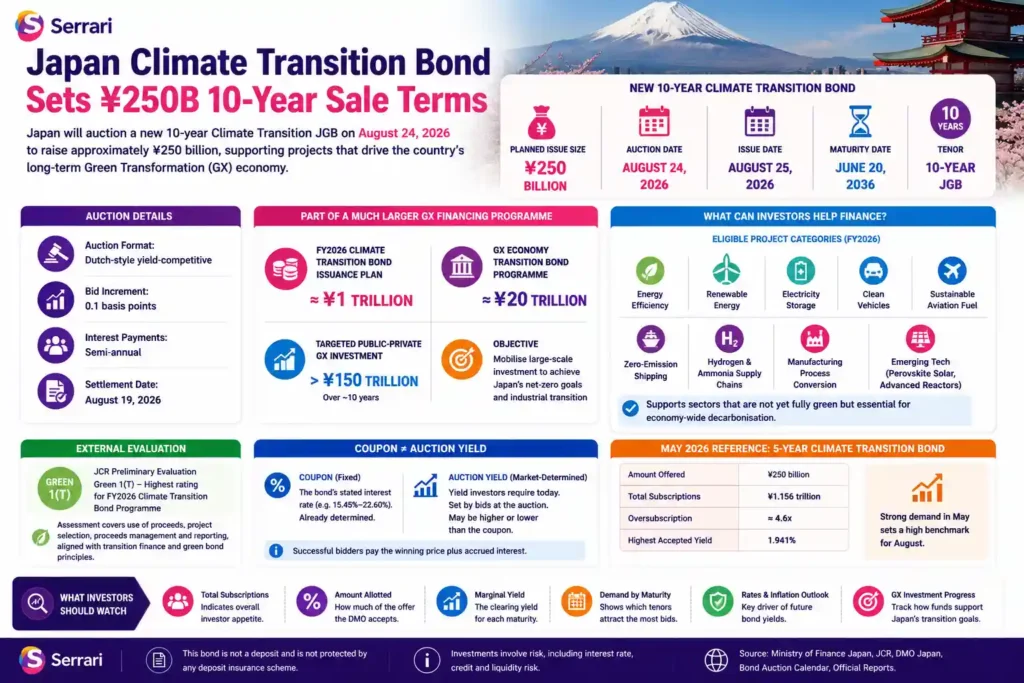
Japan’s Green Transformation financing structure begins with a roughly ¥250 billion August Climate Transition Bond and approximately ¥1 trillion of FY2026 transition issuance, feeding into a broader ¥20 trillion government GX financing programme designed to help catalyse more than ¥150 trillion of public and private investment.
Why Duration Still Matters
A climate label changes what the proceeds finance.
It does not change the basic mathematics of a bond.
A security maturing in 2036 remains exposed to changes in Japanese interest rates. If market yields rise after issuance, its secondary-market price can fall.
International investors also need to consider yen currency movements when measuring returns in their home currency.
Those financial risks remain regardless of the strength of the transition framework.
What Investors Should Watch
The August 24 auction should answer several questions:
- Final accepted yield;
- Total bids versus supply;
- Investor demand;
- Pricing versus conventional 10-year JGBs; and
- Whether a measurable transition premium emerges.
Post-issuance allocation and impact reporting will then show whether proceeds are deployed according to the framework.
Conclusion
Japan’s latest Climate Transition Bond is useful precisely because it is not simply another green government bond.
The programme attempts to finance the difficult middle of decarbonisation: technologies, infrastructure and industrial changes needed to move an economy from high-carbon systems toward cleaner ones.
The August 24 auction will determine what investors require financially to fund that transition.
The long-term test will be whether Japan can demonstrate that ¥20 trillion of public financing genuinely helps unlock the much larger GX investment it is designed to support.
FAQs
1. How large is the new bond?
Japan plans to offer approximately ¥250 billion of the new 10-year Climate Transition Bond.
2. When is the auction?
The auction is scheduled for August 24, with issuance expected August 25 and maturity on June 20, 2036.
3. Is this simply a green bond?
Not exactly. Japan deliberately uses a climate-transition framework that can finance both clearly green projects and credible decarbonisation measures in harder-to-abate sectors.
4. Does the transition label reduce investment risk?
No. Investors still face interest-rate, market-price and, for international holders, yen currency risk. The transition designation primarily governs eligible use of proceeds, assessment and reporting.
Sources: Ministry of Finance Japan; Ministry of Economy, Trade and Industry; Japan Credit Rating Agency; Japan Climate Transition Bond Framework; World Bank Sustainable Bonds Market Update.
Your financial future isn’t something you wait for—it’s something you build.
The real question is: when do you begin?
Move beyond simply staying informed.
Navigate the markets with clarity—track trends through the Serrari Group Market Index, uncover opportunities in the Serrari Marketplace, and build practical knowledge with our Curated Wealth Builder Platform.
Stay connected to what truly matters.
Get daily insights on macro trends and financial movements across Kenya, Africa, and global markets—delivered through the Serrari Newsletter.
Growth opens doors.
Advance your career through professional programs including ACCA, HESI A2, ATI TEAS 7 , HESI EXIT , NCLEX – RN and NCLEX – PN, Financial Literacy!🌟—designed to move you forward with confidence.
See where money is flowing—clearly and in real time.
Track Money Market Funds, Treasury Bills, Treasury Bonds, Green Bonds, and Fixed Deposits, alongside global and African indexes, key economic indicators, and the evolving Crypto and stablecoin landscape—all within Serrari’s Market Index.