
Liberty Kenya’s H1 2026 results show why lower interest rates matter to insurers with large investment portfolios. Investment income weakened as lower market rates reduced net yields, even as underlying insurance operations improved.
At the same time, Liberty is promoting an enhanced LifeVest investment-linked policy with portfolio choice and embedded protection.
Liberty has not said LifeVest customer returns fell.
Key Overview
- Group assets: about KSh48.89 billion.
- EPS from continuing operations: KSh0.43 versus KSh0.80.
- No interim dividend recommended.
- LifeVest combines investment with life, critical illness and disability cover.
- Customer returns depend on the selected portfolio, not the group investment-income line.
Liberty Kenya LifeVest Meets a Lower-Yield H1 Backdrop
Liberty Kenya’s half-year results provide a useful reminder that falling interest rates affect insurers as investors as well as underwriters.
In its current H1 2026 release, Liberty reported group assets of KSh48.89 billion and reported EPS of KSh0.43 from continuing operations, compared with KSh0.80 a year earlier. The company said lower interest rates reduced yields, while its underlying insurance businesses improved. No interim dividend was recommended.
That matters because Liberty is simultaneously promoting LifeVest, an investment-linked insurance product combining wealth accumulation with protection.
The correct investor question is not whether lower group investment income proves LifeVest returns fell. It does not.
It is how a LifeVest investor should think about returns when market interest rates are falling.
LifeVest Is Not a Fixed Deposit
Liberty describes LifeVest as an investment and insurance solution rather than a guaranteed-rate savings account.
Customers can start with a minimum single investment of KSh50,000 and make KSh1,000 minimum lump-sum top-ups. They can choose from four available investment portfolios: conservative, moderate, aggressive or cash.
A cash or conservative portfolio may be more directly affected by lower short-term and fixed-income yields. An aggressive portfolio can have greater exposure to growth assets whose performance depends on equity markets and other factors.
There is therefore no single “LifeVest yield” that can be inferred from Liberty Kenya Holdings’ group accounts.
How Falling Rates Can Matter
When market rates decline, newly purchased Treasury securities, deposits and other fixed-income instruments can offer lower yields than older securities already held.
Lower rates can reduce future income in fixed-income-heavy portfolios. But they can also support the market value of existing longer-duration bonds because older higher-coupon securities become more attractive.
For an investment-linked policy, returns therefore depend on portfolio composition, duration, asset prices, charges and timing.
Context is everything. Stay ahead of shifting trends with today’s market updates, and uncover emerging opportunities using the Serrari Group Market Index and Marketplace. Then, take control of your own financial future by exploring our Money & Life Reset Transformation Blueprint ™ to build stronger habits, create better systems, and design a path toward lasting wealth.
Protection Changes the Comparison
LifeVest is not directly comparable with a money market fund, Treasury bond or fixed deposit because part of its value comes from insurance protection.
The product provides life cover equal to 10% of accumulated fund value, subject to a maximum cover of KSh5 million. It also includes a 30% critical illness benefit and a 30% permanent disability benefit, each calculated from the life-cover amount.
A pure investment product is mainly assessed on return, risk, liquidity and fees. An investment-linked insurance policy also requires investors to assess the value and terms of its protection.
Liquidity Is Flexible, Not Unlimited
LifeVest allows a 25% annual withdrawal limit from the second policy year, subject to policy terms. Policies can run from five to twenty years, depending on the premium structure.
That gives LifeVest flexibility for a long-term insurance product, but it is still different from an MMF designed primarily for short-term liquidity.
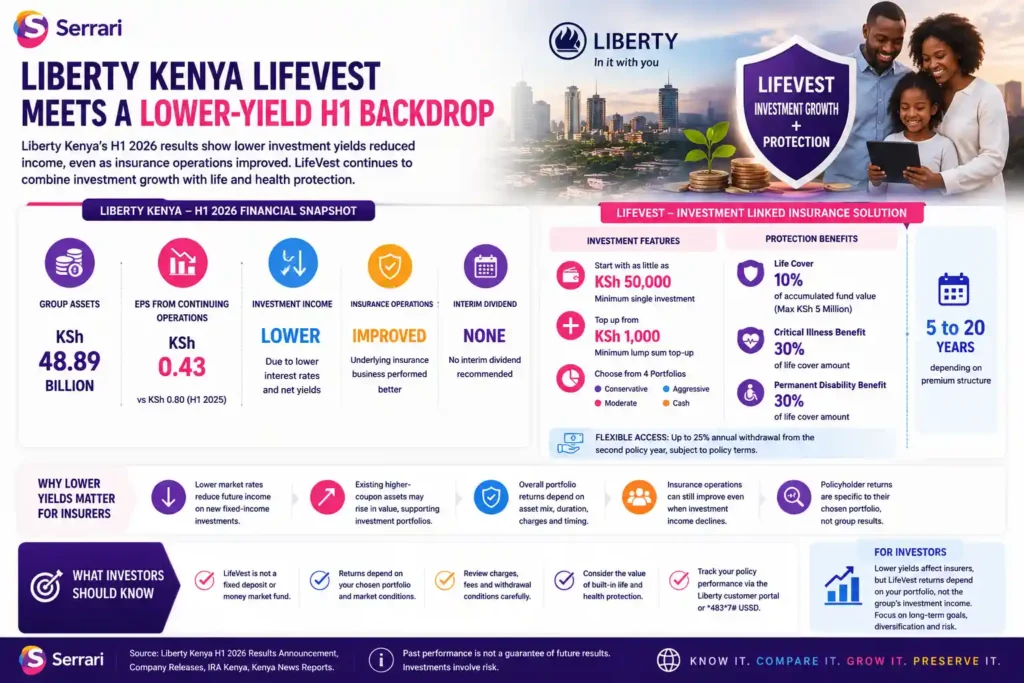
LifeVest combines an investment fund with life, critical illness and disability benefits. The graphic shows a KSh50,000 starting investment, KSh1,000 top-ups, 10% life cover capped at KSh5 million, 30% critical illness and disability benefits and up to 25% annual withdrawals, alongside Liberty Kenya’s lower-yield H1 backdrop.
What Investors Should Check
Before comparing LifeVest with an MMF, Treasury bond or fixed deposit, investors should check:
- The selected LifeVest portfolio;
- Its underlying asset mix;
- Investment and policy charges;
- Performance after charges;
- Withdrawal conditions; and
- The value of the embedded protection.
Liberty allows customers to monitor their investment performance through its customer portal and USSD service. That policy-level performance is more useful than trying to infer customer returns from group financial statements.
Conclusion
Liberty Kenya’s H1 results show that lower rates can reduce an insurer’s investment income even when insurance operations improve.
For LifeVest customers, the conclusion must be narrower: Liberty has not announced that customer returns declined.
LifeVest performance depends on the selected portfolio, underlying assets, market conditions and charges. The product then adds protection benefits that a plain MMF, bond or fixed deposit does not provide.
The better comparison is whether return, liquidity, risk, charges and insurance protection fit the investor’s objective.
FAQs
1. Did Liberty say LifeVest returns fell?
No. The H1 statement discussed lower group investment income caused by lower net yields. That does not automatically translate into individual LifeVest returns.
2. How is LifeVest invested?
Liberty says customers can choose conservative, moderate, aggressive and cash portfolios, so the selected portfolio influences both risk and performance.
3. What protection does LifeVest provide?
It includes life cover based on accumulated fund value plus critical illness and permanent total disability benefits, subject to policy terms.
4. Is LifeVest better than an MMF or fixed deposit?
Not automatically. MMFs and fixed deposits focus mainly on investing or cash management, while LifeVest combines investment accumulation with insurance protection and a longer-term policy structure.
Sources: Liberty Kenya H1 2026 financial release; Liberty Life — LifeVest product information; Liberty Kenya Investor Relations; The Standard — LifeVest enhancement coverage; Insurance Regulatory Authority.
Your financial future isn’t something you wait for—it’s something you build.
The real question is: when do you begin?
Move beyond simply staying informed.
Navigate the markets with clarity—track trends through the Serrari Group Market Index, uncover opportunities in the Serrari Marketplace, and build practical knowledge with our Curated Wealth Builder Platform.
Stay connected to what truly matters.
Get daily insights on macro trends and financial movements across Kenya, Africa, and global markets—delivered through the Serrari Newsletter.
Growth opens doors.
Advance your career through professional programs including ACCA, HESI A2, ATI TEAS 7 , HESI EXIT , NCLEX – RN and NCLEX – PN, Financial Literacy!🌟—designed to move you forward with confidence.
See where money is flowing—clearly and in real time.
Track Money Market Funds, Treasury Bills, Treasury Bonds, Green Bonds, and Fixed Deposits, alongside global and African indexes, key economic indicators, and the evolving Crypto and stablecoin landscape—all within Serrari’s Market Index.