New Kenya crypto regulations are forcing digital-asset businesses to reassess whether they have enough capital to remain in the local market. Under the new framework, stablecoin issuers face a minimum paid-up capital requirement of KSh 300 million, wallet providers need KSh 150 million and virtual asset exchanges require KSh 100 million. With a November 4 compliance deadline approaching, the rules could create a significant barrier for smaller startups while strengthening oversight of virtual asset service providers (VASPs) and consumer protection.
Key Overview
Kenya’s transition toward formal cryptocurrency regulation represents an important shift for one of Africa’s more active digital-asset markets. The framework introduces licensing, capital and compliance requirements for businesses ranging from stablecoin issuers to exchanges, asset managers and payment processors.
While regulation could improve market credibility and financial transparency, the size of the capital requirements creates a challenge for early-stage companies. Some startups may need to raise significant funding, restructure their operations or reconsider where they establish their businesses.
Kenya Crypto Regulations Set High Capital Requirements
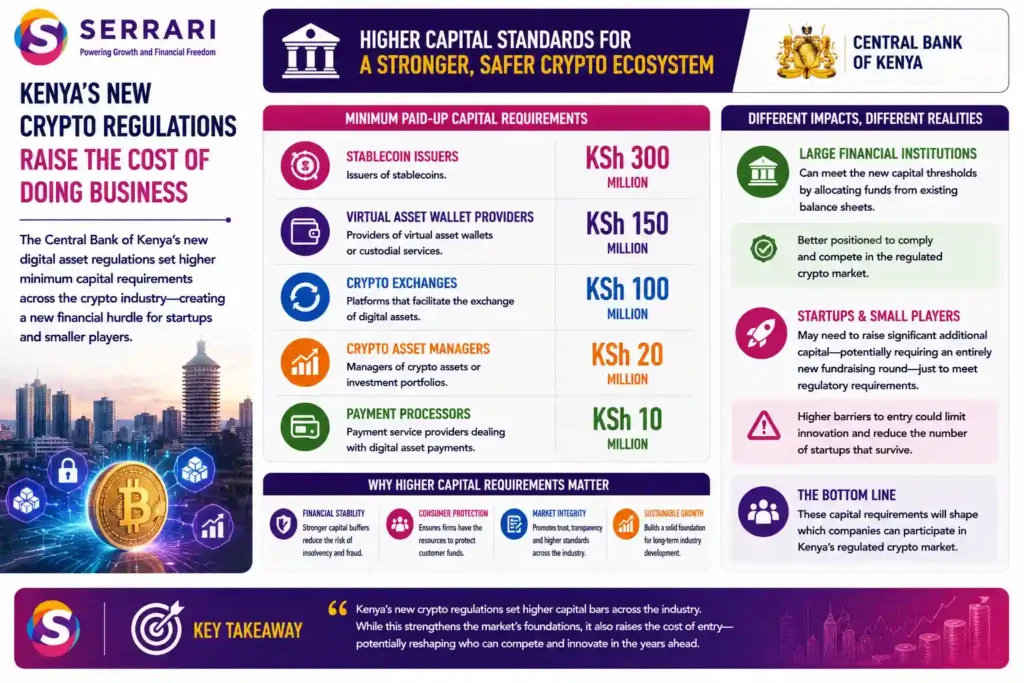
The new Kenya crypto regulations establish minimum paid-up capital thresholds depending on the type of digital-asset activity undertaken.
Stablecoin issuers face the highest requirement at KSh 300 million. Virtual asset wallet providers must maintain at least KSh 150 million, while crypto exchanges require KSh 100 million.
Crypto asset managers face a KSh 20 million threshold, while payment processors require KSh 10 million.
These requirements create very different implications depending on the size and maturity of a company.
A large financial institution may be able to allocate the required capital from an existing balance sheet. A startup operating with seed funding, however, may need to conduct an entirely new fundraising round simply to satisfy regulatory requirements.
That distinction could determine which companies can participate in Kenya’s regulated crypto market.
November 4 Deadline Puts Startups Under Pressure
The November 4 compliance deadline adds urgency to the situation.
Raising institutional capital is rarely immediate. Startups typically have to identify potential investors, negotiate valuations, complete due diligence, prepare legal documentation and finalise the transfer of funds.
Any delay in that process could make meeting the deadline more difficult.
For an exchange needing KSh 100 million or a wallet provider requiring KSh 150 million, the challenge is therefore not simply whether the capital can eventually be raised. The company must secure sufficient financing within the regulatory timetable while simultaneously meeting other licensing requirements.
This explains concerns that the deadline could effectively become an expiry date for some smaller operators.
Companies unable to satisfy the requirements could potentially leave the market, consolidate with larger businesses or explore jurisdictions where the financial requirements for operating are lower.
Context is everything. Stay ahead of shifting trends with today’s market updates, and uncover emerging opportunities using the Serrari Group Market Index and Marketplace. Then, take control of your own financial future by exploring our Money & Life Reset Transformation Blueprint ™ to build stronger habits, create better systems, and design a path toward lasting wealth.
Stablecoin Issuers Face Toughest Requirements
Stablecoin businesses face particularly demanding requirements under the framework.
Issuers must obtain approval from the Central Bank of Kenya before commencing operations and maintain at least KSh 300 million in paid-up capital.
They must also fully back their stablecoins with reserve assets equal to or exceeding the value of outstanding tokens.
Reserve requirements are important because stablecoins are designed to maintain a relatively stable value, often by linking their price to conventional currencies such as the U.S. dollar.
Ensuring that sufficient reserve assets exist can reduce the risk that an issuer is unable to honour redemptions during periods of heavy withdrawals.
However, combining reserve requirements with substantial minimum capital creates a high financial threshold for potential entrants.
That could favour established institutions and heavily funded fintech companies over smaller startups seeking to experiment with new stablecoin products.
Regulation Could Strengthen Crypto Compliance
The capital requirements represent only one side of Kenya’s regulatory transition.
Formal regulation could also provide greater certainty for businesses and consumers participating in the crypto market.
Clear rules around licensing, reserves, governance and financial reporting can help distinguish regulated businesses from operators functioning without adequate oversight.
This could become particularly important as cryptocurrency increasingly intersects with conventional banking, payments and cross-border transactions.
Formal crypto compliance requirements can also strengthen anti-money laundering controls and improve regulators’ ability to monitor potentially suspicious financial activity.
For institutional investors and traditional financial companies, regulatory clarity may make partnerships with digital-asset companies easier because the legal responsibilities of different participants become clearer.
The trade-off is that compliance comes with costs that may disproportionately affect smaller businesses.
Kenya Faces Innovation Versus Regulation Challenge
Kenya is not alone in trying to determine how aggressively digital assets should be regulated.
African jurisdictions have adopted significantly different approaches to cryptocurrency. Some have moved toward comprehensive regulatory frameworks, while others have relied on restrictions, regulatory sandboxes or less developed rules.
South Africa and Mauritius have already established formal digital-asset frameworks.
A 2025 report associated with Yellow Card’s African regulatory work highlighted these differences while emphasising the need to balance consumer protection and financial transparency with technological innovation.
Kenya faces the same challenge.
Weak regulation could expose consumers and the wider financial system to fraud, poor governance and financial crime. Excessively expensive regulation, however, could discourage legitimate startups from operating domestically.
The critical question is therefore not whether cryptocurrency should be regulated, but whether the requirements are proportionate to the risks posed by different types and sizes of businesses.
Could Crypto Companies Move Outside Kenya?
One potential consequence is regulatory migration.
Digital-asset companies can often structure operations across multiple jurisdictions because much of their technology and customer infrastructure is digital.
If entrepreneurs determine that Kenya’s capital requirements are too expensive relative to other markets, some could establish businesses elsewhere while continuing to serve eligible customers internationally.
That would undermine part of the objective of bringing the sector into a clearly supervised domestic framework.
However, relocating is not necessarily an easy escape from regulation. A company serving Kenyan customers may still face local legal obligations depending on how the framework defines regulated activities and jurisdiction.
Other markets are also strengthening oversight of digital assets, meaning moving abroad does not automatically eliminate compliance costs.
Kenya’s Large Crypto Market Raises the Stakes
The regulatory debate matters because Kenya already has substantial participation in digital assets.
Chainalysis figures cited in reports have placed Kenya 21st globally and fourth in Africa for cryptocurrency adoption.
Crypto has attracted users for several reasons, including investment, trading, remittances and cross-border payments.
Kenya’s established fintech ecosystem and widespread adoption of digital financial services also provide fertile ground for further blockchain-based innovation.
Regulation could potentially strengthen that ecosystem by giving legitimate operators clearer rules.
But if compliance costs substantially exceed those in competing jurisdictions, Kenya risks creating a market dominated by larger companies with the financial resources to satisfy licensing requirements.
What Kenya’s Crypto Rules Mean for the Market
The new Kenya crypto regulations represent a transition from regulatory uncertainty toward formal supervision of the country’s digital-asset industry.
For consumers and regulators, stricter licensing, reserve and capital requirements could improve accountability and strengthen protection against poorly capitalised operators.
For startups, the consequences are more complicated.
The KSh 300 million requirement for stablecoin issuers and KSh 100 million threshold for exchanges could fundamentally alter the economics of entering Kenya’s regulated crypto industry.
The November 4 deadline makes that calculation even more immediate.
Kenya’s challenge will be ensuring that stronger oversight creates a safer and more credible digital-asset market without unintentionally pushing viable fintech innovation toward other jurisdictions.
FAQs
What are the new Kenya crypto regulations?
The framework introduces licensing, capital and compliance requirements for businesses providing regulated virtual-asset services in Kenya.
How much capital do crypto exchanges need in Kenya?
Virtual asset exchanges face a minimum paid-up capital requirement of KSh 100 million, while wallet providers require KSh 150 million.
How much capital do stablecoin issuers need?
Stablecoin issuers must maintain at least KSh 300 million in paid-up capital and meet additional requirements concerning reserves and regulatory approval.
Why are the regulations challenging for startups?
Early-stage companies may have to raise substantial new capital within a limited period to satisfy licensing requirements, potentially making market entry or continued operation more difficult.
Your financial future isn’t something you wait for—it’s something you build.
The real question is: when do you begin?
Move beyond simply staying informed.
Navigate the markets with clarity—track trends through the Serrari Group Market Index, uncover opportunities in the Serrari Marketplace, and build practical knowledge with our Curated Wealth Builder Platform.
Stay connected to what truly matters.
Get daily insights on macro trends and financial movements across Kenya, Africa, and global markets—delivered through the Serrari Newsletter.
Growth opens doors.
Advance your career through professional programs including ACCA, HESI A2, ATI TEAS 7 , HESI EXIT , NCLEX – RN and NCLEX – PN, Financial Literacy!🌟—designed to move you forward with confidence.
See where money is flowing—clearly and in real time.
Track Money Market Funds, Treasury Bills, Treasury Bonds, Green Bonds, and Fixed Deposits, alongside global and African indexes, key economic indicators, and the evolving Crypto and stablecoin landscape—all within Serrari’s Market Index.