The AFC digital bond has raised CHF 350 million through a five-year issuance in Switzerland, marking a major step in the adoption of tokenized debt by African institutions. Africa Finance Corporation (AFC) said it is the first African institution to issue a digital bond listed, traded and settled on a regulated digital exchange. The transaction, carrying a 1.4925% coupon, is also the largest digital bond issued in the Swiss franc market. Strong participation from institutional investors, particularly Swiss banks and asset managers, highlights growing acceptance of blockchain-based securities within established capital markets.
Key Overview
Africa Finance Corporation raised CHF 350 million through a five-year digital bond carrying a 1.4925% coupon.
The issuance represents AFC’s fourth and largest transaction in the Swiss franc market and follows its CHF 150 million green bond issued in 2020.
The bond is structured as a tokenized security using Distributed Ledger Technology and is listed on the SIX Swiss Exchange, with its digital infrastructure linked to SIX Digital Exchange.
Swiss domestic investors accounted for 90% of demand, demonstrating strong local institutional participation.
The transaction further expands the role of digital securities in conventional fixed-income markets while strengthening AFC’s access to international capital.
AFC Digital Bond Raises CHF 350 Million
Africa Finance Corporation has completed a landmark CHF 350 million bond issuance, strengthening both its position in international debt markets and its adoption of digital financial infrastructure.
The five-year AFC digital bond carries a coupon of 1.4925%, with pricing aligned with the Corporation’s US$500 million benchmark issuance completed in June 2026.
AFC said the transaction was completed against a backdrop of geopolitical uncertainty but benefited from constructive investor sentiment and confidence in the institution’s credit profile.
The Corporation currently holds two investment-grade ratings. S&P rates AFC at “A” with a positive outlook, while Moody’s assigns it an A3 rating with a stable outlook.
Those ratings are particularly important for institutional fixed-income investors because they provide an independent assessment of AFC’s creditworthiness and ability to meet its debt obligations.
Digital Bond Sets New Swiss Franc Market Record
The transaction represents an important milestone for the Swiss bond market.
According to AFC, the CHF 350 million transaction is the largest digital bond ever issued in Swiss francs. It also makes AFC the first African institution to issue a digital bond that is listed, traded and settled through regulated digital market infrastructure.
That distinction matters because digital bonds differ from conventional cryptocurrency assets.
The AFC security remains a bond with defined maturity, coupon and repayment obligations. The innovation is primarily in the infrastructure used to issue, record and manage ownership of the security.
The transaction therefore demonstrates how blockchain and distributed ledger infrastructure can be incorporated into conventional regulated capital markets without necessarily changing the underlying economic characteristics of a bond.
How AFC’s Tokenized Bond Works
The digital bond was issued under AFC’s US$5 billion Global Medium Term Note Programme.
It is structured as a tokenized security on a Distributed Ledger Technology platform, meaning ownership can be represented and recorded digitally through regulated infrastructure.
The bond is listed on the SIX Swiss Exchange and deposited with SIX Digital Exchange, with SIX SIS AG involved in the market infrastructure.
This approach to tokenization potentially allows traditional financial securities to benefit from digital recordkeeping and more integrated settlement processes while remaining within established regulatory structures.
Importantly, calling the bond “digital” does not mean investors are buying a cryptocurrency. It remains a debt security issued by AFC, with the Corporation responsible for paying interest and repaying principal according to the bond’s terms.
The distinction is increasingly important as financial institutions explore ways of applying blockchain technology to conventional assets such as government bonds, corporate debt and investment funds.
Context is everything. Stay ahead of shifting trends with today’s market updates, and uncover emerging opportunities using the Serrari Group Market Index and Marketplace. Then, take control of your own financial future by exploring our Money & Life Reset Transformation Blueprint ™ to build stronger habits, create better systems, and design a path toward lasting wealth.
Swiss Investors Dominate AFC Digital Bond Demand
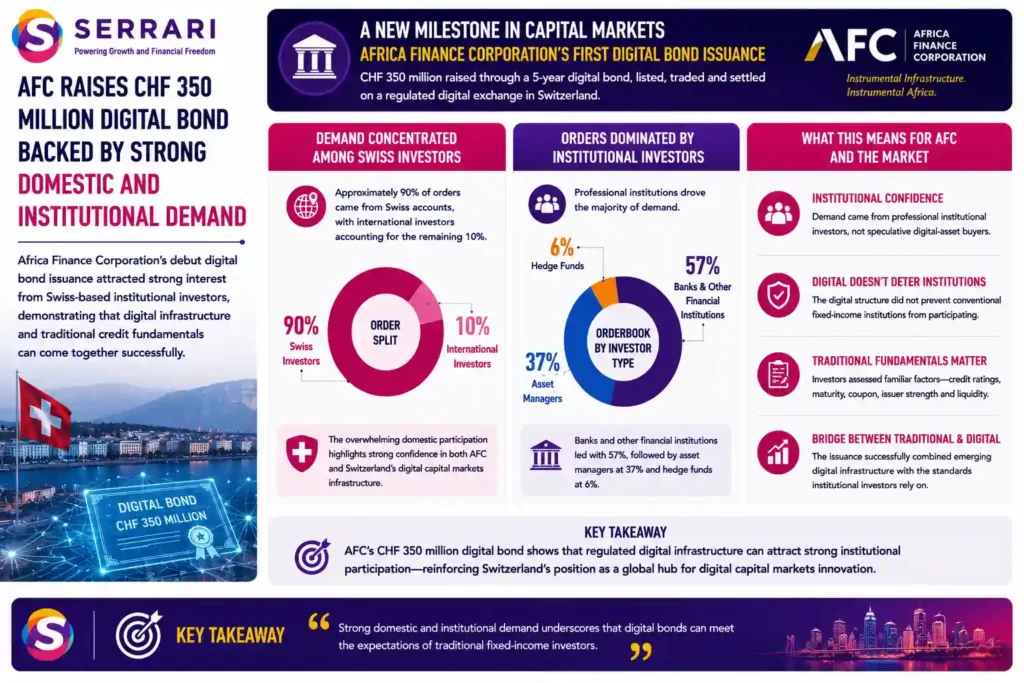
Demand for the issuance was heavily concentrated among domestic Swiss investors.
Approximately 90% of orders came from Swiss accounts, while international investors accounted for the remaining 10%.
Banks and other financial institutions represented 57% of the orderbook, making them the largest investor category. Asset managers accounted for another 37%, while hedge funds represented 6%.
The allocation indicates that demand came primarily from professional institutional investors rather than speculative digital-asset buyers.
For AFC, this is significant because it suggests that the digital structure did not prevent conventional fixed-income institutions from participating.
Instead, the issuance combined emerging digital infrastructure with the traditional characteristics institutional investors normally assess, including credit ratings, maturity, coupon, issuer fundamentals and liquidity.
AFC Strengthens Its Swiss Capital Markets Presence
The transaction is AFC’s fourth and largest Swiss franc-denominated issuance.
Its history in the market includes a CHF 150 million green bond issued in 2020, which was also AFC’s inaugural green bond.
The latest transaction substantially increases the size of its individual Swiss franc fundraising while introducing digital infrastructure into the Corporation’s financing strategy.
Access to different international capital markets can help development finance institutions diversify funding sources and reduce dependence on any single investor base or currency.
AFC can subsequently deploy capital raised through international markets toward its broader infrastructure mandate across Africa.
Established in 2007, the Corporation has 48 member countries and has invested approximately US$18.5 billion across the continent. Its activities span power, transport, telecommunications, natural resources and heavy industry.
Switzerland Emerges as a Digital Bond Hub
AFC’s decision to issue the bond in Switzerland comes as the country develops one of the world’s more established regulated markets for tokenized securities.
Switzerland’s legal framework allows digital representations of securities to operate within its broader financial system, helping create an environment where regulated institutions can experiment with distributed ledger infrastructure.
SIX Digital Exchange has played a significant role in that development since its first digital bond transaction in 2021.
The platform has since facilitated a growing number of digital debt transactions from different types of issuers.
One prominent example came from the World Bank in May 2024, when it priced a CHF 200 million seven-year digital bond. That transaction also attracted attention because settlement involved wholesale central bank digital currency provided by the Swiss National Bank as part of Project Helvetia.
AFC’s CHF 350 million transaction exceeds the size of that World Bank issuance, demonstrating how quickly the market for regulated tokenized debt has progressed.
Digital Bonds Move Further Into Mainstream Finance
Digital bonds are part of a broader effort to bring traditional financial assets onto blockchain and distributed ledger infrastructure.
Instead of limiting blockchain applications to cryptocurrencies, financial institutions are increasingly experimenting with conventional securities represented digitally.
Potential applications include corporate bonds, sovereign debt, money market funds, private credit and other financial instruments.
Tokenization proponents argue that the technology could eventually make issuance, ownership records and settlement more efficient while creating financial infrastructure capable of operating across traditional and digital markets.
However, the technology itself does not eliminate conventional investment risks.
Investors in a tokenized bond remain exposed to the issuer’s creditworthiness, interest-rate movements, liquidity conditions and broader market risks. The use of distributed ledger infrastructure changes how the security is represented and processed, not the fundamental obligation behind it.
Tokenized Assets Continue Rapid Expansion
AFC’s transaction comes as the wider market for tokenized real-world assets expands.
Industry estimates placed tokenized assets above US$24 billion by February 2026 following substantial growth during 2025.
Although this remains small relative to traditional financial markets, the potential addressable market is enormous. Global fixed-income securities alone represent a market estimated at roughly US$141 trillion.
Even limited migration of conventional bonds onto digital infrastructure could therefore create a substantial market for tokenized securities.
Large regulated transactions such as the AFC digital bond are particularly significant because they test whether blockchain infrastructure can accommodate institutional-scale issuance rather than smaller experimental transactions.
What the AFC Digital Bond Means for African Capital Markets
The transaction carries additional significance because AFC is an African multilateral development finance institution.
African financial markets have traditionally relied heavily on conventional banking systems, domestic bond markets and international debt issuance for financing.
AFC’s transaction demonstrates that African institutions can also participate in the emerging market for regulated digital securities.
It does not mean that Africa’s bond markets are suddenly moving onto blockchain infrastructure. Digital bond issuance remains a relatively small segment of global fixed income.
Nevertheless, AFC has established a precedent that other African sovereign, corporate or development-finance issuers could eventually examine as digital market infrastructure matures.
The transaction also illustrates how financial innovation can be introduced without abandoning established regulatory frameworks.
AFC Expands Digital Financing Strategy
The CHF 350 million issuance combines several important developments: AFC’s continued expansion in international capital markets, Switzerland’s growing digital securities infrastructure and increasing institutional interest in tokenized assets.
Strong Swiss demand is particularly noteworthy. With 90% of orders coming from domestic investors and banks and asset managers representing most of the book, the transaction shows that digital bonds are increasingly capable of attracting conventional fixed-income capital.
For Africa Finance Corporation, the deal also strengthens a funding relationship with the Swiss market that dates back several years.
As digital bonds become more integrated with conventional financial infrastructure, the AFC transaction could serve as an important benchmark for other international and African issuers considering tokenized debt.
FAQs
How much did AFC raise through its digital bond?
Africa Finance Corporation raised CHF 350 million through the five-year digital bond, which carries a coupon of 1.4925%.
Why is the AFC digital bond significant?
AFC says it is the first African institution to issue a digital bond listed, traded and settled through a regulated digital exchange and that the transaction is the largest Swiss franc digital bond issued to date.
Where is the AFC digital bond listed?
The bond is listed on the SIX Swiss Exchange and uses regulated digital market infrastructure associated with SIX Digital Exchange.
Who invested in the AFC bond?
Swiss domestic investors accounted for approximately 90% of orders. Banks and financial institutions represented 57% of the orderbook, asset managers 37% and hedge funds 6%.
Sources: Financial Nigeria, Africa Finance Corporation, SMB Tech, Business Day Nigeria, Trading View
Your financial future isn’t something you wait for—it’s something you build.
The real question is: when do you begin?
Move beyond simply staying informed.
Navigate the markets with clarity—track trends through the Serrari Group Market Index, uncover opportunities in the Serrari Marketplace, and build practical knowledge with our Curated Wealth Builder Platform.
Stay connected to what truly matters.
Get daily insights on macro trends and financial movements across Kenya, Africa, and global markets—delivered through the Serrari Newsletter.
Growth opens doors.
Advance your career through professional programs including ACCA, HESI A2, ATI TEAS 7 , HESI EXIT , NCLEX – RN and NCLEX – PN, Financial Literacy!🌟—designed to move you forward with confidence.
See where money is flowing—clearly and in real time.
Track Money Market Funds, Treasury Bills, Treasury Bonds, Green Bonds, and Fixed Deposits, alongside global and African indexes, key economic indicators, and the evolving Crypto and stablecoin landscape—all within Serrari’s Market Index.