The on-chain money market fund market has received a significant regulatory boost after the U.S. Securities and Exchange Commission issued Franklin Templeton a no-action letter covering certain custody arrangements involving its blockchain-based government money market fund. The August 12, 2026 letter means SEC staff will not recommend enforcement action if specified Franklin Templeton registered funds hold shares of the Franklin OnChain U.S. Government Money Fund under the conditions described. The decision could make it easier for traditional investment funds to incorporate tokenization into cash management while remaining within existing U.S. securities regulations.
Key Overview
Franklin Templeton’s OnChain Fund, ticker FOBXX and commonly associated with the BENJI designation, is a registered government money market fund whose ownership records incorporate public blockchain infrastructure.
The fund invests at least 99.5% of its assets in U.S. government securities, cash and fully collateralized repurchase agreements while seeking to maintain a stable $1 net asset value.
The SEC’s relief addresses specific custody requirements under the Investment Company Act of 1940. Importantly, a no-action letter does not rewrite securities law or provide unrestricted approval for tokenized funds. It applies to the particular circumstances and conditions outlined in Franklin Templeton’s request.
SEC Issues Franklin Templeton No-Action Letter
The Securities and Exchange Commission (SEC) Division of Investment Management issued the no-action letter on August 12, addressing how Franklin Templeton’s registered investment funds can hold shares of its blockchain-based money market fund.
The relief covers certain U.S. open-end and closed-end registered funds seeking to use the Franklin OnChain U.S. Government Money Fund for cash-management purposes.
At issue were custody arrangements under Section 17(f) and Rule 17f-2 of the Investment Company Act of 1940.
SEC staff said they would not recommend enforcement action if the relevant Franklin Templeton funds hold shares of the OnChain Fund without complying with certain provisions of Rule 17f-2, provided the arrangements operate according to the representations and conditions submitted to the regulator.
That distinction matters. The SEC has not broadly exempted blockchain-based investment products from custody regulation. Instead, the letter provides specific regulatory assurance for the structure presented by Franklin Templeton.
What Is a No-Action Letter?
A no-action letter is a response from SEC staff indicating that they do not intend to recommend enforcement action concerning a particular activity conducted under specified circumstances.
It is therefore different from changing a regulation or passing a new law.
The relief generally depends on the applicant following the facts, procedures and safeguards described in its request. Materially different arrangements cannot automatically assume that the same regulatory treatment applies.
For financial regulation, however, these letters can be influential because they demonstrate how existing securities rules may be applied to emerging financial technologies.
For Franklin Templeton, the letter provides greater certainty around how its registered funds can hold shares in an on-chain investment product without creating particular custody-rule problems.
How the On-Chain Money Market Fund Works
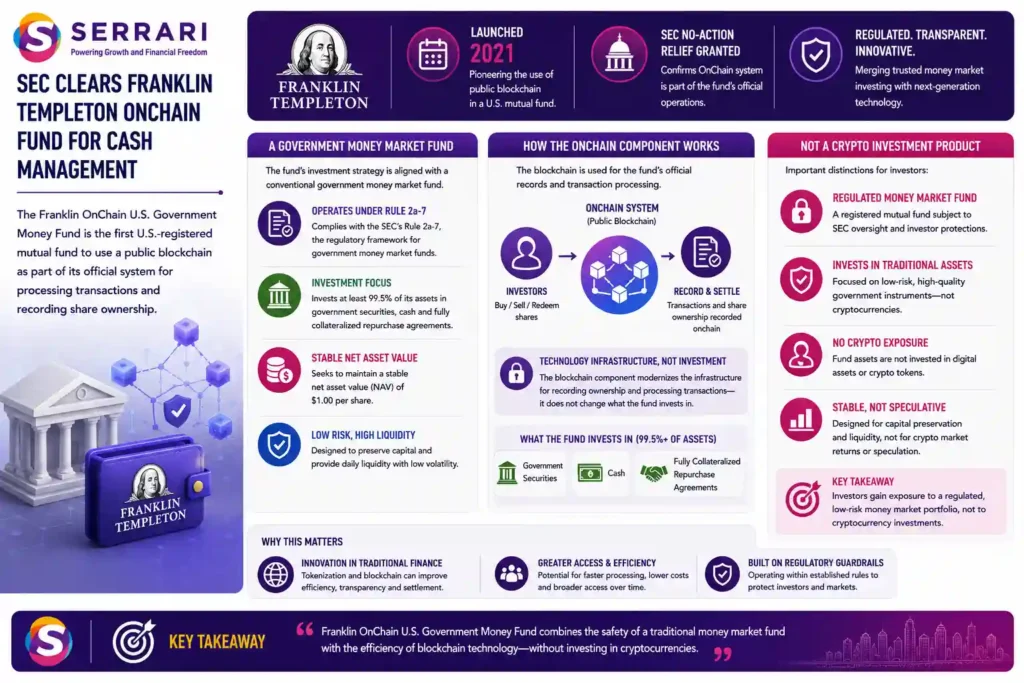
The Franklin OnChain U.S. Government Money Fund was launched in 2021 and became the first U.S.-registered mutual fund to use a public blockchain as part of its official system for processing transactions and recording share ownership.
Its underlying investment strategy remains much closer to a conventional government money market fund than to a cryptocurrency investment product.
The fund operates under Rule 2a-7 and invests at least 99.5% of its assets in government securities, cash and fully collateralized repurchase agreements.
It seeks to maintain a stable net asset value of $1 per share.
The blockchain component primarily changes the technological infrastructure through which ownership and transactions can be recorded. Investors are therefore gaining exposure to a regulated money market portfolio rather than directly investing the fund’s assets in cryptocurrencies.
That distinction is important when assessing the risks and significance of tokenized investment products.
Context is everything. Stay ahead of shifting trends with today’s market updates, and uncover emerging opportunities using the Serrari Group Market Index and Marketplace. Then, take control of your own financial future by exploring our Money & Life Reset Transformation Blueprint ™ to build stronger habits, create better systems, and design a path toward lasting wealth.
Blockchain Meets Traditional Asset Management
Franklin Templeton’s model illustrates how blockchain technology is increasingly being integrated into conventional financial products rather than operating exclusively through cryptocurrencies.
Tokenization can represent ownership interests in traditional assets or investment funds using blockchain-based infrastructure.
Potential advantages include improved recordkeeping, greater automation and the ability to integrate investment products with emerging digital financial infrastructure.
Money market funds are particularly significant in this transition because they are widely used by institutional and retail investors for liquidity and short-term cash management.
An on-chain version could eventually become useful as a blockchain-compatible cash-management instrument within tokenized financial markets.
However, technological efficiency does not eliminate conventional investment, operational, cybersecurity or regulatory risks.
Government Securities Remain at the Core
Despite its blockchain infrastructure, the OnChain Fund remains fundamentally connected to traditional U.S. financial markets.
At least 99.5% of the portfolio is allocated to U.S. government securities, cash and fully collateralized repurchase agreements.
This structure separates the fund from digital assets whose values depend primarily on cryptocurrency market conditions.
The fund’s objective of maintaining a $1 net asset value also places it within the familiar structure of government money market funds.
This combination is one reason tokenized money market funds have emerged as an important bridge between traditional finance and digital markets. Blockchain can change how ownership is represented without necessarily changing the underlying investment portfolio.
Custody Rules Have Been a Key Regulatory Issue
Custody has remained one of the more difficult questions surrounding the integration of digital assets with registered investment funds.
Traditional securities regulation was developed around established custodians, financial intermediaries and conventional ownership records. Blockchain networks introduce different mechanisms for recording and transferring ownership.
This can create uncertainty over how existing custody rules apply.
The Franklin Templeton letter is consequently significant because it addresses a practical regulatory obstacle rather than merely acknowledging blockchain technology.
Greater clarity could make regulated financial institutions more comfortable experimenting with tokenized investment structures.
It does not, however, establish blanket permission for every registered mutual fund or ETF to hold any blockchain-based asset. Other firms and structures may still need to establish how their arrangements comply with applicable securities laws.
Tokenized Funds Gain Momentum
Franklin Templeton has become one of the major traditional asset managers pursuing tokenized financial products.
The OnChain Fund had approximately $727 million in assets by mid-August 2026, demonstrating that blockchain-based fund structures have progressed beyond small experimental projects.
Franklin Templeton’s broader presence in tokenized investments also illustrates increasing competition among major asset managers seeking to develop infrastructure connecting conventional securities with blockchain networks.
For institutional investors, regulatory clarity could be particularly important. Large financial institutions generally require clearly defined custody, compliance and operational frameworks before incorporating new asset structures into portfolios.
No-action relief can therefore reduce one source of regulatory uncertainty, even though broader questions surrounding tokenized securities remain.
What the SEC Decision Means for Tokenization
The SEC’s action could have implications beyond Franklin Templeton.
If traditional investment funds can hold blockchain-recorded shares while satisfying regulatory expectations, tokenized money market funds could become increasingly useful for institutional cash management and blockchain-based financial transactions.
The development also demonstrates that tokenization does not necessarily require abandoning established securities frameworks.
Instead, financial institutions may increasingly adapt blockchain technology to existing regulated products.
That could prove more significant for mainstream adoption than creating entirely separate crypto-native financial systems because institutional investors can potentially access blockchain efficiencies while maintaining exposure to familiar underlying assets.
Outlook for On-Chain Money Market Funds
The SEC’s no-action letter represents another step in the gradual integration of blockchain infrastructure with conventional asset management.
Franklin Templeton’s on-chain money market fund combines a traditional government securities portfolio with blockchain-based ownership records, creating a practical example of tokenization operating within the registered U.S. fund industry.
The regulatory relief does not amount to blanket SEC approval of tokenized securities, nor does it eliminate custody requirements across the industry. Its significance is narrower but still important: it demonstrates one pathway through which registered investment funds can use blockchain-based fund shares under existing securities rules.
If similar structures continue gaining regulatory acceptance, tokenized money market funds could become an increasingly important link between traditional capital markets and emerging on-chain financial infrastructure.
FAQs
What is Franklin Templeton’s on-chain money market fund?
The Franklin OnChain U.S. Government Money Fund, ticker FOBXX, is a registered government money market fund that uses public blockchain technology as part of its system for recording and processing share ownership.
What did the SEC’s no-action letter allow?
SEC staff indicated they would not recommend enforcement action concerning specified custody arrangements when eligible Franklin Templeton registered funds hold shares of the OnChain Fund, subject to stated conditions.
Does the SEC letter change U.S. securities law?
No. A no-action letter does not change securities law or create a blanket exemption. It provides enforcement assurance based on the particular circumstances described in the request.
What does the OnChain Fund invest in?
The fund invests at least 99.5% of its assets in U.S. government securities, cash and fully collateralized repurchase agreements while seeking to maintain a stable $1 net asset value.
Sources: Crypto Rank, Crowdfund Insider, Bloomingbit, Ledger Insights, The Block
Your financial future isn’t something you wait for—it’s something you build.
The real question is: when do you begin?
Move beyond simply staying informed.
Navigate the markets with clarity—track trends through the Serrari Group Market Index, uncover opportunities in the Serrari Marketplace, and build practical knowledge with our Curated Wealth Builder Platform.
Stay connected to what truly matters.
Get daily insights on macro trends and financial movements across Kenya, Africa, and global markets—delivered through the Serrari Newsletter.
Growth opens doors.
Advance your career through professional programs including ACCA, HESI A2, ATI TEAS 7 , HESI EXIT , NCLEX – RN and NCLEX – PN, Financial Literacy!🌟—designed to move you forward with confidence.
See where money is flowing—clearly and in real time.
Track Money Market Funds, Treasury Bills, Treasury Bonds, Green Bonds, and Fixed Deposits, alongside global and African indexes, key economic indicators, and the evolving Crypto and stablecoin landscape—all within Serrari’s Market Index.