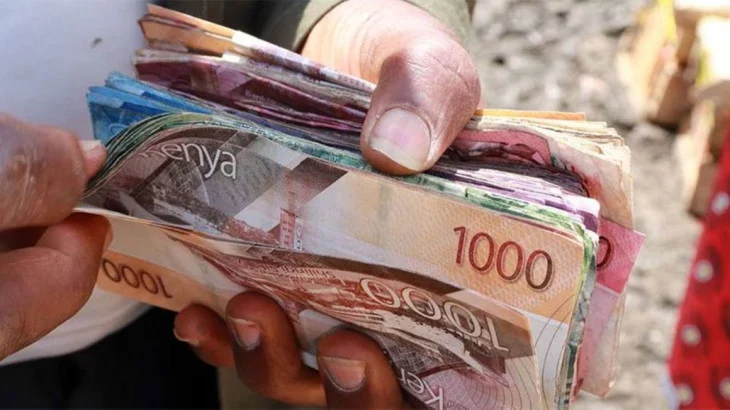
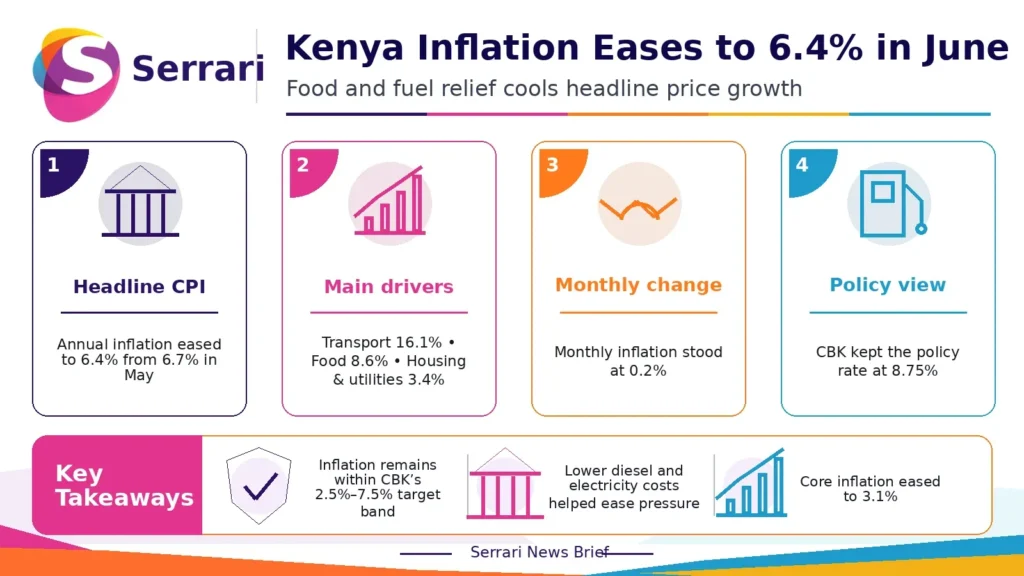
Kenya’s annual inflation eased to 6.4% in June 2026 from 6.7% in May, marking the first decline after two months of sharp increases driven by fuel, food and transport costs.
The reading kept inflation within the Central Bank of Kenya’s 2.5% to 7.5% target range, but still above the preferred midpoint of 5.0%. The slowdown offers some relief to households and policymakers, although transport and food prices remain elevated compared with last year.
Key Overview
The Kenya National Bureau of Statistics said annual inflation stood at 6.4% in June 2026, down from 6.7% in May. The agency said the main upward drivers were Food and Non-Alcoholic Beverages at 8.6%, Transport at 16.1%, and Housing, Water, Electricity, Gas and Other Fuels at 3.4%.
The June figure followed a steep May increase, when inflation rose to 6.7% from 5.6% in April, its highest level in more than two years. In monthly terms, June inflation was modest at 0.2%, with the Consumer Price Index rising to 154.91 from 154.56 in May.
Food and Transport Still Shape the Inflation Picture
Even though headline inflation eased, the largest pressure points remained in essential household categories. Food and Non-Alcoholic Beverages inflation stood at 8.6%, with mixed movements across common food items. Kale, spinach and maize grain rose during the month, while tomatoes, green grams and beans declined.
Transport remained the strongest year-on-year driver at 16.1%, reflecting the delayed impact of earlier fuel price increases. Reuters reported that Kenya’s April and May inflation surge was largely linked to fuel price hikes after higher global energy costs fed into domestic pump prices.
However, June brought some relief. The Energy and Petroleum Regulatory Authority cut diesel prices by KSh10 per litre for the June-July pricing cycle, while petrol was reduced slightly and kerosene was left unchanged, according to the latest fuel review. That helped reduce some pressure on transport and logistics costs.
Context is everything. Stay ahead of shifting trends with today’s market updates, and uncover emerging opportunities using the Serrari Group Market Index and Marketplace. Then, take control of your own financial future by exploring our Money & Life Reset Transformation Blueprint ™ to build stronger habits, create better systems, and design a path toward lasting wealth.
CBK Holds Rates as Inflation Remains Within Target
The Central Bank of Kenya kept the Central Bank Rate at 8.75% in June, saying the current policy stance remained appropriate as inflation expectations stayed anchored within the target band.
The decision reflected caution rather than comfort. Inflation had moved close to the upper end of the government’s preferred range in May, and the CBK said it would continue watching global oil prices and possible second-round effects on inflation. The bank also lowered its 2026 growth forecast to 4.9% from 5.3%, showing that policymakers are balancing price risks against weaker economic momentum.
With inflation easing in June, the pressure for immediate tightening has reduced. Still, the central bank may be reluctant to resume rate cuts until it is clear that transport and food pressures are continuing to cool.
Core Inflation Signals Softer Underlying Pressure
Underlying inflation trends were more encouraging. Core inflation, which excludes volatile food and energy prices, eased to 3.1% in June from 3.2% in May, while non-core inflation slowed to 15.1% from 16.0%, according to market analysis of the June CPI data.
That suggests the sharpest inflation pressure remains concentrated in volatile items such as fuel, transport and food rather than broad-based demand. This supports the CBK’s view that recent price increases are more linked to supply shocks than overheating domestic demand.
Electricity also helped soften the monthly inflation picture. Reports ahead of the June CPI release said electricity costs had been reduced by Sh0.2685 per kilowatt hour, easing part of the pressure on households and businesses.
Market Takeaway
Kenya’s June inflation slowdown is a positive signal, but not a full return to price stability. The headline rate remains within the official target range, while core inflation is still contained. However, transport and food prices remain high enough to keep household budgets under strain.
For markets, the June data supports the case for the CBK to remain cautious. If fuel and food costs continue easing, inflation could move closer to the 5.0% midpoint. If global oil prices rise again, the recent relief could prove temporary.
Sources used: Kenya National Bureau of Statistics / Reuters / Central Bank of Kenya / Kenyans.co.ke / Khusoko / The Eastleigh Voice
Your financial future isn’t something you wait for—it’s something you build.
The real question is: when do you begin?
Move beyond simply staying informed.
Navigate the markets with clarity—track trends through the Serrari Group Market Index, uncover opportunities in the Serrari Marketplace, and build practical knowledge with our Curated Wealth Builder Platform.
Stay connected to what truly matters.
Get daily insights on macro trends and financial movements across Kenya, Africa, and global markets—delivered through the Serrari Newsletter.
Growth opens doors.
Advance your career through professional programs including ACCA, HESI A2, ATI TEAS 7 , HESI EXIT , NCLEX – RN and NCLEX – PN, Financial Literacy!🌟—designed to move you forward with confidence.
See where money is flowing—clearly and in real time.
Track Money Market Funds, Treasury Bills, Treasury Bonds, Green Bonds, and Fixed Deposits, alongside global and African indexes, key economic indicators, and the evolving Crypto and stablecoin landscape—all within Serrari’s Market Index.