US CD rates remain unusually competitive ahead of a potentially important inflation update, with the highest rate tracked by Forbes Advisor reaching 4.94% on a six-month certificate of deposit.
The same August 10 survey showed maximum rates of 4.18% for three months, 4.40% for one year, 4.45% for two years and 4.35% for five years. However, the 4.94% rate is an exceptional top offer rather than a typical national rate. NerdWallet’s current survey shows leading widely available CD rates closer to 4.0%–4.5%.
The timing matters because the Federal Reserve held its policy range at 3.50%–3.75% on July 29, while the Bureau of Labor Statistics will publish July CPI on August 12 at 8:30 a.m. Eastern Time.
For savers, this creates a genuine decision. Locking today’s CD rate protects the yield if market rates later decline. Waiting preserves flexibility if inflation surprises higher and banks subsequently raise deposit rates. Neither strategy is automatically better because future inflation and Federal Reserve policy remain uncertain.
Key Overview
- The highest CD rate tracked by Forbes on August 10 was 4.94%.
- The 4.94% offer was available on a six-month term.
- The highest three-month rate was 4.18%.
- The highest one-year rate was 4.40%.
- The highest two-year rate was 4.45%.
- The highest five-year rate was 4.35%.
- The average six-month APY in the Forbes survey was only 1.62%.
- The average one-year APY was 1.82%.
- NerdWallet’s August survey showed leading rates up to 4.50%.
- The Federal Reserve maintained a 3.50%–3.75% policy range on July 29.
- July CPI is scheduled for August 12 at 8:30 a.m. ET.
- CDs generally provide fixed rates but restrict access to funds until maturity.
- Early-withdrawal penalties vary by institution.
- Eligible CDs at FDIC-insured banks are covered within applicable deposit-insurance limits.
US CD Rates Reach 4.94% as August CPI Test Nears for Savers
US savers can still find certificate-of-deposit rates approaching 5%, even though the Federal Reserve’s benchmark interest-rate range is substantially lower.
The Forbes Advisor’s August 10 CD survey showed the highest six-month annual percentage yield at 4.94%. The survey also reported a 4.18% maximum for three months, 4.40% for one year, 4.45% for two years and 4.35% for five years.
That creates an unusual-looking CD curve.
The highest six-month rate exceeds the best one-year and five-year offers in the same survey.
Instead of being rewarded automatically for keeping money locked away longer, savers are currently finding some of the highest advertised yields at shorter maturities.
The 4.94% Rate Is Not Typical
The first point for investors is that 4.94% should not be interpreted as the normal US six-month CD rate.
Forbes reported an average six-month APY of only 1.62% on August 10, compared with the 4.94% highest observed rate. The one-year average was 1.82%, despite a top offer of 4.40%.
The difference shows why shopping across institutions matters.
Banks and credit unions do not all need deposits equally.
One institution may offer an unusually high promotional rate because it wants to attract funding for a particular period, while another may have enough deposits and see little reason to compete aggressively.
A saver who accepts the first CD offered by a large local bank can therefore receive a very different yield from someone comparing online banks and credit unions.
Other Surveys Show Lower Top Rates
A separate national comparison provides useful context.
The NerdWallet’s current CD market survey reported top rates of up to 4.50% as of August 10. Its standard-term comparison showed a leading six-month offer around 4.20%, a one-year rate of 4.40% and several longer-maturity offers up to 4.50%.
This does not mean the Forbes 4.94% figure is incorrect.
Different rate-comparison services monitor different banks, credit unions, jumbo products, promotional accounts and eligibility conditions.
Instead, the difference reinforces an important investor lesson:
The best observed CD rate is not the same thing as the rate every saver can obtain.
Minimum deposits, membership requirements, geographic restrictions and product conditions all matter.
Six Months Currently Offers an Interesting Trade-Off
A six-month CD occupies a middle ground between immediate liquidity and long-term rate locking.
The saver gives up access to the money for approximately half a year but does not commit for several years.
At today’s highest tracked rate, that shorter commitment can also deliver a higher APY than many longer CDs.
That makes the six-month term particularly relevant before a major inflation release.
A saver who expects interest rates to remain high—or even rise—may prefer a shorter maturity so the money becomes available again relatively soon.
A saver expecting rates to fall may instead consider locking a competitive rate for longer.
The choice depends less on identifying today’s single highest number and more on what happens to reinvestment rates after the CD matures.
CPI Is the Immediate Market Test
The US Bureau of Labor Statistics is scheduled to release the July Consumer Price Index on Wednesday, August 12 at 8:30 a.m. Eastern Time.
The official BLS August release calendar confirms the timing.
The latest available June CPI showed headline consumer prices 3.5% above their level a year earlier, while core CPI excluding food and energy was 2.6% higher.
The July report will therefore provide another indication of whether inflation is moving closer to the Federal Reserve’s 2% objective or remaining persistently elevated.
That matters to deposit rates because expectations for future Federal Reserve policy affect short-term market rates and the prices banks are willing to pay for deposits.
The Fed Held Rates in July
The Federal Reserve did not change its policy rate at its latest meeting.
The Federal Reserve’s July policy statement maintained the federal funds target range at 3.50%–3.75%.
The vote was not unanimous.
Three policymakers preferred a 25-basis-point increase, highlighting disagreement over how much additional tightening might be required while inflation remained above target.
That disagreement adds to the uncertainty facing savers.
The next move is not predetermined.
If inflation proves more persistent, the Federal Reserve could keep rates higher for longer or consider further tightening.
If inflation eases convincingly and other economic conditions weaken, expectations could shift toward eventual rate cuts.
CD Rates Do Not Equal the Fed Rate
A 4.94% CD rate can seem strange when the Federal Reserve’s target range is only 3.50%–3.75%.
However, banks do not simply copy the federal funds rate when pricing CDs.
Deposit rates are influenced by:
- The institution’s need for funding;
- Competition for customer deposits;
- Expected future interest rates;
- CD maturity;
- Promotional strategy;
- Loan demand; and
- Alternative wholesale funding costs.
A bank that wants six-month funding may therefore offer a temporarily high six-month APY even when the Federal Reserve’s overnight policy rate is lower.
This is why different banks can quote substantially different CD rates on the same day.
Fixed Rates Are the Main Advantage
A traditional CD normally offers a fixed APY for a defined period.
Once the account is opened and funded under the agreed terms, later market-rate declines do not normally reduce that fixed rate.
This creates protection for savers who lock a high yield before broader deposit rates fall.
Consider someone who opens a one-year CD at 4.40%.
If comparable one-year offers later decline to 3.50%, the existing CD continues earning its contracted rate until maturity.
That certainty is the main advantage compared with a variable-rate savings account.
Savings Accounts Provide More Flexibility
A high-yield savings account works differently.
The saver generally has easier access to the cash, but the bank can change the APY as market conditions evolve.
If the Federal Reserve eventually reduces interest rates, savings-account yields may decline.
A CD holder who locked a competitive fixed rate before the decline could continue earning that rate until maturity.
However, if rates rise instead, the savings-account holder may benefit from an increased variable rate while the CD investor remains locked into the older yield.
The trade-off is therefore certainty versus flexibility.
Waiting for CPI Is Also a Decision
A saver could decide to wait until after the August 12 inflation report before opening a CD.
That strategy preserves flexibility.
If inflation is significantly stronger than markets expect, investors may increase expectations that policy rates remain elevated or rise.
Banks could then maintain or increase selected deposit rates.
But this outcome is not guaranteed.
A softer inflation report could increase expectations for lower future rates.
Banks may then reduce some attractive CD offers before a saver acts.
Rate changes can also occur independently of the CPI report.
A promotional 4.94% offer could disappear because the institution has attracted enough deposits, even if the broader interest-rate outlook remains unchanged.
Waiting therefore carries opportunity risk just as locking carries reinvestment risk.
Locking Today Protects Against Lower Rates
The case for locking a CD now is strongest for someone who:
- Already has sufficient emergency liquidity;
- Knows the money will not be needed during the term;
- Is satisfied with the available fixed return;
- Wants predictable interest income; and
- Is concerned that rates could decline.
A longer CD provides greater protection from falling rates because the fixed APY lasts longer.
But that protection comes at a cost.
If market rates increase significantly after the account is opened, the investor cannot automatically move into the new higher rate without dealing with the existing CD’s withdrawal rules.
Short CDs Reduce Commitment
Shorter CDs provide a different form of protection.
They reduce the time before an investor can reconsider the allocation.
A six-month CD may therefore appeal to someone who wants today’s relatively high rate but does not want to make a multi-year interest-rate forecast.
When the CD matures, the investor can examine the available market again.
The risk is that rates may be substantially lower by then.
This is known as reinvestment risk.
A high six-month yield is attractive today only if the investor is comfortable with the possibility that the next six-month investment may pay much less.
Longer CDs Reduce Reinvestment Risk
A longer-term CD addresses that problem by locking the rate for a larger portion of the investor’s horizon.
Forbes’ August 10 survey showed a best five-year rate of 4.35%, lower than the 4.94% six-month maximum.
The five-year saver accepts a lower headline APY today in exchange for knowing that the rate can continue for several years.
If deposit rates fall sharply during 2027 and beyond, that longer lock could become valuable.
If rates rise materially, the same commitment could become frustrating because new products may offer more attractive yields.
Neither maturity is inherently superior.
They solve different problems.
Context is everything. Stay ahead of shifting trends with today’s market updates, and uncover emerging opportunities using the Serrari Group Market Index and Marketplace. Then, take control of your own financial future by exploring our Money & Life Reset Transformation Blueprint ™ to build stronger habits, create better systems, and design a path toward lasting wealth.
Early Withdrawal Changes the Calculation
The quoted APY should never be considered separately from the withdrawal conditions.
Traditional CDs generally expect the depositor to leave the funds untouched until maturity.
Withdrawing principal early can trigger a penalty.
The Forbes Advisor’s current CD rate guide notes that penalties become particularly important on longer maturities and can consume a meaningful amount of interest.
The exact penalty varies by institution.
One bank may charge several months of interest.
Another may impose a substantially larger penalty.
Some institutions also offer no-penalty CDs, but those products can have different rates or conditions.
The highest APY is therefore not automatically the best account.
Liquidity Should Come Before Yield
Money required for emergencies should generally not be locked into a conventional CD solely to earn a higher rate.
A 4.94% APY is less useful if the saver must break the CD unexpectedly and lose a significant portion of the interest.
CDs are better suited to money linked to a known future date or funds the saver is reasonably confident will not be needed during the term.
Examples could include:
- A planned property deposit;
- Future tuition;
- A vehicle purchase;
- Scheduled business expenditure; or
- A portion of a conservative savings portfolio.
Liquidity requirements should determine the maturity before the investor compares the final few basis points of yield.
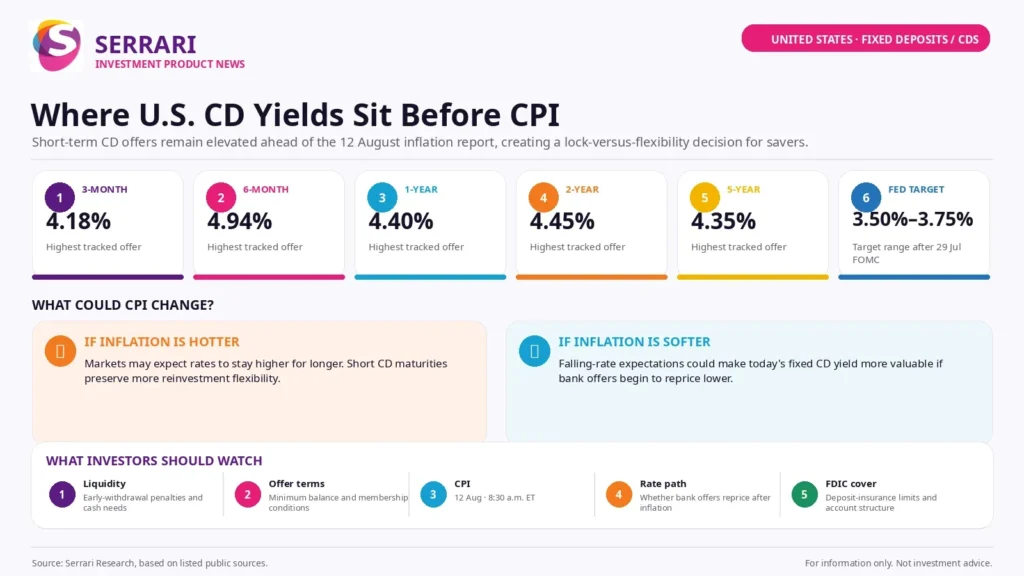
Alt text: Serrari infographic titled “Where U.S. CD Yields Sit Before CPI.” The visual compares selected U.S. certificate of deposit yields ahead of the 12 August inflation report. It shows highest tracked offers of 4.18% for 3-month CDs, 4.94% for 6-month CDs, 4.40% for 1-year CDs, 4.45% for 2-year CDs and 4.35% for 5-year CDs, alongside a Federal Reserve target range of 3.50% to 3.75% after the 29 July FOMC meeting. The infographic explains that hotter inflation could keep rate expectations higher for longer, favouring shorter maturities and reinvestment flexibility, while softer inflation could make current fixed CD yields more valuable if bank offers begin to reprice lower. Investor watchpoints include liquidity needs, early-withdrawal penalties, minimum balances, membership conditions, CPI timing, the rate path and FDIC insurance coverage.
US CD rates remain competitive before the July inflation report, with Forbes Advisor reporting a highest six-month APY of 4.94% on August 10, compared with 4.18% for three months, 4.40% for one year, 4.45% for two years and 4.35% for five years. The Federal Reserve’s policy target remains 3.50%–3.75%, while July CPI is scheduled for August 12 at 8:30 a.m. Eastern Time. The infographic explains the saver decision: a stronger-than-expected inflation report could support higher-for-longer rate expectations and make shorter CDs useful for flexibility, while softer inflation could increase the value of having already locked today’s fixed yields. It also notes that the 4.94% rate is a top observed offer rather than a typical national CD rate.
A CD Ladder Can Reduce Timing Risk
A saver does not have to choose between placing all available money in six months or locking everything away for several years.
A CD ladder divides the investment across different maturities.
For example, the saver might divide funds among:
- Six-month;
- One-year;
- Two-year; and
- Longer-term CDs.
As each CD matures, the saver decides whether to reinvest at the new prevailing rate or use the cash elsewhere.
The Forbes Advisor’s current CD survey identifies CD ladders as one approach for accessing competitive rates without locking all funds into one long maturity.
This does not eliminate interest-rate risk.
It spreads the timing risk across several maturity dates.
A Ladder Helps in Both Rate Scenarios
Suppose rates fall.
The longer portions of the ladder continue earning their previously locked yields.
Suppose rates rise.
The shorter CDs mature sooner, allowing at least part of the portfolio to be reinvested at the new higher rates.
The investor gives up the possibility of making the perfect one-time maturity decision in exchange for greater flexibility.
That can be useful around uncertain events such as inflation releases and Federal Reserve meetings.
APY Makes Rate Comparison Easier
CD advertisements normally quote annual percentage yield, or APY.
APY reflects the interest rate together with the effect of compounding over one year.
This makes it easier to compare accounts with different compounding schedules.
However, a six-month CD paying 4.94% APY does not mean the depositor receives 4.94% of principal during six months.
The quoted figure annualises the return.
The actual interest earned during a shorter maturity will be lower because the money is invested for only part of a year.
This distinction is important when comparing a six-month 4.94% APY with a one-year 4.40% APY.
The shorter account has a higher annualised rate, but the one-year account remains invested for twice as long.
The Highest APY May Have Conditions
Some high-rate CDs come with larger minimum-deposit requirements.
Forbes specifically identifies the 4.94% level as available among six-month and jumbo six-month products, while noting that jumbo CDs commonly require substantial deposits.
Another national comparison shows how conditions vary.
The NerdWallet’s August CD comparison table lists some competitive CDs with no minimum deposit, while others require $1,500 or $10,000.
Investors therefore need to compare:
- APY;
- Minimum opening deposit;
- Minimum balance;
- Withdrawal penalty;
- Renewal rules;
- Membership requirements; and
- Deposit insurance.
A slightly lower rate with better conditions may be more useful than the absolute highest advertised APY.
Automatic Renewal Can Matter
Many CDs automatically renew when they mature unless the customer instructs the bank otherwise during a specified grace period.
The new rate may be substantially different from the original rate.
A saver who originally secured an attractive promotional APY could therefore end up renewing into a less competitive product without actively comparing alternatives.
Investors should record maturity dates and understand the bank’s renewal rules before opening the account.
That becomes particularly important if market interest rates change substantially during the original CD term.
FDIC Coverage Is Important
A conventional CD held at an FDIC-insured bank is a deposit product covered by federal deposit insurance within applicable limits.
The official FDIC deposit insurance guidance states that the standard amount is $250,000 per depositor, per FDIC-insured bank, per ownership category. CDs are among the deposit products eligible for coverage.
This does not mean every product sold through a bank is FDIC insured.
Stocks, bonds, mutual funds and other investment securities are different from insured bank deposits.
Savers should therefore confirm both the institution and the ownership structure when placing large balances.
Credit Unions Use a Different Insurer
Some of the market’s most competitive certificates are offered by credit unions rather than banks.
Credit-union certificates can provide similar fixed-rate economics to bank CDs, but federal insurance generally comes through the National Credit Union Administration rather than the FDIC.
This is another reason to verify the institution rather than assuming every high-rate product is covered by the same scheme.
The article’s quoted Forbes and NerdWallet surveys include products from different types of deposit-taking institutions.
Today’s Rate Curve Is Not Normal
Savers often expect longer commitments to produce higher yields.
Today’s top CD rates do not follow that simple pattern.
Forbes’ maximum rates were:
| Term | Highest tracked APY |
| 3 months | 4.18% |
| 6 months | 4.94% |
| 1 year | 4.40% |
| 2 years | 4.45% |
| 5 years | 4.35% |
The six-month maturity clearly stands out.
This does not necessarily mean investors believe six months is the ideal economic horizon.
It can also reflect temporary bank-funding needs and isolated promotional products.
The broader market picture is less extreme.
NerdWallet’s August analysis says leading CD rates generally range from about 3.50% to 4.50%, with short-term products still among the strongest offers.
CPI Could Change Rate Expectations Quickly
The July CPI number does not directly determine what a bank will pay on a six-month CD the next morning.
Its effect works mainly through expectations.
If inflation is unexpectedly high, investors may conclude that the Federal Reserve has less room to reduce rates—or may eventually have to raise them.
Short-term market yields could respond.
Banks may then adjust deposit pricing depending on their own funding needs.
A weaker inflation reading could produce the opposite expectations.
But neither outcome guarantees an immediate or uniform move in CDs.
Some institutions may change offers quickly.
Others may leave them unchanged.
Savers Should Avoid Predicting One Number
The central decision should therefore not depend on trying to correctly forecast Wednesday’s CPI release.
Inflation forecasts can be wrong, and even predicting the CPI number correctly does not guarantee predicting the market reaction correctly.
A better approach is to begin with the investor’s own time horizon.
Someone who definitely needs the money within six months should not use a five-year CD simply because they fear falling rates.
Someone with a five-year savings horizon should not automatically choose six months only because 4.94% is today’s highest advertised APY.
The term needs to fit the cash requirement.
The rate decision comes second.
Inflation Also Affects the Real Return
A CD pays a nominal return.
What ultimately matters to purchasing power is the return after inflation and taxes.
June CPI was 3.5% higher than a year earlier.
Comparing that backward-looking figure with today’s top 4.94% APY produces a positive nominal spread.
But it does not establish the depositor’s future real return.
July inflation has not yet been released, and inflation over the actual six-month holding period remains unknown.
The saver should therefore avoid treating the difference between today’s CD APY and the latest CPI figure as a guaranteed inflation-adjusted profit.
Tax Can Reduce the Effective Return
Interest earned on US bank CDs can also create taxable income depending on the investor’s circumstances.
The headline APY is therefore a gross deposit rate rather than a universal after-tax return.
Two investors holding the same CD may experience different effective returns because of tax treatment.
This makes comparisons with tax-advantaged securities or retirement accounts more complicated than comparing headline percentages alone.
What Savers Should Monitor
The immediate number to watch is July CPI on August 12.
Beyond that, investors should monitor:
- Federal Reserve communications;
- Future FOMC decisions;
- Short-term Treasury yields;
- Bank deposit competition;
- Savings-account rates;
- CD promotional offers;
- Early-withdrawal terms;
- Minimum deposits; and
- Inflation expectations.
The Federal Reserve’s official policy releases and the BLS official CPI release schedule provide the primary dates around which market expectations can change.
Savers should also compare multiple institutions on the day they are ready to fund the CD because advertised rates can change.
Conclusion
US CD rates remain unusually competitive heading into the July inflation report.
Forbes Advisor’s August 10 survey showed a highest six-month APY of 4.94%, above its maximum one-year rate of 4.40%, two-year rate of 4.45% and five-year rate of 4.35%.
But 4.94% is a top observed rate, not a typical market yield.
The average six-month rate in the same Forbes survey was only 1.62%, while NerdWallet’s broader comparison showed its highest currently featured CDs at around 4.50%.
That makes shopping around as important as deciding when to lock.
The August 12 CPI report introduces another decision.
A saver who locks a competitive fixed CD today gains protection if rates decline later.
Someone who remains in shorter-term or variable savings retains more flexibility if inflation remains stubborn and deposit rates move higher.
Neither strategy requires correctly predicting the Federal Reserve.
The better starting point is the saver’s own liquidity requirement and investment horizon.
Once that is clear, today’s unusual rate structure presents a practical choice:
Lock today’s yield for certainty, or preserve flexibility for whatever comes after CPI.
FAQs
1. Is 4.94% a normal six-month CD rate in the US?
No. Forbes Advisor reported 4.94% as its highest tracked six-month APY on August 10, but the average six-month APY in the same survey was only 1.62%. Other national comparisons show leading broadly available offers closer to 4.0%–4.5%. The 4.94% figure should therefore be treated as an exceptional top offer rather than a standard rate available at every bank.
2. Should savers lock a CD before the August 12 CPI report?
There is no universally correct choice. Locking before CPI protects a fixed rate if inflation comes in softer and market expectations shift toward lower future interest rates. Waiting preserves the opportunity to benefit if inflation surprises higher and deposit rates subsequently rise. However, the CPI report does not mechanically determine individual bank CD rates, and promotional offers can change for institution-specific reasons.
3. Why does a six-month CD pay more than some longer CDs?
Banks price CDs according to their funding requirements and expectations for future rates rather than following a rule that longer terms must always pay more. A bank may currently value six-month deposits enough to offer a promotional APY near 5%, while expecting lower market rates later. The result can be an inverted CD-rate structure where a short maturity offers a higher annualised rate than a longer one.
4. Are US CDs insured?
Eligible certificates of deposit held at an FDIC-insured bank are covered by FDIC deposit insurance within applicable limits. The standard coverage amount is $250,000 per depositor, per insured bank, per ownership category. Investors should confirm that the institution is insured and consider their other deposits at the same bank when determining total coverage.
Sources: Forbes Advisor August 10 CD survey, NerdWallet August CD rate comparison, Federal Reserve July policy statement, BLS August economic release calendar, official BLS CPI information, official FDIC deposit insurance guidance, Marcus official high-yield CD platform.
Your financial future isn’t something you wait for—it’s something you build.
The real question is: when do you begin?
Move beyond simply staying informed.
Navigate the markets with clarity—track trends through the Serrari Group Market Index, uncover opportunities in the Serrari Marketplace, and build practical knowledge with our Curated Wealth Builder Platform.
Stay connected to what truly matters.
Get daily insights on macro trends and financial movements across Kenya, Africa, and global markets—delivered through the Serrari Newsletter.
Growth opens doors.
Advance your career through professional programs including ACCA, HESI A2, ATI TEAS 7 , HESI EXIT , NCLEX – RN and NCLEX – PN, Financial Literacy!🌟—designed to move you forward with confidence.
See where money is flowing—clearly and in real time.
Track Money Market Funds, Treasury Bills, Treasury Bonds, Green Bonds, and Fixed Deposits, alongside global and African indexes, key economic indicators, and the evolving Crypto and stablecoin landscape—all within Serrari’s Market Index.