Australia has become the first market selected to pilot a new approach that could allow recognised national sustainable-finance taxonomy criteria to be used within Climate Bonds Certification.
Under Climate Bonds Initiative’s proposed Equivalence Methodology, eligible Australian investments that already satisfy approved Australian Sustainable Finance Taxonomy criteria could use those criteria when seeking international Climate Bonds Certification rather than repeating the entire eligibility assessment.
The proposal is designed to reduce duplication while preserving science-based standards. It could also create a model for recognising credible national taxonomies in other countries.
For investors, the central issue is interoperability. If national definitions of green investment can connect reliably with international certification frameworks, cross-border comparison could become easier and the pool of investable certified assets could expand. But equivalence cannot simply mean accepting every local green label: individual criteria still have to satisfy Climate Bonds’ scientific and governance tests.
Key Overview
- Australia is the first market selected for the Climate Bonds taxonomy-equivalence pilot.
- The announcement was made on 10 August 2026.
- The proposal could allow recognised Australian taxonomy criteria to support Climate Bonds Certification.
- Recognition will be criteria-specific rather than automatic.
- Australia has approximately USD97.5 billion of cumulative green, social and sustainable debt issuance.
- Australia is also home to Climate Bonds’ 1,000th Certified issuance.
- The Australian Sustainable Finance Taxonomy was released in June 2025.
- It provides climate criteria covering six major areas of the Australian economy.
- ASFI has been testing practical implementation with 11 financial institutions.
- Taxonomy-aligned use-of-proceeds debt guidance was released in March 2026.
- Climate Bonds says the new public consultation remains open until 4 September 2026.
- Certification assesses climate integrity; it does not remove credit, interest-rate or valuation risk.
Green Bond Certification Gets First National Taxonomy Pilot
Australia has become the first country selected to test whether national sustainable-finance taxonomy criteria can be recognised directly within the Climate Bonds Certification system.
The Climate Bonds’ August 10 announcement says eligible Australian investments could obtain Climate Bonds Certification using recognised criteria from the Australian Sustainable Finance Taxonomy under a proposed new Equivalence Methodology.
The development may appear technical, but it addresses a practical problem in global green finance.
Countries are increasingly developing their own definitions of what qualifies as a green or transition activity.
International certification systems have their own criteria.
An issuer operating across both systems can therefore face duplicated assessments even where the two frameworks are trying to measure almost the same environmental outcome.
Climate Bonds wants to test whether credible national criteria can be recognised without weakening its international standard.
What Is a Sustainable-Finance Taxonomy?
A sustainable-finance taxonomy is essentially a classification system.
It defines which economic activities can be considered environmentally sustainable or aligned with a climate-transition pathway.
For example, a taxonomy may set technical requirements for:
- Renewable electricity;
- Low-carbon transport;
- Buildings;
- Manufacturing;
- Agriculture;
- Electricity grids;
- Mining; and
- Other economic activities.
Australia released its Sustainable Finance Taxonomy on 17 June 2025.
The Australian Treasury’s sustainable-finance taxonomy page says the initial framework focuses on six areas: electricity generation and supply, minerals and metals, construction and buildings, manufacturing and industry, transport, and agriculture and land.
It also incorporates “do no significant harm” requirements and minimum social safeguards.
The objective is to create a shared definition of climate-aligned activities that investors, companies and financial institutions can use consistently.
Why Australia Created Its Own Taxonomy
International taxonomies cannot always reflect the economic structure of every country.
Australia has major mining, minerals, agriculture and energy industries that play a larger economic role than they do in some other developed markets.
The ASFI Australian taxonomy framework therefore builds on international approaches while developing criteria suited to sectors that are particularly important to Australia.
ASFI says a credible taxonomy can improve comparability, reduce case-by-case assessment costs and lower the risk of greenwashing by giving market participants clearer definitions of what qualifies as climate aligned.
The challenge is what happens when an Australian issuer then approaches international investors.
If international certification requires another full assessment against a different set of criteria, some of the efficiency gained from having the national taxonomy disappears.
That is the problem the new pilot is trying to address.
Interoperability Is the Main Idea
Interoperability means different systems can work together without becoming identical.
Australia does not need to abandon its own taxonomy.
Climate Bonds does not need to replace its international criteria.
Instead, the proposed model asks whether specific Australian criteria provide a sufficiently equivalent environmental outcome to be recognised under the Climate Bonds Standard.
The Climate Bonds’ equivalence methodology explainer describes a process for assessing externally developed criteria against principles covering scientific grounding, climate ambition, fossil-fuel lock-in and governance.
If an Australian criterion passes that assessment, an issuer may be able to use it when demonstrating eligibility for Certification.
This could reduce the amount of duplicated work required.
Recognition Is Not Automatic
This is an important distinction for investors.
Climate Bonds is not proposing to recognise everything that Australia labels sustainable.
Recognition is intended to operate at the individual activity or criteria level.
The Climate Bonds interoperability methodology proposal says external criteria need to satisfy equivalence principles before they can be incorporated into the Climate Bonds framework.
These principles include:
- Scientific grounding;
- Alignment with a 1.5°C or well-below-2°C pathway;
- Avoidance of fossil-fuel lock-in;
- Transparent governance; and
- Appropriate environmental safeguards.
Climate Bonds has already identified Australian criteria in areas such as renewable energy, transport, buildings, manufacturing, electricity grids and storage that show close convergence with its existing criteria.
Some Australian activities that do not currently have direct equivalents within the Climate Bonds framework, including parts of mining and aviation, require more careful consideration.
This Is Why the Pilot Matters for Greenwashing
Interoperability can make sustainable finance more efficient.
It can also create a new greenwashing risk if the word equivalent becomes an excuse to lower standards.
Imagine two countries have different definitions of a green industrial project.
If an international certification system automatically accepts both without assessing the scientific differences, the resulting global label could become less meaningful.
Climate Bonds is therefore trying to make equivalence conditional rather than automatic.
Its current Certification Scheme is a voluntary label assessing whether eligible instruments, assets or entities satisfy the Climate Bonds Standard and applicable science-based criteria, supported by external verification.
The credibility of the new approach will depend on whether that level of scrutiny survives as more domestic taxonomy criteria are incorporated.
Australia Gives the Pilot Meaningful Scale
Australia is not being used as a small theoretical test market.
Climate Bonds says the country has already accumulated approximately USD97.5 billion of green, social and sustainable — or GSS+ — debt issuance.
That figure requires an important distinction.
USD97.5 billion represents the broader GSS+ market.
It should not be described as USD97.5 billion of green bonds alone.
The category may include:
- Green bonds;
- Social bonds;
- Sustainability bonds; and
- Other qualifying sustainable-debt structures.
Australia therefore provides a sufficiently developed sustainable-debt market in which to test how taxonomy recognition works in actual financing transactions.
Australia Has Already Moved Into Implementation
The national taxonomy is also no longer just a policy document.
The ASFI Australian taxonomy implementation programme includes 11 pilot participants from banking, investment, ratings and institutional finance.
They include institutions such as ANZ, Commonwealth Bank of Australia, NAB, Westpac, Bank of China, the Clean Energy Finance Corporation, HESTA, Rest Super, Rabobank, Moody’s Ratings and Metrics Credit Partners.
ASFI is using the programme to identify practical challenges before taxonomy use becomes more widespread.
The pilot has already highlighted international interoperability as one of the important conditions for increasing adoption.
That makes the Climate Bonds initiative a logical next stage.
Debt Guidance Came Before Certification
In March 2026, ASFI released practical guidance on how its taxonomy can be used in use-of-proceeds financing.
The ASFI’s Australian taxonomy-aligned debt guidance covers instruments including bonds and loans and is intended to create a common approach for issuers, investors and external reviewers.
The guidance addresses how issuers can identify taxonomy-aligned activities and disclose that alignment within labelled debt transactions.
This is important because a taxonomy becomes more useful when it can move from classification into actual capital-market structures.
The Climate Bonds pilot attempts to take that process another step by testing whether locally verified criteria can connect directly with a globally recognised certification framework.
Context is everything. Stay ahead of shifting trends with today’s market updates, and uncover emerging opportunities using the Serrari Group Market Index and Marketplace. Then, take control of your own financial future by exploring our Money & Life Reset Transformation Blueprint ™ to build stronger habits, create better systems, and design a path toward lasting wealth.
The FleetPartners Milestone Shows the Existing Market
Climate Bonds’ announcement came shortly after Australia became home to its 1,000th Certified issuance through FleetPartners.
The distinction around the transaction size is important.
FleetPartners’ July 2026 FP Turbo Series 2026-1 transaction was a A$400 million asset-backed securitisation in total.
The FleetPartners’ current ABS transaction page shows that the Class A1-G green tranche was A$100 million, backed by eligible vehicle-related assets and accompanied by Climate Bonds certification documentation.
The transaction demonstrates how certification can already be applied to specialised financial structures rather than only conventional corporate green bonds.
It also helps explain why eliminating unnecessary duplication could matter as the market becomes more varied.
Why Issuers Care About Duplication
Green certification requires work.
An issuer may need to:
- Identify eligible projects;
- Assess technical criteria;
- Establish a financing framework;
- Obtain external verification;
- Track allocation of proceeds;
- Prepare environmental reporting; and
- Maintain supporting documentation.
These requirements support market credibility.
But if an issuer has already completed a credible assessment under its domestic taxonomy and then has to repeat substantially the same technical assessment under an international certification framework, some of the extra work may add cost without adding much additional environmental information.
Equivalence seeks to remove that unnecessary duplication.
The objective is not to eliminate verification.
It is to recognise credible work that has already been done.
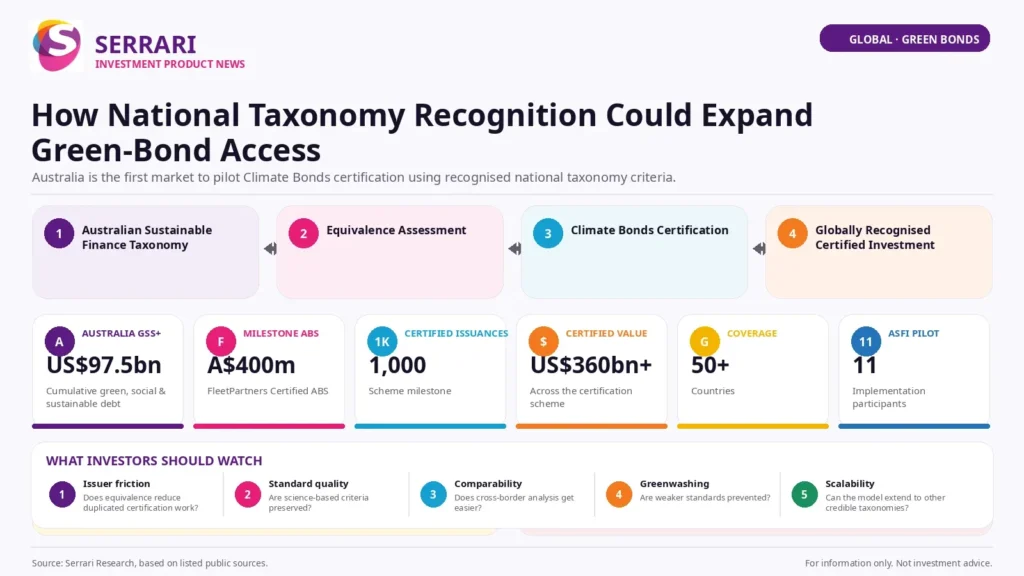
Australia becomes the first market selected to pilot Climate Bonds Certification using recognised national sustainable-finance taxonomy criteria. The infographic shows Australian taxonomy criteria moving through an equivalence assessment before eligible investments can access Climate Bonds Certification and international investor recognition. Australia has approximately USD97.5 billion of cumulative green, social and sustainable debt and is home to Climate Bonds’ 1,000th Certified issuance. The graphic explains that recognition is criteria-specific rather than automatic, with Climate Bonds testing scientific alignment, climate ambition, governance and safeguards. It also highlights the 4 September 2026 consultation deadline and explains that interoperability could reduce duplicated issuer assessments without reducing environmental standards.
Investors Could Get a Larger Certified Market
The most obvious potential investor benefit is supply.
If more Australian issuers can pursue Certification without repeating already completed technical assessments, the number of certified securities could increase.
Climate Bonds says this could broaden the investment opportunities available to investors seeking verified climate-aligned debt.
A larger market may eventually provide greater choice across:
- Sectors;
- Issuers;
- Credit qualities;
- Maturities;
- Financing structures; and
- Climate activities.
This matters for institutional investors whose mandates require assets to satisfy particular sustainability frameworks.
Greater compatibility between frameworks can make it easier to determine whether a security fits an investment mandate.
Cross-Border Comparison Could Improve
International investors frequently face several sustainability systems at once.
An Australian green investment may reference Australian criteria.
A European investment may use European taxonomy terminology.
An Asian investment may follow another national framework.
The investor then has to determine whether those definitions are genuinely comparable.
Climate Bonds has previously argued that a lack of taxonomy interoperability can fragment global capital flows and make sustainable investments harder to compare.
A credible equivalence framework could provide a bridge.
Instead of forcing every taxonomy to use exactly the same language, the system could identify where different national criteria reach sufficiently similar climate outcomes.
Local Context Still Matters
Interoperability does not mean every country should use one global taxonomy.
Different economies have different transition challenges.
Australia’s taxonomy, for example, includes detailed treatment of mining and minerals because these industries play a particularly important role in its economy.
The Australian framework also includes specific attention to transition activities and expectations concerning First Nations peoples and cultural heritage.
A taxonomy designed for another jurisdiction might not address those issues in the same way.
The purpose of equivalence is therefore to connect credible local criteria with global standards without pretending national economic circumstances are identical.
The Test Is Whether Standards Stay Strong
The greatest risk is that interoperability eventually becomes a race toward the easiest available standard.
If issuers can choose whichever national criteria give them the simplest route to certification, the global label could lose credibility.
The Equivalence Methodology therefore needs transparent rules describing:
- Which criteria are recognised;
- Why they are considered equivalent;
- Which safeguards remain compulsory;
- How disagreements are reviewed;
- Whether criteria are updated over time; and
- How recognition can be withdrawn.
Climate Bonds’ proposed methodology includes independent Standards Board review and consultation as part of the recognition process.
Those governance mechanisms will be particularly important if the model expands beyond Australia.
Public Consultation Runs Until September 4
Climate Bonds says its current consultation on the Australian pilot and proposed equivalence approach remains open until 4 September 2026.
This means the system is still being developed.
The pilot should not be described as a completed permanent change to the global Certification Scheme.
Market participants are being asked to assess the proposed methodology before final implementation.
Investors, issuers, banks, verifiers and policymakers therefore have an opportunity to challenge individual criteria and the broader process before the framework is finalised.
Australia Could Become the Template
The longer-term significance extends beyond Australia.
Climate Bonds says the pilot is intended to establish an approach that could eventually be used for other credible national taxonomies.
If successful, a future issuer in another jurisdiction might be able to demonstrate that a locally defined green activity already meets recognised international-equivalence requirements.
That could make national taxonomies more useful to international investors.
It could also encourage governments to develop stronger criteria if global recognition provides issuers with improved access to sustainable-finance markets.
However, expansion should depend on quality rather than simply the existence of a taxonomy.
A country publishing a sustainability framework does not automatically make that framework scientifically credible.
Certification Does Not Make a Bond Financially Safe
Green certification addresses the environmental characteristics of an investment.
It does not guarantee that the issuer will repay investors.
Climate Bonds describes Certification as a system for assessing climate credentials and environmental integrity against its Standard and science-based criteria.
That means investors still need to assess:
- Credit quality;
- Interest-rate risk;
- Liquidity;
- Currency exposure;
- Bond maturity;
- Valuation;
- Covenants;
- Issuer leverage; and
- Overall portfolio suitability.
A weak borrower does not become a strong borrower simply because a project is environmentally credible.
Similarly, a green bond purchased at an unattractive price can produce a weak financial return even if its environmental use of proceeds is genuine.
Green Integrity and Credit Quality Are Separate
This separation is particularly important as the pool of certified assets expands.
Consider two bonds financing identical renewable-energy projects.
Both may satisfy the same taxonomy criteria.
One issuer may have a very strong balance sheet.
The other may be highly leveraged and exposed to refinancing risk.
Their climate credentials may be similar while their credit risks are very different.
Investors therefore need two separate questions:
Is the investment genuinely climate aligned?
And:
Is the financial return sufficient for the risk being taken?
Taxonomies and certification primarily help answer the first question.
Credit analysis must still answer the second.
What Investors Should Monitor
The first issue is what ultimately survives the consultation.
Investors should monitor whether the final Equivalence Methodology maintains the current requirements around scientific alignment, fossil-fuel lock-in and governance.
They should also watch:
- Which Australian criteria receive recognition;
- Which criteria remain excluded;
- Treatment of mining activities;
- Treatment of aviation;
- External-verification requirements;
- Disclosure standards;
- Post-issuance reporting;
- Expansion into additional countries;
- Growth in Australian Certified issuance; and
- Whether issuers actually experience lower certification friction.
ASFI’s existing implementation work will also provide useful evidence on how the Australian taxonomy functions in actual financial transactions.
Conclusion
Australia’s selection as the first national-taxonomy pilot for Climate Bonds Certification represents a shift in the infrastructure supporting green finance.
The green-bond market has spent much of its development creating standards, taxonomies and certification systems.
The next challenge is making those systems work together.
Climate Bonds’ proposed Equivalence Methodology would allow approved Australian taxonomy criteria to support international Certification without requiring issuers to repeat equivalent assessments.
If the model works, issuers may face less duplication while investors gain access to a larger and more comparable pool of climate-aligned assets.
Australia provides a meaningful testing ground, with USD97.5 billion of cumulative GSS+ issuance, a national taxonomy already being used in practical pilot programmes and the Climate Bonds scheme’s 1,000th Certified issuance.
But the most important word is equivalence.
Recognition cannot simply mean accepting whatever a domestic market calls green.
The model will retain investor credibility only if recognised criteria continue meeting transparent and science-based standards.
If Australia demonstrates that national context and international consistency can coexist, the pilot could become a useful template for other sustainable-finance markets.
If equivalence results in weaker environmental thresholds, the efficiency gains would come at the cost of the very investor confidence the system is meant to improve.
FAQs
1. What is Climate Bonds Certification?
Climate Bonds Certification is a voluntary framework used to assess whether eligible debt instruments, assets or entities satisfy the Climate Bonds Standard and applicable science-based environmental criteria. Independent verification forms part of the process. Certification helps investors assess climate integrity, but it is not a credit rating and does not guarantee that an investment will generate a positive financial return.
2. What does taxonomy equivalence mean?
Taxonomy equivalence means that criteria developed under one sustainable-finance framework can be assessed to determine whether they achieve sufficiently similar climate outcomes to criteria used by another framework. Under the proposed Climate Bonds methodology, approved Australian criteria could be recognised where they meet principles concerning scientific grounding, climate ambition, fossil-fuel lock-in and governance. Recognition would apply to qualifying criteria rather than automatically to the entire Australian taxonomy.
3. Why was Australia chosen for the first pilot?
Australia already has an established sustainable-finance taxonomy, a substantial GSS+ debt market and active implementation work involving banks, investors and other financial institutions. Climate Bonds also participated closely in the taxonomy’s development. The organisation says Australia has USD97.5 billion of cumulative GSS+ issuance and is home to its 1,000th Certified issuance.
4. Does the pilot mean every Australian green bond will receive Climate Bonds Certification?
No. The proposed system does not automatically certify every bond or activity described as sustainable in Australia. Eligible criteria must first pass the equivalence process, and issuers still need to satisfy other relevant Certification requirements. The methodology is also still under consultation, meaning final requirements could change before permanent implementation.
Sources: Climate Bonds’ August 10 announcement, Climate Bonds’ equivalence methodology explainer, Climate Bonds interoperability methodology proposal, Australian Treasury sustainable-finance taxonomy page, ASFI Australian taxonomy framework, ASFI Australian taxonomy implementation programme, ASFI Australian taxonomy-aligned debt guidance, Climate Bonds certification scheme overview.
Your financial future isn’t something you wait for—it’s something you build.
The real question is: when do you begin?
Move beyond simply staying informed.
Navigate the markets with clarity—track trends through the Serrari Group Market Index, uncover opportunities in the Serrari Marketplace, and build practical knowledge with our Curated Wealth Builder Platform.
Stay connected to what truly matters.
Get daily insights on macro trends and financial movements across Kenya, Africa, and global markets—delivered through the Serrari Newsletter.
Growth opens doors.
Advance your career through professional programs including ACCA, HESI A2, ATI TEAS 7 , HESI EXIT , NCLEX – RN and NCLEX – PN, Financial Literacy!🌟—designed to move you forward with confidence.
See where money is flowing—clearly and in real time.
Track Money Market Funds, Treasury Bills, Treasury Bonds, Green Bonds, and Fixed Deposits, alongside global and African indexes, key economic indicators, and the evolving Crypto and stablecoin landscape—all within Serrari’s Market Index.