













Kenya money market rates enter the August 11 Central Bank of Kenya Monetary Policy Committee meeting with short-term yields tightly clustered around the current 8.75% Central Bank Rate.
KESONIA, the overnight interbank benchmark, was approximately 8.75% in the latest readings. The August 6 Treasury-bill auction produced accepted average rates of 8.7820% for 91 days, 8.9500% for 182 days and 9.0042% for 364 days.
The more interesting signal is demand. Investors offered KSh13.59 billion for KSh8 billion of 91-day bills, producing a 169.9% performance rate. Demand for the 364-day bill reached only 62.1% of the amount offered.
That suggests investors are still placing considerable value on short-term flexibility ahead of the monetary-policy decision.
For money-market fund investors, fixed-deposit savers and Treasury-bill buyers, tomorrow’s decision matters because changes in policy can eventually flow through overnight funding rates, government securities, deposit pricing and the yields earned as MMF portfolios reinvest maturing assets. The transmission is not immediate or one-for-one.
Key Overview
- The CBK Monetary Policy Committee is scheduled to meet on 11 August 2026.
- The current Central Bank Rate is 8.75%.
- KESONIA has recently converged around 8.75%.
- The latest 91-day Treasury bill rate is 8.7820%.
- The 182-day Treasury bill rate is 8.9500%.
- The 364-day Treasury bill rate is 9.0042%.
- The August 6 T-bill auction attracted KSh29.97 billion against KSh28 billion offered.
- Overall auction performance was 107.03%.
- The 91-day bill was 169.9% subscribed.
- The 182-day bill was 101.7% subscribed.
- The 364-day bill reached only 62.1%.
- July headline inflation increased to 6.5% from 6.4% in June.
- KBA has recommended that CBK retain the CBR at 8.75%, but this is an industry position rather than the MPC decision.
- MMF yields may react to policy changes with a lag because funds hold instruments purchased at different times and maturities.
Kenya Money Market Rates Face an August 11 CBK Test
Kenya’s short-term investment market heads into Tuesday’s monetary-policy meeting with one unusual feature: most of the important cash-market rates are already clustered close to the Central Bank Rate.
The CBR currently stands at 8.75%.
KESONIA, Kenya’s overnight interbank benchmark, has also settled around 8.75% in recent weeks, effectively aligning the cost at which banks lend overnight with the central bank’s policy reference rate. The Business Daily’s KESONIA convergence report describes this convergence as creating a common reference point for short-term banking rates.
Treasury bills sit only slightly above that level.
The official August 6 Treasury bill results show accepted rates of 8.7820% for the 91-day bill, 8.9500% for 182 days and 9.0042% for 364 days.
For investors holding cash, money-market funds or short-term government securities, Tuesday’s MPC decision could therefore influence several products at once.
Tomorrow’s Decision Sits Above the Cash Market
The Central Bank of Kenya’s Monetary Policy Committee is scheduled to meet on Tuesday, 11 August.
The Kenyan Wall Street’s August MPC preview confirms the meeting and reports that the Kenya Bankers Association currently favours keeping the policy rate unchanged at 8.75%.
That view should not be confused with the actual MPC decision.
The committee can:
- Keep the CBR unchanged;
- Increase the rate;
- Reduce the rate; or
- Adjust other elements of its policy framework.
Until the official statement is published, the outcome remains unknown.
For a cash investor, however, the important question is less about predicting the committee and more about understanding how each possible decision could eventually affect their portfolio.
KESONIA Is the First Important Link
KESONIA stands for the Kenya Shilling Overnight Interbank Average.
It measures the average rate at which banks lend unsecured Kenya-shilling funds to each other overnight.
The official CBK KESONIA reference page provides the daily benchmark.
The August 6 reading supplied for the current market snapshot was 8.7541%, effectively matching the 8.75% CBR.
That alignment is significant because KESONIA now plays a much larger role in Kenya’s financial system.
The Kenya Bankers Association pricing framework explains that KESONIA serves as the common base rate for variable-rate lending under the revised credit-pricing framework.
A change in monetary-policy conditions can therefore affect not only interbank trading but eventually the pricing of loans and other financial products.
KESONIA Does Not Automatically Equal CBR
The two rates are currently very close, but they are conceptually different.
The CBR is a policy rate set by the central bank.
KESONIA is a market rate created from actual overnight interbank transactions.
Liquidity conditions can cause KESONIA to trade slightly above or below the CBR.
If banks have abundant liquidity and little need to borrow from each other, overnight rates may soften.
If liquidity tightens, banks may become willing to pay more for overnight funds.
The fact that KESONIA has recently remained around 8.75% suggests that current interbank pricing is closely aligned with CBK’s policy stance.
Treasury Bills Are Also Near the Policy Rate
The latest Treasury-bill yields create a very narrow short-term government curve.
Accepted rates from the August 6 auction were:
| Instrument | Accepted rate |
| 91-day Treasury bill | 8.7820% |
| 182-day Treasury bill | 8.9500% |
| 364-day Treasury bill | 9.0042% |
The CBK’s official Treasury bill platform now uses these rates as the previous accepted rates for the next auction scheduled for 13 August.
The difference from the CBR is modest.
The 91-day bill is only around 3.2 basis points above the 8.75% policy rate.
The 182-day bill offers around 20 basis points more.
The 364-day bill provides approximately 25.4 basis points more.
That means investors currently receive relatively little additional headline yield for extending from overnight money toward a full one-year Treasury bill.
Investors Still Strongly Preferred 91 Days
The yields alone tell only half the story.
Investor demand was heavily concentrated in the shortest maturity.
CBK offered KSh8 billion of 91-day bills but received KSh13.59 billion in bids.
That produced a performance rate of 169.90%.
The 182-day instrument received KSh10.17 billion against KSh10 billion offered, producing a 101.67% performance rate.
The 364-day bill received only KSh6.21 billion against KSh10 billion offered.
Its performance rate was just 62.09%.
The contrast is important.
Investors were willing to accept a slightly lower yield in exchange for getting their money back much sooner.
Short-Term Flexibility Has Value
Why choose 8.782% for approximately three months when 9.0042% is available for almost one year?
The answer is flexibility.
The 91-day investor can reassess the market when the bill matures.
If interest rates rise, the proceeds can potentially be reinvested at a higher rate.
If another opportunity becomes more attractive, the investor can move the cash elsewhere.
That flexibility may be particularly valuable immediately before a central-bank policy decision.
The 364-day investor gives up more of that flexibility in exchange for locking the current yield for longer.
Neither approach is automatically superior.
They represent different views on liquidity and future interest rates.
A 91-Day Investor Carries Reinvestment Risk
Short maturity creates flexibility, but it also creates reinvestment risk.
Imagine an investor purchases a 91-day bill at 8.782%.
When it matures, the next available 91-day rate may be:
- 9.50%;
- 8.50%; or
- 7.50%.
Today’s investor does not know.
If rates decline significantly over the coming year, someone repeatedly purchasing 91-day bills may ultimately earn less than an investor who locked the 364-day rate today.
The 364-day investor sacrifices liquidity but receives greater certainty over the annualised rate applicable to the holding period.
This is why short versus long maturity is not simply a question of which number is highest.
The Latest Auction Was Slightly Oversubscribed Overall
Across all three maturities, CBK offered KSh28 billion.
Investors submitted bids worth KSh29.97 billion, producing an overall performance rate of 107.03%.
The central bank accepted KSh28.52 billion.
However, describing the auction only as 107% subscribed hides the large difference underneath.
The 91-day bill was heavily oversubscribed.
The one-year bill was materially undersubscribed.
For investors, maturity-level demand therefore provides more useful information than the combined headline number.
Rates Edged Lower at the Auction
All three accepted Treasury-bill rates declined slightly from the preceding auction.
The 91-day bill moved from 8.7882% to 8.7820%.
The 182-day bill declined from 8.9545% to 8.9500%.
The 364-day bill fell from 9.0169% to 9.0042%.
These were small changes rather than a dramatic repricing.
That leaves the entire bill curve close to 9% heading into the MPC meeting.
Tomorrow’s policy communication may therefore help shape expectations for whether this stable pattern continues.
Inflation Is the Main Constraint
Kenya’s headline inflation increased to 6.5% in July from 6.4% in June.
The official KNBS July inflation report is the primary statistical source, while current MPC reporting confirms the increase and notes that headline inflation remains inside CBK’s 2.5%–7.5% target range.
Inflation is important to cash investors because a nominal yield does not tell the whole story.
A 9% Treasury-bill yield sounds attractive in isolation.
But the purchasing power of the return depends partly on what happens to consumer prices during the investor’s actual holding period.
Today’s Inflation Comparison Is Backward Looking
A simple comparison places the latest rates approximately:
- 2.28 percentage points above July inflation for the 91-day bill;
- 2.45 points above inflation for the 182-day bill; and
- 2.50 points above inflation for the 364-day bill.
These are simple nominal-rate-minus-current-inflation comparisons.
They are not guaranteed real returns.
July’s 6.5% inflation measures how prices changed over the preceding 12 months.
An investor purchasing a 364-day bill today cares about inflation over the next year.
That rate is unknown.
Tax, transaction costs and intermediary fees can also affect the effective return ultimately received.
KBA Currently Supports a Hold
The Kenya Bankers Association has recommended that the MPC retain the CBR at 8.75%.
The current August MPC industry analysis says KBA believes keeping policy unchanged would allow previous easing to continue supporting private-sector credit while policymakers monitor inflation and external risks.
The same analysis highlights the unusual composition of current inflation.
Headline inflation is 6.5%, but core inflation remains much lower at around 3.2%, while non-core inflation is considerably higher at approximately 15%.
That suggests much of the headline pressure is coming from more volatile areas such as food, fuel and transport rather than strong demand across the entire economy.
Again, this is part of the policy debate.
It is not a guarantee that CBK will hold.
Context is everything. Stay ahead of shifting trends with today’s market updates, and uncover emerging opportunities using the Serrari Group Market Index and Marketplace. Then, take control of your own financial future by exploring our Money & Life Reset Transformation Blueprint ™ to build stronger habits, create better systems, and design a path toward lasting wealth.
What a Hold Could Mean
If CBK retains the CBR at 8.75%, the immediate policy anchor for the money market would remain unchanged.
That could support continued stability in KESONIA around current levels, assuming banking-system liquidity also remains broadly stable.
Treasury-bill yields would not have to remain unchanged.
Government borrowing needs, investor demand and liquidity conditions can still push auction rates higher or lower.
However, an unchanged policy rate would remove one immediate source of repricing.
For money-market fund investors, a hold could mean portfolio yields continue adjusting gradually based on securities purchased and maturing within each fund rather than experiencing a sudden policy-driven shift.
What a Rate Increase Could Mean
If CBK raises the policy rate, upward pressure could eventually move through several parts of the financial system.
The simplified direction would be:
Higher CBR → potentially higher overnight rates → higher short-term yields → gradual repricing of deposits and money-market portfolios.
But the process would not occur instantly.
KESONIA is market determined.
Treasury bills are auctioned.
Banks price deposits according to their own funding needs.
Money-market funds hold portfolios containing securities bought on different dates.
A rate increase might therefore raise the yield available on newly purchased instruments while older lower-yielding holdings remain in the fund until they mature or are sold.
MMF Yields Would Usually Lag
This is especially important for Kenyan money-market fund investors.
An MMF does not simply take tomorrow’s CBR and declare the same return.
A typical fund may hold a mix of:
- Treasury bills;
- Bank fixed deposits;
- Commercial paper;
- Call deposits;
- Other short-term instruments; and
- Cash.
Each investment may mature on a different date.
If market rates rise tomorrow, the fund generally benefits as existing assets mature and are reinvested at higher rates.
That process can take time.
The speed depends on the fund’s maturity structure and portfolio composition.
The Same Lag Works When Rates Fall
Suppose CBK cuts rates instead.
New Treasury bills and bank deposits may eventually reprice lower.
But an MMF that already owns higher-yielding securities does not immediately lose those contracted returns.
Those assets can continue generating their existing yields until maturity, subject to their terms and portfolio valuation.
The fund’s overall yield may then decline gradually as the old securities mature and are replaced by new lower-rate investments.
This is why MMF returns often lag movements in short-term market rates.
Fixed Deposits Depend on Bank Funding Needs
Commercial-bank fixed-deposit rates are influenced by the same broad interest-rate environment, but they do not move mechanically with the CBR.
A bank with plenty of customer deposits may have little reason to offer an aggressive fixed-deposit rate.
Another institution seeking additional funding may pay more.
Factors include:
- Deposit maturity;
- Amount invested;
- Negotiating power;
- Bank liquidity;
- Competition;
- Expected future rates; and
- Alternative funding costs.
Investors comparing an MMF with a fixed deposit should therefore obtain the actual deposit quotation rather than assuming it follows the policy rate exactly.
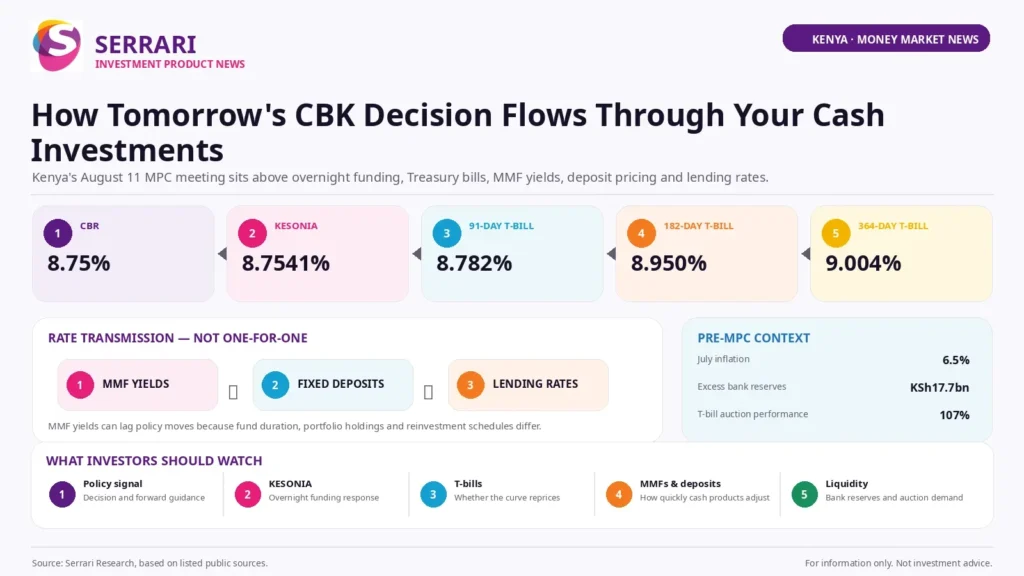
Kenya money market rates head into the August 11 CBK Monetary Policy Committee meeting with the Central Bank Rate at 8.75%, KESONIA around 8.75% and accepted Treasury-bill rates of 8.7820% for 91 days, 8.9500% for 182 days and 9.0042% for 364 days. The infographic shows how a monetary-policy change can move through the financial system from the CBR to overnight KESONIA, Treasury-bill auctions, money-market fund reinvestment yields, fixed deposits and lending rates. A side panel shows July inflation at 6.5% and August 6 Treasury-bill auction performance at 107.03%. It also highlights the maturity split: the 91-day bill was 169.9% subscribed while the 364-day bill reached only 62.1%, showing strong investor preference for short-term flexibility.
Liquidity Is Another Important Signal
Interest rates do not operate independently of available cash in the banking system.
Kenya’s commercial banks are required to maintain reserves equivalent to 3.25% of applicable deposits.
The current Kenyan bank reserve framework confirms the 3.25% Cash Reserve Ratio requirement.
When banks have substantial excess liquidity, they have less reason to compete aggressively for overnight funds.
That can help keep interbank rates stable.
When liquidity becomes scarce, overnight borrowing can become more expensive.
The user-supplied August 6 CBK snapshot showed commercial banks carrying approximately KSh17.7 billion of reserves above the required level, pointing to a relatively liquid market.
A Liquid Market Can Limit Rate Pressure
Liquidity is one reason a policy-rate change and market-rate change do not always match perfectly.
Imagine CBK leaves the CBR unchanged, but the banking system suddenly faces a shortage of cash.
KESONIA could still rise as banks compete to borrow overnight.
Alternatively, the central bank could hold the CBR while the banking system remains highly liquid, allowing overnight rates to remain close to or slightly below the policy reference.
Investors should therefore monitor both the MPC decision and banking-system liquidity.
Treasury Bills Add Government Demand
Government borrowing introduces another layer.
Treasury-bill rates reflect the intersection of:
- The yields investors demand;
- The amount National Treasury needs;
- Available banking liquidity;
- Alternative investment opportunities; and
- CBK’s decision on which bids to accept.
That means a CBR hold does not guarantee a Treasury-bill hold.
National Treasury could require more domestic funding at a future auction.
Investors could demand higher yields.
Or strong demand could push accepted yields lower even without a change in monetary policy.
The CBK Treasury bill auction results demonstrate this auction process directly.
MMFs and T-Bills Solve Different Problems
A Treasury bill gives an investor direct exposure to a specific government security and maturity.
An MMF provides a diversified portfolio managed by a professional fund manager.
The MMF generally provides greater day-to-day liquidity, although withdrawal terms vary by fund.
A direct Treasury bill allows the investor to lock the specific accepted government rate for the chosen maturity.
The MMF return changes as its underlying portfolio changes.
This means an investor should not compare the two only using today’s displayed yield.
Other considerations include:
- Liquidity;
- Minimum investment;
- Access time;
- Diversification;
- Management fees;
- Tax;
- Reinvestment administration; and
- Investment horizon.
A Policy Cut Would Create a Different Trade-Off
If CBK cuts the CBR, investors with existing high-yielding fixed instruments may become relatively better positioned.
A 364-day bill already locked around 9% would continue under its agreed terms even if new short-term rates decline.
A 91-day investor would regain cash sooner but might then have to reinvest at a lower rate.
MMF portfolio yields would generally begin declining as higher-yielding securities mature and are replaced.
Banks might also lower fixed-deposit offers where their funding needs permit.
For borrowers, lower policy and KESONIA rates could eventually support lower variable lending rates under the revised pricing framework.
Again, transmission would take time.
A Rate Hike Reverses the Advantage
If CBK raises rates, shorter maturities can become useful because they mature quickly.
The 91-day investor may then reinvest at a higher yield.
A 364-day investor remains locked at today’s rate.
That investor has certainty but misses the opportunity to immediately capture higher rates.
An MMF can gradually benefit as portfolio instruments mature and are reinvested.
A variable high-yield savings or call account might also reprice depending on the institution.
This is the essence of reinvestment risk.
Cash Investors Should Start With Their Time Horizon
Trying to predict tomorrow’s decision should not be the first step in cash allocation.
A better starting point is:
When will the money actually be needed?
An investor who needs the funds in three months should be cautious about extending to one year solely for an additional 22 basis points.
An investor with a known one-year horizon may place greater value on locking a rate and eliminating repeated reinvestment decisions.
An investor requiring daily access may accept a different yield through a money-market fund or bank account in exchange for liquidity.
The product should fit the cash requirement before the investor attempts to forecast interest rates.
Rate Differences Are Currently Small
The current curve makes this particularly relevant.
Moving from the 91-day to 364-day Treasury bill adds only around 22 basis points.
On KSh1 million, 0.22 percentage points represents roughly KSh2,200 on a simple annualised basis before considering the exact bill pricing, tax treatment and investment period.
That is not insignificant.
But it provides useful context for the additional nine months of commitment.
For some investors, locking the longer rate may be worthwhile.
For others, retaining flexibility may have greater value.
What Investors Should Watch Tomorrow
The headline will be the new Central Bank Rate.
But cash investors should read beyond the headline.
Important signals include:
- CBK’s inflation assessment;
- Comments on core versus non-core inflation;
- Expectations for fuel prices;
- Exchange-rate stability;
- Private-sector credit growth;
- Banking-system liquidity;
- Economic-growth forecasts; and
- Guidance on future policy.
A hold accompanied by more hawkish language could have a different market effect from a hold accompanied by confidence that inflation will decline.
The direction of future policy expectations can matter almost as much as tomorrow’s numerical decision.
What Happens After the Decision
Investors should then monitor the market rather than assuming all products immediately change.
Useful follow-up indicators will include:
- Daily KESONIA;
- The August 13 Treasury-bill auction;
- New bank fixed-deposit quotations;
- Published MMF yields;
- Commercial-bank variable lending rates; and
- The shilling.
The next Treasury-bill auction is particularly useful because it occurs only two days after the MPC meeting.
CBK is offering KSh8 billion of 91-day bills, KSh10 billion of 182-day bills and KSh10 billion of 364-day bills for the 13 August auction.
That will provide an early market test of how investors interpret tomorrow’s policy decision.
Conclusion
Kenya’s short-term interest-rate market enters the August 11 MPC meeting in a relatively tight range.
The CBR stands at 8.75%.
KESONIA is around the same level.
Treasury-bill rates range from 8.7820% for 91 days to 9.0042% for 364 days.
The latest auction also reveals a clear investor preference.
The 91-day bill attracted bids worth almost 170% of the amount offered, while the 364-day bill reached only 62%.
That suggests investors currently place significant value on flexibility even though the one-year bill offers a slightly higher yield.
Tomorrow’s policy decision could influence this balance.
A higher CBR could eventually improve new short-term investment yields while making existing lower-rate positions less attractive.
A lower CBR could make today’s locked yields more valuable while reducing future reinvestment rates.
A hold could preserve the current environment but would not prevent Treasury-bill, deposit or MMF yields from moving for other reasons.
For investors, the most important lesson is that the CBR does not flow directly and instantly into every cash product.
The chain is more gradual:
CBR → overnight liquidity and KESONIA → Treasury bills and deposits → MMF portfolio reinvestment → investor yields.
Tomorrow’s announcement therefore matters.
But the real investor story will continue unfolding in the days and weeks after the MPC meeting.
FAQs
1. Will money-market fund yields change immediately if CBK changes the CBR?
No. Money-market funds hold portfolios containing Treasury bills, bank deposits and other short-term securities purchased at different times. A policy change mainly affects the rates available when those investments mature and the fund reinvests the money. MMF yields can therefore rise or fall gradually rather than moving one-for-one with the CBR on announcement day.
2. Why are investors buying more 91-day than 364-day Treasury bills?
The latest auction suggests investors currently value short-term flexibility. The 91-day bill attracted bids equal to 169.9% of the amount offered, compared with only 62.1% for the 364-day instrument. A shorter bill allows investors to reassess rates after approximately three months, which is useful if they believe monetary conditions may change. The trade-off is reinvestment risk if rates fall before the bill matures.
3. Is a 9% Treasury-bill yield attractive when inflation is 6.5%?
The current nominal yield is above the latest annual inflation rate, but this does not guarantee a positive real return. July’s 6.5% inflation rate looks backward over the previous 12 months, while an investor buying a Treasury bill today is exposed to inflation during the future holding period. Taxes, fees and changes in purchasing power must also be considered.
4. What should investors watch after the August 11 MPC decision?
The most useful immediate indicators will be KESONIA, the August 13 Treasury-bill auction, bank fixed-deposit quotations and published MMF yields. Investors should also read CBK’s inflation and policy guidance rather than focusing only on whether the CBR is raised, cut or held. The next T-bill auction takes place only two days later and should provide a useful early signal of how short-term investors respond.
Sources: CBK official August 6 Treasury bill results, CBK official Treasury bill platform, CBK official KESONIA reference page, official KNBS July inflation report, Kenya Bankers Association pricing framework, Business Daily KESONIA convergence report, Kenyan Wall Street August MPC preview.
Your financial future isn’t something you wait for—it’s something you build.
The real question is: when do you begin?
Move beyond simply staying informed.
Navigate the markets with clarity—track trends through the Serrari Group Market Index, uncover opportunities in the Serrari Marketplace, and build practical knowledge with our Curated Wealth Builder Platform.
Stay connected to what truly matters.
Get daily insights on macro trends and financial movements across Kenya, Africa, and global markets—delivered through the Serrari Newsletter.
Growth opens doors.
Advance your career through professional programs including ACCA, HESI A2, ATI TEAS 7 , HESI EXIT , NCLEX – RN and NCLEX – PN, Financial Literacy!🌟—designed to move you forward with confidence.
See where money is flowing—clearly and in real time.
Track Money Market Funds, Treasury Bills, Treasury Bonds, Green Bonds, and Fixed Deposits, alongside global and African indexes, key economic indicators, and the evolving Crypto and stablecoin landscape—all within Serrari’s Market Index.