The NGX All-Share Index extended its extraordinary 2026 rally on Monday, closing around 248,529 points after gaining approximately 1.20%.
That takes the index’s year-to-date advance to roughly 59.7%, building on an already exceptional first half.
But the headline index gain does not tell the whole story.
NGX Pulse’s latest detailed late-session snapshot showed only 26 advancing stocks against 33 decliners, even as the index was more than 1% higher. Airtel Africa, one of Nigeria’s largest listed companies, was up 8.59%, helping demonstrate how large-cap gains can lift a market-capitalisation-weighted index even when more individual stocks are falling than rising.
For investors, the key lesson is simple: a rising index and a broadly rising stock market are not always the same thing.
Key Overview
- The NGX All-Share Index finished around 248,529 points.
- The index gained approximately 1.20% on Monday.
- Friday’s previous close was 245,573.60.
- The implied 2026 year-to-date return is approximately 59.7%.
- Market capitalisation was around ₦160.4 trillion late in the session.
- The latest detailed NGX Pulse breadth snapshot showed 26 advancers and 33 decliners.
- Airtel Africa gained 8.59% late in the session.
- Access Holdings gained 6.68%.
- UBA gained 3.12%.
- Ecobank Transnational Incorporated fell 9.92%.
- First HoldCo declined 1.65%.
- Trading volume had reached approximately 658.9 million shares by 3:30 p.m. WAT.
- Traded value had reached approximately ₦20.44 billion by the same snapshot.
- The NGX had already returned 46.8% during the first half of 2026 according to BusinessDay’s H1 sector review.
NGX All-Share Index Jumps Above 248,000 as Breadth Stays Weak
Nigeria’s stock market began the week with another strong headline gain as the NGX All-Share Index climbed above 248,000 points.
Post-close market data showed the benchmark around 248,529 points, approximately 1.20% higher than Friday’s 245,573.60 close. The move added almost 3,000 index points in a single session.
The gain pushed the index’s year-to-date return to roughly 59.7%, extending one of the strongest equity-market advances seen globally during 2026.
However, the day’s individual-stock performance was much less impressive than the index headline suggested.
The NGX Pulse detailed Monday market snapshot showed 26 stocks advancing and 33 declining at 3:30 p.m. WAT, despite the benchmark being up more than 1%.
That divergence is the main investor story.
The Index Rose While More Stocks Fell
Market breadth measures how widely a market move is being shared among individual stocks.
One simple method is to compare the number of shares that rise with the number that fall.
If 50 companies gain and 20 decline, the rally has broad participation.
If 20 rise and 50 fall while the headline index still advances sharply, performance is being driven by a smaller group of companies.
Monday looked closer to the second situation.
The latest detailed NGX Pulse market-breadth reading showed 26 advancers against 33 decliners late in the session.
The index was therefore showing substantial strength while the average listed share was experiencing a much more mixed day.
Large Companies Can Move the Index
The NGX All-Share Index is influenced by the market values of its constituent companies.
This means movements in Nigeria’s biggest listed businesses can have much more impact on the overall benchmark than movements in smaller stocks.
Monday provided a clear example.
Airtel Africa was up approximately 8.59% in the late-session NGX Pulse data.
At the same time, the company had a market capitalisation of roughly ₦23.7 trillion, making it one of the largest stocks on the exchange.
A strong move in a company of that size can have a meaningful effect on the overall market.
A small company falling 5% may have far less impact.
This is why investors should never assume a 1.2% index gain means the typical NGX-listed stock also gained 1.2%.
Airtel Africa Was a Major Support
Airtel Africa’s 8.59% advance made it one of the strongest large-cap performers during the session.
The latest NGX Pulse stock table showed Airtel Africa trading around ₦6,300, giving it a market value approaching ₦24 trillion.
That is substantially larger than most companies on the exchange.
Other positive financial-sector movements also helped.
Access Holdings was approximately 6.68% higher.
United Bank for Africa gained around 3.12%.
GTCO added approximately 1.41%, while Zenith Bank was modestly positive.
These large-cap gains helped support the benchmark even as weakness continued elsewhere.
Several Stocks Were Falling Sharply
The negative breadth was not simply the result of a few tiny declines.
Some stocks recorded substantial losses.
Ecobank Transnational Incorporated was down approximately 9.92% in the late-session data.
AVA Capital was down 10%.
Cornerstone Insurance had fallen almost 8%, while Ikeja Hotel was more than 8% lower.
The market therefore contained strong winners and significant losers at the same time.
This is a very different environment from a broad rally where almost every sector and company is moving higher together.
Friday Had Already Shown Weak Breadth
The divergence also did not begin on Monday.
Nigeria’s previous completed trading week ended with the All-Share Index at 245,573.60, up 0.12% for the week and 57.81% year to date.
Yet market breadth for the week was heavily negative.
The Punch weekly NGX market analysis reported 63 declining stocks against only 26 gainers, while 58 were unchanged.
The Banking Index gained 2.33%, helping the overall market remain positive.
Meanwhile:
- Insurance fell 3.31%;
- The Growth Index declined 2.14%; and
- Consumer Goods lost 1.75%.
That means Monday’s divergence extended a pattern already visible during the previous week.
Banking Has Been Supporting the Market
Financial stocks have played an important role in Nigeria’s 2026 equity rally.
During the week ending 7 August, the Banking Index increased by 2.33%.
Financial-services stocks also represented 64.73% of total equity trading volume and more than half of traded value for the week.
The sector has been supported by investor positioning around recapitalisation, earnings, dividends and changing expectations for Nigeria’s banking industry.
Monday continued to show selective strength among major lenders.
But bank performance itself was not uniform.
Access, UBA, GTCO and Zenith were positive in the late-session data, while First HoldCo was down and Ecobank recorded a particularly sharp decline.
Even within one sector, the rally is becoming increasingly selective.
The Market Has Already Had an Exceptional Year
Monday’s gain comes after an extraordinary first half.
The BusinessDay H1 sector performance review reported a 46.8% first-half return for the NGX All-Share Index.
The strongest sector gains were even larger.
BusinessDay reported:
- Oil and Gas: +90.2%;
- Industrial Goods: +79%;
- Banking: +36.6%;
- Consumer Goods: +15.6%; and
- Insurance: -7.7%.
Those differences are important.
An investor who owned mainly oil, industrial and selected banking stocks experienced a very different first half from someone concentrated in insurance.
Again, the headline All-Share Index concealed major differences underneath.
Year-to-Date Gains Are Approaching 60%
Friday’s official weekly close left the index up approximately 57.81% for 2026.
Monday’s roughly 1.20% gain pushes that figure to around 59.7%.
That level of appreciation is substantial.
It also changes the questions investors need to ask.
Early in a market recovery, the focus may be on whether stocks are cheap and whether economic conditions are stabilising.
After a rally approaching 60%, valuation and concentration become increasingly important.
Investors must ask whether corporate earnings have risen quickly enough to support the higher prices.
A strong past return does not guarantee another strong return from today’s entry price.
Market Capitalisation Has Expanded Sharply
The NGX equity market was valued at approximately ₦158.5 trillion at the previous Friday close.
Monday’s rally lifted market value to roughly ₦160.4 trillion during the session.
That represents a substantial increase in the nominal value of listed equities.
But market capitalisation growth should also be interpreted carefully.
A larger market value can come from:
- Higher share prices;
- New share issuance;
- New listings;
- Corporate actions; and
- Changes in the number of shares outstanding.
The rising index confirms strong price performance, but market-capitalisation growth is not always caused solely by the same price movement.
Market Breadth Helps Test Rally Quality
Market breadth can be thought of as a health check on an index rally.
A broad rally has many companies contributing.
A narrow rally relies heavily on a smaller number of large stocks.
Neither structure automatically predicts what happens next.
A narrow rally can continue for a long time if the dominant companies continue delivering strong earnings.
But concentration creates vulnerability.
If the few large companies supporting the index begin to decline, the benchmark may have fewer other stocks available to offset them.
Investors should therefore watch whether breadth begins to improve alongside further index gains.
Context is everything. Stay ahead of shifting trends with today’s market updates, and uncover emerging opportunities using the Serrari Group Market Index and Marketplace. Then, take control of your own financial future by exploring our Money & Life Reset Transformation Blueprint ™ to build stronger habits, create better systems, and design a path toward lasting wealth.
Index Performance Is Not Portfolio Performance
An investor can hold Nigerian shares and still significantly underperform the NGX All-Share Index.
Imagine a portfolio containing mainly insurance, smaller consumer companies and other weak-performing stocks.
That portfolio might decline on a day when Airtel Africa and a handful of major banks lift the index by more than 1%.
The reverse can also happen.
A concentrated investor could outperform the benchmark significantly by holding the day’s largest winners.
This is why investors need to compare their portfolio with the benchmark by looking at:
- Sector weights;
- Individual holdings;
- Large-cap exposure;
- Dividend income; and
- Portfolio concentration.
Simply asking whether the NGX was up or down is not enough.
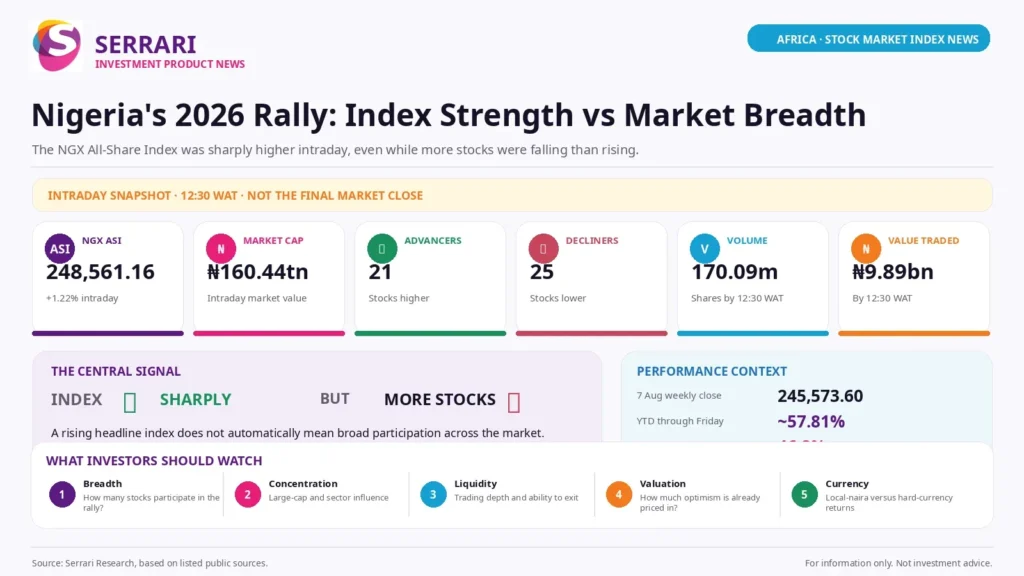
Nigeria’s NGX All-Share Index closed around 248,529 points on 10 August 2026 after gaining approximately 1.20%, pushing its year-to-date return to roughly 59.7%. The infographic contrasts the strong headline index move with weaker market breadth. The latest detailed late-session snapshot showed 26 advancing shares against 33 decliners, demonstrating how large-cap gains can lift a market-capitalisation-weighted benchmark even when more individual stocks are falling than rising. Market capitalisation was around ₦160.4 trillion, while the NGX had already returned 46.8% during the first half of 2026. The central message is: Index sharply higher does not necessarily mean most stocks are higher.
Concentration Can Magnify Returns
Large-cap concentration works in both directions.
When heavyweight shares rally, index investors benefit disproportionately.
But if those companies reverse, the same concentration can accelerate benchmark declines.
Consider Airtel Africa.
With a market capitalisation approaching ₦24 trillion in the latest NGX Pulse data, it alone represents a meaningful part of total listed equity value.
A large daily move in Airtel can therefore have more index impact than significant changes across several smaller companies.
The same principle applies to businesses such as MTN Nigeria, Dangote Cement, BUA Foods and BUA Cement.
Investors following the ASI should know which companies are actually driving it.
Equal-Weighted Performance Would Look Different
One useful way to understand concentration is to imagine an index where every company receives the same weight.
In such a benchmark, a 10% gain in a small company would have the same influence as a 10% gain in Airtel Africa.
The NGX All-Share Index does not work that way.
Larger companies carry greater weight.
An equal-weighted portfolio would therefore probably have produced a different result during Monday’s session because the negative breadth suggests weakness among a larger number of stocks.
This does not make the NGX ASI misleading.
It simply means investors need to understand what it measures.
Liquidity Matters Too
Market breadth tells investors how many shares moved.
Trading liquidity tells them how easily investors can actually enter or exit positions.
By 3:30 p.m. WAT, approximately 658.9 million shares worth ₦20.44 billion had traded in 52,087 deals, according to the latest detailed NGX Pulse Monday turnover snapshot.
FTG Insurance was the most actively traded stock by volume, with more than 305 million shares changing hands.
First HoldCo led by traded value.
High volume in a few shares should not automatically be interpreted as strong liquidity across the entire market.
Some NGX companies trade frequently.
Others can remain relatively illiquid.
Liquidity Can Distort Investor Experience
A stock may show a strong quoted return but be difficult to trade in meaningful size.
This is especially important for larger portfolios.
An institutional investor may not be able to purchase or sell a position at the displayed market price without moving the price.
Illiquid shares can also produce wide bid-offer spreads.
For that reason, two companies producing identical reported returns may provide very different practical investment experiences.
Investors should consider turnover and market depth alongside headline percentage gains.
Local-Currency Returns Are Only One Measure
The NGX ASI is measured in Nigerian naira.
A Nigerian investor whose spending and liabilities are also denominated in naira may naturally focus on that local-currency return.
A foreign investor has another calculation.
Their final return depends on both:
- The performance of the Nigerian shares; and
- The naira’s movement against the investor’s home currency.
A 60% naira equity gain could translate into a substantially different dollar return if the exchange rate changes sharply.
Currency movements can improve or reduce the foreign investor’s final performance.
This is particularly important when comparing Nigeria’s equity rally with stock-market returns in other countries.
H1 Sector Performance Shows the Difference
The enormous variation between Nigeria’s sectors demonstrates why portfolio composition matters.
Oil and Gas gained more than 90% in the first half according to BusinessDay.
Industrial Goods rose 79%.
Banking gained 36.6%.
Insurance actually declined 7.7%.
Two investors could therefore both truthfully say they invested in Nigerian equities throughout H1 and experience completely different outcomes.
That divergence is exactly why market breadth and sector analysis matter.
Strong Index Performance Can Attract New Money
A market approaching a 60% year-to-date gain naturally attracts attention.
Local retail investors may increase allocations because they see strong recent returns.
Institutional investors may increase equity weights.
Foreign investors may revisit the market.
Fund managers may face pressure to reduce cash positions if benchmarks continue rising.
These flows can reinforce momentum.
But they can also increase the risk of investors buying primarily because prices have already risen.
That behaviour becomes more dangerous when valuations move ahead of underlying earnings.
Valuation Becomes More Important After a Rally
A company trading at ₦20 can be attractive or expensive.
A company trading at ₦200 can also be attractive or expensive.
Share price alone says little about valuation.
Investors should compare price with:
- Earnings;
- Cash flow;
- Dividends;
- Book value;
- Debt;
- Growth; and
- Return on capital.
After a strong market-wide rally, those comparisons become increasingly important because prices may have moved much faster than underlying fundamentals in some companies.
Strong momentum does not eliminate valuation risk.
Breadth Can Signal Rotation
Weak breadth does not automatically mean the market rally is about to end.
It can also indicate rotation.
Investors may be moving money away from smaller or weaker companies and toward the stocks they believe have stronger earnings, dividends or balance sheets.
Recent performance suggests significant interest in banks and selected large-cap companies.
If earnings justify those valuations, selective leadership can continue.
But if the market becomes dependent on only a small number of heavyweight shares, overall index risk becomes increasingly concentrated.
Monday’s Signal Is Therefore Mixed
The headline signal is clearly positive.
The NGX All-Share Index gained about 1.20% and finished above 248,000.
The breadth signal is less convincing.
Late-session data still had more stocks falling than rising.
This does not mean the index rally is false.
It means the rally is uneven.
For investors, that difference is important.
An uneven bull market requires more stock selection than a market where nearly everything is rising.
What Investors Should Monitor
The first measure to watch is whether market breadth improves.
If the index continues rising and the number of advancing stocks begins consistently exceeding decliners, that would suggest the rally is becoming broader.
Investors should also monitor:
- Airtel Africa;
- MTN Nigeria;
- Major banking stocks;
- Industrial heavyweights;
- Sector-index performance;
- Daily market breadth;
- Trading value;
- Foreign portfolio flows;
- Corporate earnings;
- Dividend announcements;
- The naira exchange rate; and
- Valuation multiples.
The official NGX indices data platform remains the primary reference for index information, while NGX’s historical-data infrastructure provides the longer-term record needed to compare current performance.
Conclusion
Nigeria’s equity rally remained powerful on Monday, with the NGX All-Share Index finishing around 248,529 points after gaining approximately 1.20%.
The move takes the market’s 2026 return to roughly 59.7%, following an already exceptional first half.
But Monday also delivered an important warning against reading too much into one index number.
The latest detailed breadth data showed more decliners than advancers even while the benchmark climbed strongly.
Large-cap gains, particularly Airtel Africa’s strong advance and strength among selected banks, helped the index outperform the broader list of stocks.
This does not necessarily make the rally unhealthy.
It does mean the rally is increasingly selective.
For investors, the question is therefore no longer simply:
“Is the Nigerian market rising?”
A more useful question is:
“Which companies are actually driving the rise, and does my portfolio own them?”
That distinction becomes even more important after a year-to-date gain approaching 60%.
Index strength remains impressive.
But breadth, concentration, valuation and liquidity will determine how widely investors actually participate in the next stage of the rally.
FAQs
1. Where did the NGX All-Share Index close on August 10?
Post-close market data showed the Nigerian benchmark at approximately 248,529 points on Monday, representing a gain of about 1.20% from Friday’s 245,573.60 close. This pushes the index’s year-to-date advance to roughly 59.7%.
2. How can the NGX rise when more stocks are falling?
The NGX All-Share Index is influenced more heavily by companies with larger market values. Large gains in heavyweight stocks can therefore offset declines across a larger number of smaller companies. The late-session Monday data showed 26 advancers and 33 decliners while the index was still more than 1% higher, illustrating this effect.
3. Does weak market breadth mean Nigerian stocks will fall?
Not necessarily. Weak breadth shows that gains are concentrated rather than widely shared. A narrow rally can continue if the largest companies maintain strong performance. However, concentration makes the index more dependent on those heavyweight stocks. Investors should monitor whether breadth improves, remains weak or deteriorates further over several sessions before drawing stronger conclusions.
4. Why might a Nigerian investor underperform the NGX index?
Portfolio returns depend on which stocks and sectors the investor owns. Nigeria’s first-half performance varied enormously by sector: Oil and Gas gained about 90.2%, Industrial Goods 79% and Banking 36.6%, while Insurance declined 7.7%. An investor concentrated in weaker sectors could therefore substantially underperform the All-Share Index even during a powerful bull market.
Sources: official NGX indices data platform, NGX Pulse August 10 market wrap, NGX Pulse live market platform, Trading Economics Nigeria market data, Punch weekly NGX market analysis, BusinessDay H1 sector performance review.
Your financial future isn’t something you wait for—it’s something you build.
The real question is: when do you begin?
Move beyond simply staying informed.
Navigate the markets with clarity—track trends through the Serrari Group Market Index, uncover opportunities in the Serrari Marketplace, and build practical knowledge with our Curated Wealth Builder Platform.
Stay connected to what truly matters.
Get daily insights on macro trends and financial movements across Kenya, Africa, and global markets—delivered through the Serrari Newsletter.
Growth opens doors.
Advance your career through professional programs including ACCA, HESI A2, ATI TEAS 7 , HESI EXIT , NCLEX – RN and NCLEX – PN, Financial Literacy!🌟—designed to move you forward with confidence.
See where money is flowing—clearly and in real time.
Track Money Market Funds, Treasury Bills, Treasury Bonds, Green Bonds, and Fixed Deposits, alongside global and African indexes, key economic indicators, and the evolving Crypto and stablecoin landscape—all within Serrari’s Market Index.