Tanzania opens its government bond market to global investors, expanding foreign participation and access to domestic fixed-income securities
Tanzania government bonds are now accessible to global investors following regulatory changes that remove longstanding restrictions on foreign participation in the country’s domestic securities market. The reforms allow non-residents to buy, sell and transfer government securities, potentially expanding Tanzania’s investor base as the government targets TZS3.27 trillion in domestic borrowing during the current fiscal year.
Key Overview
Tanzania has significantly liberalised its capital markets by extending access to domestic government securities beyond investors from the East African Community (EAC), Southern African Development Community (SADC), and the Tanzanian diaspora. The reforms coincide with the Bank of Tanzania’s introduction of a sovereign yield curve designed to improve pricing, transparency and secondary-market development.
Tanzania Government Bonds Open to Foreign Investors
The market for Tanzania government bonds has entered a new phase after the government fully opened domestic securities to international investors.
Under the Foreign Exchange (Amendment) Regulations, 2026, signed on July 13 and gazetted on July 17, non-residents can purchase, sell and transfer securities within Tanzania, including government bonds and other government loan instruments.
The reforms represent a significant expansion of Tanzania’s previous approach to foreign participation in domestic debt markets.
Rather than limiting participation largely to regional investors and Tanzanians living abroad, the new framework potentially allows institutional and individual investors from markets around the world to gain exposure to Tanzanian government debt.
Tanzania Expands Earlier Foreign Investment Reforms
The latest liberalisation builds on reforms introduced in 2022.
Under the earlier framework, Tanzania opened its government securities market to residents of EAC and SADC countries alongside Tanzanians in the diaspora.
The 2026 changes effectively remove that regional limitation and extend market access to foreign investors globally.
Opening the market could help Tanzania diversify its investor base beyond domestic financial institutions while creating additional demand for Treasury securities.
It could also strengthen Tanzania’s position within the broader East Africa bond market, where governments continue developing domestic capital markets as an alternative source of long-term financing.
Bank of Tanzania Introduces Sovereign Yield Curve
The reforms coincide with another significant development in Tanzania’s financial markets.
On August 7, the Bank of Tanzania launched a sovereign yield curve designed to establish clearer benchmarks for pricing financial instruments across different maturities.
A functioning government yield curve can provide an important reference point for determining borrowing costs throughout the economy.
Government securities typically form the foundation of such curves because sovereign debt provides benchmark interest rates against which other financial instruments can be priced.
The new framework could therefore support more transparent pricing of Treasury bonds, corporate bonds and bank lending products.
It may also improve price discovery and encourage greater activity in Tanzania’s secondary bond market.
Tanzania Targets TZS3.27 Trillion in Domestic Borrowing
Opening government securities to international investors comes as Tanzania seeks additional financing from domestic markets.
The government plans to raise approximately TZS3.27 trillion, equivalent to about US$1.24 billion, through domestic borrowing during the current fiscal year.
That represents an increase of nearly 11% compared with the previous year’s planned borrowing.
Allowing a wider range of investors to participate could help absorb additional government issuance while reducing reliance on a relatively concentrated domestic investor base.
However, greater foreign participation could also make the market more sensitive to global interest rates, exchange-rate expectations and shifts in international investor sentiment.
Treasury Bonds Dominate Tanzania’s Domestic Debt
Central government debt stood at approximately TZS114.34 trillion at the end of March 2026, representing an increase of 8.97% from a year earlier.
Domestic debt accounted for TZS38.45 trillion, equivalent to approximately 33.63% of total central government debt.
Within the domestic debt portfolio, Treasury bonds represented the overwhelming majority.
Outstanding Treasury bonds reached approximately TZS31.61 trillion, accounting for 82.22% of domestic government debt.
The high share reflects Tanzania’s strategy of relying more heavily on longer-dated securities, helping extend the maturity profile of government borrowing and reduce refinancing risks associated with frequently rolling over short-term debt.
Domestic Bond Ownership Remains Concentrated
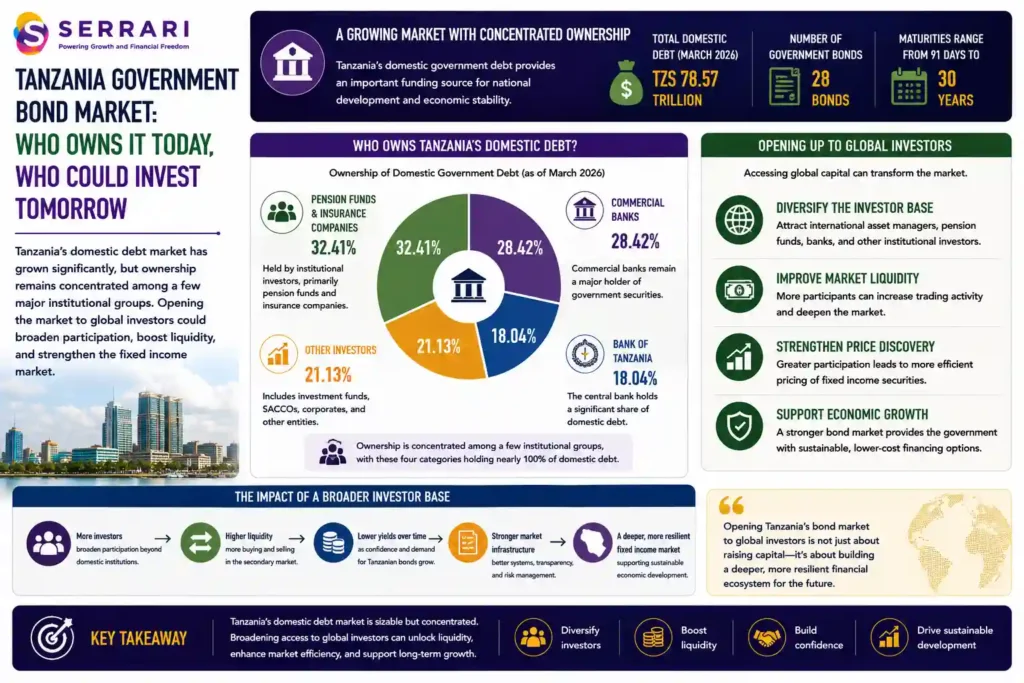
Despite the size of Tanzania’s domestic debt market, ownership remains concentrated among several major institutional groups.
Institutional investors, particularly pension funds and insurance companies, held approximately 32.41% of domestic debt as of March 2026.
Commercial banks accounted for another 28.42%, while the Bank of Tanzania held approximately 18.04%.
Opening the market to global investors could gradually change this structure by bringing international asset managers, pension funds, banks and other institutional investors into Tanzanian fixed income securities.
A broader investor base could potentially increase market liquidity and strengthen secondary-market trading.
Context is everything. Stay ahead of shifting trends with today’s market updates, and uncover emerging opportunities using the Serrari Group Market Index and Marketplace. Then, take control of your own financial future by exploring our Money & Life Reset Transformation Blueprint ™ to build stronger habits, create better systems, and design a path toward lasting wealth.
Minimum Investment Requirements Remain Accessible
Tanzania’s government securities market offers different minimum investment thresholds depending on the instrument.
Treasury bills require a minimum investment of TZS500,000, equivalent to approximately US$189, while Treasury bonds require at least TZS1 million, or approximately US$378.
These relatively modest thresholds make government securities accessible beyond large institutional investors, although international participation will also depend on settlement arrangements, foreign-exchange rules, custody infrastructure and investors’ assessment of currency and sovereign risk.
For foreign investors in particular, returns must be evaluated alongside potential movements in the Tanzanian shilling because currency depreciation can reduce returns when investments are converted back into dollars or other foreign currencies.
Financial Market Reforms Continue
The bond-market liberalisation forms part of broader changes to Tanzania’s financial system.
In January 2024, the country adopted an interest-rate-based monetary policy framework, increasing the importance of efficient financial markets in transmitting monetary policy decisions throughout the economy.
The Bank of Tanzania also introduced an electronic matching system for USD/TZS interbank foreign-exchange transactions in May 2026.
The system is intended to improve transparency and price discovery within the foreign-exchange market, another important consideration as Tanzania seeks greater international participation in its financial markets.
Together with the new sovereign yield curve and expanded foreign access to government securities, the measures point toward deeper integration between Tanzania’s domestic financial system and international capital markets.
Tanzania Also Considers a Eurobond
Tanzania is separately considering entering international debt markets through a potential Eurobond.
A government adviser has indicated that a possible transaction could raise as much as US$500 million, although any issuance would depend on prevailing global market conditions.
A Eurobond and the liberalisation of domestic Tanzania government bonds would represent two different approaches to attracting international capital.
A Eurobond would typically involve borrowing directly in foreign currency on international markets, while opening domestic government securities allows international investors to participate in instruments issued within Tanzania’s existing local market.
The latter can help deepen domestic capital markets, although foreign investors would generally assume additional currency risk.
Outlook for Tanzania Government Bonds
Opening Tanzania government bonds to global investors represents an important step in the development of the country’s financial markets.
The reforms could diversify the government’s funding sources, increase competition among investors and improve liquidity across the domestic bond market.
The introduction of a sovereign yield curve should further support market development by creating clearer pricing benchmarks for government and corporate debt.
Still, attracting substantial international capital will depend on more than regulatory access. Foreign investors will assess inflation, fiscal sustainability, exchange-rate stability, liquidity, political risk and the ability to move capital efficiently into and out of Tanzania.
If these reforms successfully translate regulatory access into sustained investor participation, Tanzania could strengthen both its domestic fixed income market and its position within East Africa’s increasingly important capital markets.
FAQs
Can foreign investors buy Tanzania government bonds?
Yes. Tanzania’s 2026 foreign-exchange reforms allow non-residents to purchase, sell and transfer domestic securities, significantly expanding international access to Tanzania government bonds.
How much does Tanzania plan to borrow domestically?
Tanzania plans to raise approximately TZS3.27 trillion, or around US$1.24 billion, through domestic borrowing during the current fiscal year, nearly 11% more than the previous year’s target.
What is the minimum investment in Tanzania Treasury bonds?
The minimum investment for Treasury bonds is TZS1 million, approximately US$378, while Treasury bills have a minimum investment requirement of TZS500,000.
Why did the Bank of Tanzania introduce a sovereign yield curve?
The Bank of Tanzania introduced the sovereign yield curve to provide clearer pricing benchmarks for government securities, corporate bonds and other financial products while improving price discovery and supporting secondary-market development.
Sources: Kenyan Wallstreet, Eastleigh Voice, Eagle News Feed, Business Insider Africa, Reuters
Your financial future isn’t something you wait for—it’s something you build.
The real question is: when do you begin?
Move beyond simply staying informed.
Navigate the markets with clarity—track trends through the Serrari Group Market Index, uncover opportunities in the Serrari Marketplace, and build practical knowledge with our Curated Wealth Builder Platform.
Stay connected to what truly matters.
Get daily insights on macro trends and financial movements across Kenya, Africa, and global markets—delivered through the Serrari Newsletter.
Growth opens doors.
Advance your career through professional programs including ACCA, HESI A2, ATI TEAS 7 , HESI EXIT , NCLEX – RN and NCLEX – PN, Financial Literacy!🌟—designed to move you forward with confidence.
See where money is flowing—clearly and in real time.
Track Money Market Funds, Treasury Bills, Treasury Bonds, Green Bonds, and Fixed Deposits, alongside global and African indexes, key economic indicators, and the evolving Crypto and stablecoin landscape—all within Serrari’s Market Index.