LAPTRUST I-REIT reported weaker earnings in the first half of 2026 as a sharp contraction in rental income outweighed an improvement in its occupancy rate. Rental income fell 49.6% to KSh 124.63 million, while net profit declined 28.5% to KSh 57.82 million. The deterioration came despite overall portfolio occupancy increasing to 86% from 82%. The real estate investment trust also recorded declining property values, weaker investment returns and a lower interim distribution, highlighting the continuing pressure on its underlying property portfolio.
Key Overview
The first-half results reveal a widening gap between LAPTRUST I-REIT’s physical occupancy and financial performance. Total revenue declined 42.2% to KSh 176.29 million, while rental income almost halved. Although operating expenses fell substantially, the savings were insufficient to prevent another decline in REIT earnings. At the same time, the value of the fund’s seven properties has fallen by approximately KSh 1.20 billion since the end of 2022, while net asset value per unit has dropped below the original KSh 20 issue value.
LAPTRUST I-REIT Rental Income Falls Nearly 50%
LAPTRUST Imara I-REIT recorded a significant deterioration in its core property earnings during the six months ended June 2026, despite reporting stronger occupancy across parts of its portfolio.
Rental income dropped 49.6% to KSh 124.63 million, compared with KSh 247.21 million in the corresponding period of 2025. The decline was substantial enough to push rental income below the level recorded three years earlier.
The latest performance represents a sharp reversal in what had previously been a steady upward trend. Rental income increased from KSh 167.10 million in H1 2023 to KSh 198.35 million in H1 2024 before climbing further to KSh 247.21 million in H1 2025.
By H1 2026, however, rental income had fallen to KSh 124.63 million, representing a decline of almost KSh 123 million in a single year.
The deterioration is particularly important for a real estate investment trust because recurring rental income is central to generating distributable earnings for investors.
Total Revenue Drops 42% as REIT Earnings Weaken
The decline in property income filtered through to LAPTRUST I-REIT’s overall financial performance.
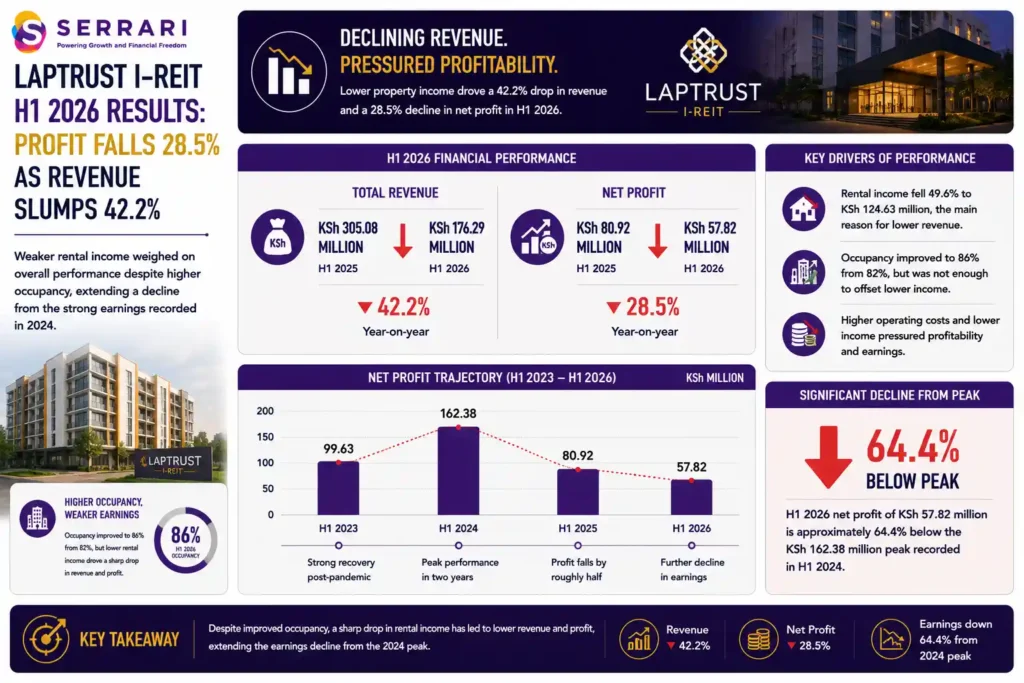
Total revenue fell 42.2% to KSh 176.29 million from KSh 305.08 million in the corresponding period of 2025.
Net profit subsequently declined 28.5% to KSh 57.82 million from KSh 80.92 million a year earlier.
The latest results extend a decline from the significantly stronger earnings recorded in 2024. LAPTRUST I-REIT generated a first-half net profit of KSh 99.63 million in 2023 before earnings climbed to KSh 162.38 million in 2024.
Profit then fell by roughly half to KSh 80.92 million in 2025 before declining again to KSh 57.82 million in 2026.
That means H1 2026 net profit was approximately 64.4% below the KSh 162.38 million peak recorded two years earlier, illustrating how significantly the fund’s earnings trajectory has changed.
Lower Operating Expenses Cushion the Decline
One positive development in the latest results was a substantial reduction in operating costs.
Operating expenses fell 47.1% to KSh 118.47 million, providing some protection against the much steeper deterioration that could otherwise have occurred in profitability.
Provisions for bad debts were among the expenses recording the largest reductions, declining 74.1% to KSh 31.45 million.
Cost reductions can improve the efficiency of a property portfolio, but there is a limit to how much expense management can compensate for declining recurring income.
For LAPTRUST I-REIT, the latest numbers suggest improving operating efficiency alone was insufficient to offset the sharp contraction in rental revenue.
Occupancy Rate Improves to 86%
The financial deterioration occurred despite an improvement in the fund’s overall occupancy rate, creating one of the most notable features of the H1 2026 results.
Overall occupancy increased to 86% from 82%.
Residential properties performed particularly strongly, reaching an occupancy rate of 97%, while utility and education properties achieved full occupancy.
Retail occupancy stood at 70%.
Commercial properties recorded an occupancy rate of 89%, although performance softened as some tenants rationalised the amount of space they occupied and negotiated more competitive leasing arrangements.
Parking was substantially weaker, with occupancy falling to 54%. Hybrid working arrangements and lower daily office density continued to affect demand for parking facilities associated with commercial properties.
The contrast between rising overall occupancy and falling rental income demonstrates why occupancy alone does not provide a complete picture of the financial health of rental properties.
Lease pricing, tenant mix, concessions, collection rates and the amount of income generated per occupied square metre can all materially affect revenue even when more space is technically occupied.
Property Portfolio Loses KSh 1.2 Billion in Value
The deterioration extends beyond income generated by the properties.
The value of LAPTRUST I-REIT’s seven-property portfolio has declined considerably since the fund’s early reporting period.
The portfolio was valued at approximately KSh 6.90 billion at the end of 2022. By June 2026, that value had fallen to approximately KSh 5.70 billion.
That represents an erosion of around KSh 1.20 billion, equivalent to approximately 17.4%.
Declining valuations are significant for property investment vehicles because investors ultimately have exposure not only to rental cash flows but also to changes in the underlying value of the assets held by the fund.
Continued valuation pressure could therefore affect both the balance sheet and the longer-term returns available to investors.
Context is everything. Stay ahead of shifting trends with today’s market updates, and uncover emerging opportunities using the Serrari Group Market Index and Marketplace. Then, take control of your own financial future by exploring our Money & Life Reset Transformation Blueprint ™ to build stronger habits, create better systems, and design a path toward lasting wealth.
Net Asset Value Per Unit Falls Below Issue Value
The weakening portfolio valuation has been reflected in LAPTRUST I-REIT’s net asset value.
NAV declined 8.0% over the latest year to approximately KSh 5.87 billion. NAV per unit consequently fell to KSh 16.95 from KSh 18.43.
The latest figure is particularly notable when compared with the KSh 20.00 value at which the fund’s 346.23 million units were originally issued.
At KSh 16.95, NAV per unit is approximately 15% below that original level.
The number of units has remained unchanged, meaning the reduction primarily reflects movements in the underlying net asset base rather than dilution caused by the issuance of additional units.
For investors assessing Kenya real estate through listed or regulated investment vehicles, NAV trends provide an important indication of how underlying property values are evolving.
Investment Returns Continue to Weaken
Several return measures also deteriorated during the reporting period.
Annualised return on assets declined to 1.8% from 2.4%, indicating that the portfolio generated less income relative to the assets deployed.
The portfolio’s net operating income yield experienced an even sharper decline, falling to 3.5% from 7.0%.
Distribution yield on NAV decreased to 1.5% from 1.9%, while NAV total return remained negative at 6.6%.
Together, these measures show that the weakness in the latest results extends beyond accounting profit. Both income generation and asset-value performance have come under pressure.
For investors comparing the fund with other opportunities across the real estate market, fixed income and equities, sustained weakness in total returns could influence the attractiveness of the REIT relative to alternative investments.
LAPTRUST I-REIT Cuts Interim Distribution
Lower earnings have also translated into a smaller payout to investors.
LAPTRUST I-REIT declared an interim distribution of KSh 46.26 million, equivalent to KSh 0.134 per unit.
That compares with KSh 64.73 million distributed during the corresponding period a year earlier, representing a decline of approximately 28.5%.
The latest payout represents 80% of distributable income.
Distributions are one of the primary attractions of REIT investing because they allow investors to receive income generated by professionally managed property portfolios without directly purchasing and managing individual buildings.
Declining property income can therefore have a direct effect on the cash returns received by unit holders.
Zero Debt Provides an Important Buffer
One factor working in LAPTRUST I-REIT’s favour is its ungeared position.
The fund remains without debt, meaning the deterioration in returns cannot primarily be attributed to rising financing costs or higher interest payments.
That distinction is important in the current commercial real estate environment, where leveraged property owners can face additional pressure when interest rates rise or loans need to be refinanced.
Without significant debt costs, LAPTRUST has greater protection from that particular risk.
However, the ungeared position also makes the underlying issue clearer: weaker performance is principally connected to operating income and property valuations rather than financial leverage.
What the Results Mean for Kenya’s REIT Market
LAPTRUST I-REIT’s first-half performance illustrates some of the challenges facing institutional property investment in Kenya.
Higher occupancy would normally be considered encouraging because it indicates that more of the portfolio is being utilised. Yet the simultaneous decline in rental income shows that investors need to look beyond headline occupancy figures when assessing property performance.
The crucial question will be whether improved occupancy eventually translates into stronger recurring rental revenue.
If the fund can maintain high residential occupancy, strengthen commercial leasing and improve income generated from occupied properties, earnings could stabilise. Recovery in underlying property valuations would provide an additional boost to net asset value.
Conversely, continued declines in rental income and asset valuations could place further pressure on distributions and overall investment returns.
For now, LAPTRUST I-REIT enters the second half of 2026 with stronger occupancy but considerably weaker income, profits and asset values than its earlier performance might have suggested.
FAQs
Why did LAPTRUST I-REIT’s profit decline in H1 2026?
LAPTRUST I-REIT’s net profit fell 28.5% to KSh 57.82 million as rental income declined sharply to KSh 124.63 million. Lower operating expenses helped cushion the impact, but they were insufficient to offset the substantial reduction in revenue.
What is LAPTRUST I-REIT’s current occupancy rate?
The fund’s overall occupancy rate improved to 86% from 82%. Residential occupancy reached 97%, while utility and education properties were fully occupied. Commercial occupancy stood at 89%, retail at 70% and parking occupancy at 54%.
How much has LAPTRUST I-REIT’s property portfolio declined in value?
The seven-property portfolio declined from approximately KSh 6.90 billion at the end of 2022 to KSh 5.70 billion by June 2026. This represents an estimated KSh 1.20 billion, or 17.4%, reduction in portfolio value.
How much will LAPTRUST I-REIT distribute to investors?
The REIT declared an interim distribution of KSh 46.26 million, equivalent to KSh 0.134 per unit. The distribution represents 80% of distributable income and is lower than the KSh 64.73 million paid for the corresponding period a year earlier.
Your financial future isn’t something you wait for—it’s something you build.
The real question is: when do you begin?
Move beyond simply staying informed.
Navigate the markets with clarity—track trends through the Serrari Group Market Index, uncover opportunities in the Serrari Marketplace, and build practical knowledge with our Curated Wealth Builder Platform.
Stay connected to what truly matters.
Get daily insights on macro trends and financial movements across Kenya, Africa, and global markets—delivered through the Serrari Newsletter.
Growth opens doors.
Advance your career through professional programs including ACCA, HESI A2, ATI TEAS 7 , HESI EXIT , NCLEX – RN and NCLEX – PN, Financial Literacy!🌟—designed to move you forward with confidence.
See where money is flowing—clearly and in real time.
Track Money Market Funds, Treasury Bills, Treasury Bonds, Green Bonds, and Fixed Deposits, alongside global and African indexes, key economic indicators, and the evolving Crypto and stablecoin landscape—all within Serrari’s Market Index.