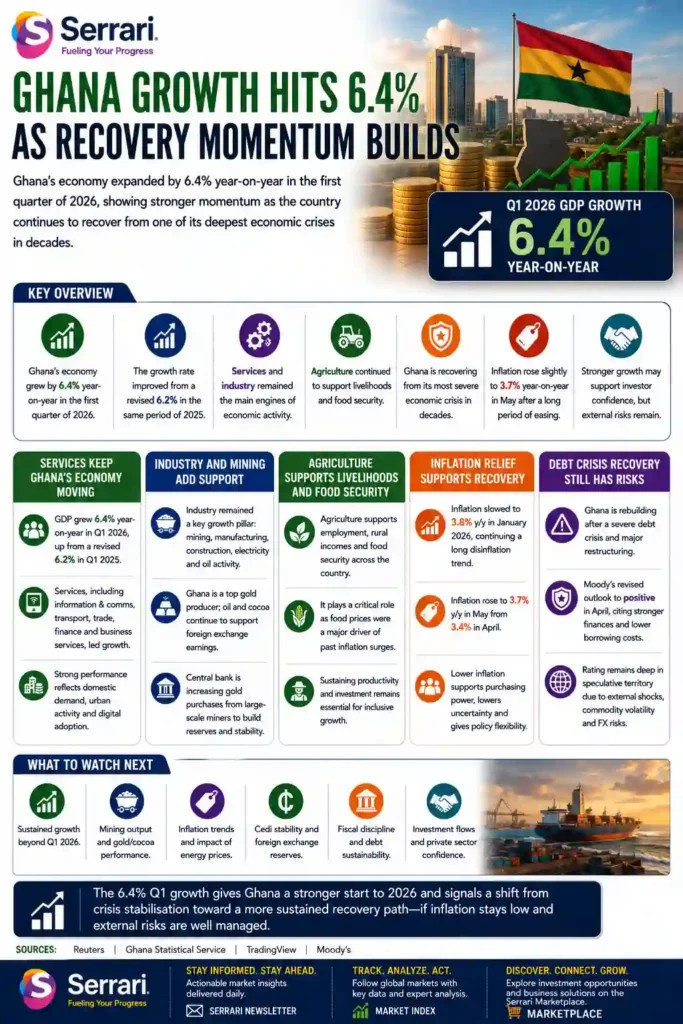
Ghana’s economy expanded by 6.4% year-on-year in the first quarter of 2026, showing stronger momentum as the country continues to recover from one of its deepest economic crises in decades.
The latest data showed that services remained the main driver of growth, supported by activity in information and communication, transport, trade and other business-linked sectors. Industry also contributed to the expansion, helped by mining and quarrying in a country where gold, oil and cocoa remain major economic pillars.
The growth figures come as Ghana benefits from a sharper slowdown in inflation compared with the crisis period, although prices edged higher again in May. The combination of stronger output and more stable prices gives policymakers some room to rebuild confidence, but the recovery still faces risks from commodity prices, external financing needs and global energy shocks.
Key Overview
- Ghana’s economy grew by 6.4% year-on-year in the first quarter of 2026.
- The growth rate improved from a revised 6.2% in the same period of 2025.
- Services and industry remained the main engines of economic activity.
- Agriculture continued to support livelihoods and food security.
- Ghana is recovering from its most severe economic crisis in decades.
- Inflation rose slightly to 3.7% year-on-year in May after a long period of easing.
- Stronger growth may support investor confidence, but external risks remain.
Services Keep Ghana’s Economy Moving
Ghana’s latest growth data shows that the services sector is still carrying much of the economy’s momentum. According to official data reported on Wednesday, gross domestic product grew by 6.4% year-on-year in the first quarter of 2026, compared with a revised 6.2% in the same period of 2025.
Government Statistician Alhassan Iddrisu said the results showed an economy that continued to expand while experiencing greater price stability. Services remained central to that expansion, covering areas such as information and communication technology, transport, trade, financial services and other commercial activity.
This is important because services tend to reflect domestic demand, urban business activity and digital adoption. Stronger performance in this part of the economy suggests that households and businesses are operating in a more stable environment than during the height of Ghana’s debt and inflation crisis.
Industry And Mining Add Support
Industry also remained a key growth pillar. Ghana’s industrial sector includes mining and quarrying, manufacturing, construction, electricity and oil-related activity. Mining is especially important because Ghana is one of Africa’s major gold producers, while oil and cocoa continue to influence foreign exchange earnings.
The country has also been working to strengthen its external buffers through gold accumulation. In May, the central bank sought to increase gold purchases from large-scale miners to strengthen reserves, according to details of the gold reserve plan. That policy highlights how important the mining sector has become to Ghana’s broader macroeconomic stabilisation strategy.
Agriculture, while not the fastest-growing sector, remains important for employment, rural incomes and food security. Its role is particularly relevant because food prices were one of the major drivers of Ghana’s previous inflation surge.
Markets move fast; don’t get left behind. We’ve paired the Serrari Group Market Index with a curated Marketplace and a comprehensive Wealth Builder Platform to ensure you have the data—and the skills—to act on it.
Inflation Relief Supports Recovery
Ghana’s growth recovery is being helped by a major improvement in price stability. Inflation had slowed sharply over the past two years, falling from crisis-era highs to single-digit levels. In January 2026, consumer inflation slowed to 3.8% year-on-year, continuing a long disinflation trend, according to inflation data at the start of the year.
However, the latest figures show that inflation is no longer falling in a straight line. Ghana’s consumer inflation rose to 3.7% year-on-year in May from 3.4% in April, according to May price data. The increase was mild compared with previous years, but it shows that global shocks, especially energy-related pressures, can still affect the domestic outlook.
For businesses and consumers, lower inflation remains one of the most important parts of the recovery. It supports purchasing power, lowers uncertainty and gives the Bank of Ghana more flexibility in managing interest rates.
Debt Crisis Recovery Still Has Risks
Ghana is still rebuilding after a severe debt crisis that forced a major restructuring and weakened investor confidence. The latest growth numbers suggest the recovery is gaining traction, but the country is not yet fully out of the woods.
In April, Moody’s revised Ghana’s outlook to positive, citing improvements in domestic financing conditions, lower borrowing costs and a stronger fiscal position, according to the ratings update. However, the rating agency kept Ghana’s rating deep in speculative territory, reflecting continued exposure to external shocks, commodity price volatility and foreign exchange risks.
The challenge now is to convert the rebound into durable growth. That means keeping inflation contained, strengthening public finances, attracting investment and ensuring that growth reaches sectors that create jobs.
What To Watch Next
Ghana’s next test will be whether growth remains strong beyond the first quarter. Investors will be watching services activity, mining output, cocoa sector performance, inflation trends and the cedi’s stability.
If inflation remains low and growth stays above expectations, Ghana could continue rebuilding credibility after its debt crisis. But if global oil prices rise further or export earnings weaken, the recovery could become more fragile.
For now, the 6.4% first-quarter growth figure gives Ghana a stronger start to 2026 and signals that the economy is moving from crisis stabilisation toward a more sustained recovery path.
Sources used: Reuters / Ghana Statistical Service / TradingView / Moody’s
Context is everything. Stay ahead of shifting trends with today’s market updates, and uncover emerging opportunities using the Serrari Group Market Index and Marketplace. Then, take control of your own financial future by exploring our Money & Life Reset Transformation Blueprint ™ to build stronger habits, create better systems, and design a path toward lasting wealth.
Your financial future isn’t something you wait for—it’s something you build.
The real question is: when do you begin?
Move beyond simply staying informed.
Navigate the markets with clarity—track trends through the Serrari Group Market Index, uncover opportunities in the Serrari Marketplace, and build practical knowledge with our Curated Wealth Builder Platform.
Stay connected to what truly matters.
Get daily insights on macro trends and financial movements across Kenya, Africa, and global markets—delivered through the Serrari Newsletter.
Growth opens doors.
Advance your career through professional programs including ACCA, HESI A2, ATI TEAS 7 , HESI EXIT , NCLEX – RN and NCLEX – PN, Financial Literacy!🌟—designed to move you forward with confidence.
See where money is flowing—clearly and in real time.
Track Money Market Funds, Treasury Bills, Treasury Bonds, Green Bonds, and Fixed Deposits, alongside global and African indexes, key economic indicators, and the evolving Crypto and stablecoin landscape—all within Serrari’s Market Index.