Kenya’s banking sector is entering a tougher capital cycle after the Central Bank of Kenya ruled out grace periods for lenders that have not met the KSh 3 billion minimum core capital requirement.
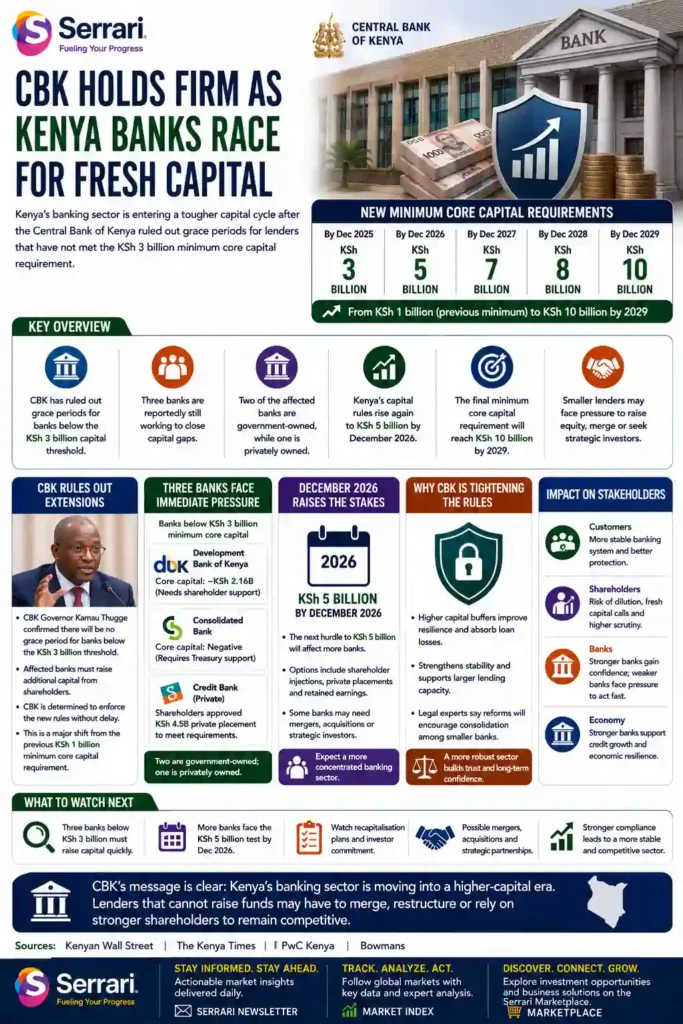
The new rules, introduced through the Business Laws (Amendment) Act, 2024, require banks and mortgage finance companies to progressively raise minimum core capital from KSh 1 billion to KSh 10 billion by 2029. The first major threshold was KSh 3 billion by the end of 2025, with the next hurdle rising to KSh 5 billion by the end of 2026.
CBK Governor Kamau Thugge said affected banks must raise additional capital from shareholders, with Treasury support expected for at least one institution. The decision could accelerate consolidation, recapitalisation and restructuring among smaller lenders.
Key Overview
- CBK has ruled out grace periods for banks below the KSh 3 billion capital threshold.
- Three banks are reportedly still working to close capital gaps.
- Two of the affected banks are government-owned, while one is privately owned.
- Kenya’s capital rules rise again to KSh 5 billion by December 2026.
- The final minimum core capital requirement will reach KSh 10 billion by 2029.
- Smaller lenders may face pressure to raise equity, merge or seek strategic investors.
CBK Rules Out Extensions
CBK Governor Kamau Thugge confirmed that the regulator has not offered banks any grace period to meet the KSh 3 billion minimum core capital requirement. Speaking after the Monetary Policy Committee meeting, he said some lenders were expected to issue additional capital, while shareholders would be required to inject more funds to meet the regulatory floor.
The latest position, reported in CBK’s capital threshold update, signals that the regulator is determined to enforce the new rules without delay. This is a major shift for smaller banks that previously operated under a KSh 1 billion minimum core capital requirement.
The pressure follows the enactment of the Business Laws (Amendment) Act, 2024, which introduced a phased increase in capital requirements. Under the new framework, banks must move from KSh 3 billion by the end of 2025 to KSh 5 billion by the end of 2026, KSh 7 billion by 2027, KSh 8 billion by 2028 and KSh 10 billion by 2029, according to a capital rules analysis.
Three Banks Face Immediate Capital Pressure
The immediate concern is the group of lenders still below the KSh 3 billion threshold. According to local market reporting, CBK indicated that about three banks were yet to meet the requirement and would need to complete their capital-raising plans.
The raw disclosures point to Development Bank of Kenya, Consolidated Bank and Credit Bank as institutions facing notable pressure. Development Bank reportedly had core capital of about KSh 2.16 billion, while Consolidated Bank remained deeply undercapitalised with negative core capital. Credit Bank, the private lender in breach, had already secured shareholder approval to raise KSh 4.5 billion through a private placement.
The government-owned nature of two affected banks makes Treasury support an important part of the recapitalisation picture. Consolidated Bank has long been viewed as one of the most distressed lenders, while Development Bank is expected to rely on shareholder backing to close its capital gap.
Markets move fast; don’t get left behind. We’ve paired the Serrari Group Market Index with a curated Marketplace and a comprehensive Wealth Builder Platform to ensure you have the data—and the skills—to act on it.
December 2026 Raises The Stakes
The KSh 3 billion requirement is only the first challenge. The bigger pressure point arrives at the end of 2026, when the minimum core capital requirement rises to KSh 5 billion.
This next phase could affect more banks, particularly small and mid-sized lenders whose profits, retained earnings and investor access are limited. Some banks may be able to close the gap through shareholder injections, private placements or retained earnings. Others may need mergers, acquisitions or strategic investors.
The likely result is a more concentrated banking sector. Larger banks with stronger balance sheets may benefit from increased market confidence, while smaller lenders may need to prove that they can survive in a higher-capital regulatory environment.
Why CBK Is Tightening The Rules
CBK’s capital reform is aimed at strengthening financial sector resilience. Higher capital buffers give banks more room to absorb loan losses, withstand economic shocks and support larger lending books without becoming unstable.
Legal experts have also noted that the reforms are designed to make the sector more robust while encouraging consolidation among smaller institutions. A review of the Business Laws (Amendment) Act by legal advisers said the higher capital requirement is likely to result in mergers and acquisitions among smaller banks.
For customers, the reform could create a more stable banking system. For shareholders, however, it means more dilution risk, fresh capital calls and tougher scrutiny of weak balance sheets.
What To Watch Next
The next six months will be critical. Investors, depositors and regulators will be watching whether the three banks below the KSh 3 billion requirement secure fresh capital quickly. Attention will then shift to the wider group of lenders that must meet the KSh 5 billion threshold by December 2026.
Banks with credible recapitalisation plans may retain confidence. Those that delay may face rising regulatory pressure, weaker market perception and possible consolidation talks.
CBK’s message is clear: Kenya’s banking sector is moving into a higher-capital era, and lenders that cannot raise funds may have to merge, restructure or rely on stronger shareholders to remain competitive.
Sources used: Kenyan Wall Street / The Kenya Times / PwC Kenya / Bowmans
Context is everything. Stay ahead of shifting trends with today’s market updates, and uncover emerging opportunities using the Serrari Group Market Index and Marketplace. Then, take control of your own financial future by exploring our Money & Life Reset Transformation Blueprint ™ to build stronger habits, create better systems, and design a path toward lasting wealth.
Your financial future isn’t something you wait for—it’s something you build.
The real question is: when do you begin?
Move beyond simply staying informed.
Navigate the markets with clarity—track trends through the Serrari Group Market Index, uncover opportunities in the Serrari Marketplace, and build practical knowledge with our Curated Wealth Builder Platform.
Stay connected to what truly matters.
Get daily insights on macro trends and financial movements across Kenya, Africa, and global markets—delivered through the Serrari Newsletter.
Growth opens doors.
Advance your career through professional programs including ACCA, HESI A2, ATI TEAS 7 , HESI EXIT , NCLEX – RN and NCLEX – PN, Financial Literacy!🌟—designed to move you forward with confidence.
See where money is flowing—clearly and in real time.
Track Money Market Funds, Treasury Bills, Treasury Bonds, Green Bonds, and Fixed Deposits, alongside global and African indexes, key economic indicators, and the evolving Crypto and stablecoin landscape—all within Serrari’s Market Index.