














Tencent Holdings has raised $4.66 billion through a dual-currency bond sale, marking its first US dollar debt issuance in more than five years and another major offshore yuan raise. The deal gives the Chinese technology giant fresh funding capacity as it accelerates investment in artificial intelligence, cloud infrastructure and next-generation AI products.
The timing is important. Tencent is increasing AI spending while facing tighter national security scrutiny from the United States, after being named on a Pentagon list of Chinese military-linked companies. The bond demand shows credit investors remain comfortable with Tencent’s financial strength, but equity investors may now focus more closely on leverage, interest costs and whether AI investments can translate into sustainable revenue growth.
Key Overview
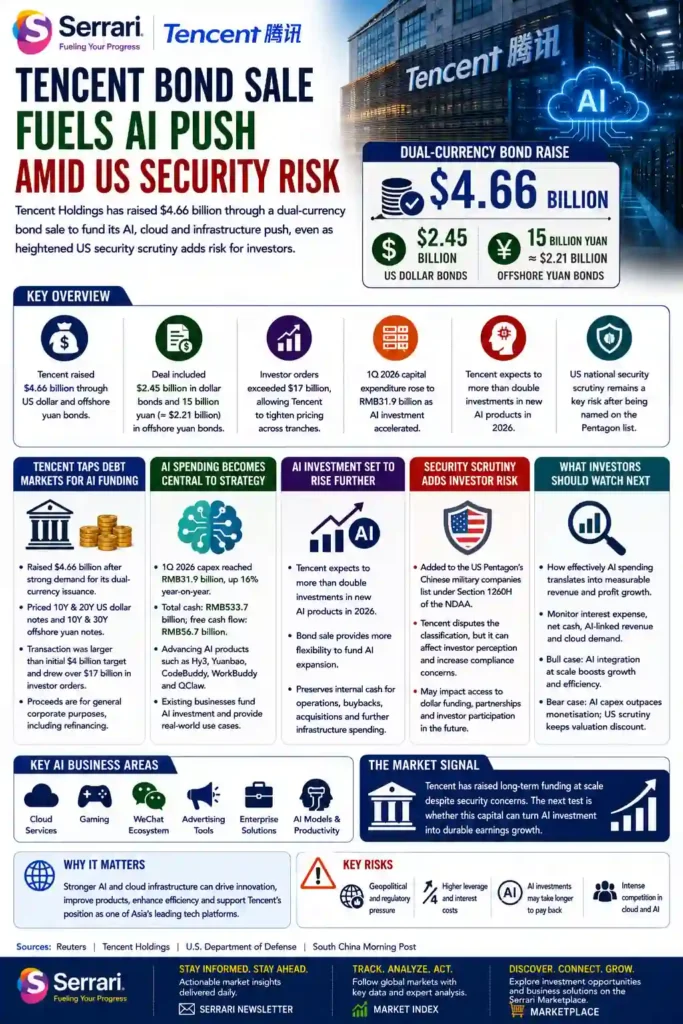
- Tencent raised $4.66 billion through US dollar and offshore yuan bonds.
- The deal included $2.45 billion in dollar bonds and 15 billion yuan, or about $2.21 billion, in offshore yuan bonds.
- Investor orders exceeded $17 billion, allowing Tencent to tighten pricing across the tranches.
- Tencent’s 2026 first-quarter capital expenditure rose to RMB31.9 billion as AI investment increased.
- The company has said it expects to more than double investments in new AI products in 2026.
- US national security scrutiny remains a key risk after Tencent was included on the Pentagon’s Chinese military companies list.
Tencent Taps Debt Markets For AI Funding
Tencent’s latest bond sale underlines how aggressively large technology companies are funding the AI race. The company raised $4.66 billion after strong demand for its dual-currency issuance, with final pricing covering 10-year and 20-year US dollar notes as well as 10-year and 30-year offshore yuan notes, according to details of the bond sale.
The transaction was larger than the initial $4 billion target and drew more than $17 billion in orders. That level of demand suggests Tencent still enjoys strong access to global credit markets, supported by its cash generation, diversified business lines and investment-grade profile.
The company’s earlier term sheets showed that proceeds were intended for general corporate purposes, including refinancing. However, the broader investment story is clearly tied to Tencent’s AI build-out. The group has been investing in AI models, productivity agents, cloud infrastructure and tools designed to improve advertising, gaming, enterprise services and consumer products.
Markets move fast; don’t get left behind. We’ve paired the Serrari Group Market Index with a curated Marketplace and a comprehensive Wealth Builder Platform to ensure you have the data—and the skills—to act on it.
AI Spending Becomes Central To Tencent’s Strategy
Tencent’s own disclosures show that AI is no longer a side initiative. In its first-quarter 2026 results, the company said capital expenditure reached RMB31.9 billion, up 16% year-on-year, while total cash stood at RMB533.7 billion and free cash flow rose to RMB56.7 billion, according to its quarterly results announcement.
Management also highlighted progress in AI products including Hy3, Yuanbao, CodeBuddy, WorkBuddy and QClaw. Tencent said its existing businesses continued to provide the cash flow needed to fund AI investment, while also giving the company real use cases for future deployment.
The scale of the spending is set to rise further. In its 2025 annual results presentation, Tencent said it expected to more than double investments in new AI products in 2026. That makes the bond sale important because it gives the company more flexibility to fund AI expansion while preserving internal cash for operations, buybacks, acquisitions or further infrastructure spending.
Security Scrutiny Adds Investor Risk
The opportunity is not without complications. Tencent’s bond sale comes against a tense geopolitical backdrop, especially after the US Department of Defense released an updated list of Chinese military companies operating directly or indirectly in the United States, under Section 1260H of the National Defense Authorization Act, according to the official release.
Tencent has previously disputed such classification, and being named does not automatically equal broad financial sanctions. However, the label can still affect investor perception, increase compliance concerns and make some global institutions more cautious. For bondholders, the immediate question is whether future US actions could affect Tencent’s access to dollar funding. For shareholders, the bigger concern is whether geopolitical pressure could raise the company’s cost of capital or restrict partnerships, suppliers and investor participation.
The risk also comes as Washington has widened scrutiny of Chinese technology firms. A recent US update added several major Chinese companies to the Pentagon-linked list, increasing attention on the country’s technology, semiconductor, electric vehicle and artificial intelligence sectors, according to reported details.
What Investors Should Watch Next
Tencent’s bond sale strengthens its funding base, but investors will need to monitor how effectively the company converts AI spending into measurable returns. AI-related infrastructure can be expensive, and payback periods may be long if revenue from cloud, agents, advertising tools and enterprise products grows more slowly than expected.
Key items to watch include the company’s interest expense, net cash position, AI-linked revenue disclosures and management commentary on cloud demand. Tencent’s first-quarter results showed strong cash resources, but higher debt still raises the bar for execution.
The bullish case is that Tencent uses its gaming, WeChat, advertising and cloud ecosystem to integrate AI at scale, improving both revenue growth and operating efficiency. The bearish case is that AI capex expands faster than monetisation, while US scrutiny keeps a valuation discount on the stock.
For now, the bond market has sent a positive signal. Tencent has raised long-term funding at scale despite security concerns. The next test is whether that capital can help turn AI investment into durable earnings growth.
Sources used: Reuters / Tencent Holdings / U.S. Department of Defense / South China Morning Post
Context is everything. Stay ahead of shifting trends with today’s market updates, and uncover emerging opportunities using the Serrari Group Market Index and Marketplace. Then, take control of your own financial future by exploring our Money & Life Reset Transformation Blueprint ™ to build stronger habits, create better systems, and design a path toward lasting wealth.
Your financial future isn’t something you wait for—it’s something you build.
The real question is: when do you begin?
Move beyond simply staying informed.
Navigate the markets with clarity—track trends through the Serrari Group Market Index, uncover opportunities in the Serrari Marketplace, and build practical knowledge with our Curated Wealth Builder Platform.
Stay connected to what truly matters.
Get daily insights on macro trends and financial movements across Kenya, Africa, and global markets—delivered through the Serrari Newsletter.
Growth opens doors.
Advance your career through professional programs including ACCA, HESI A2, ATI TEAS 7 , HESI EXIT , NCLEX – RN and NCLEX – PN, Financial Literacy!🌟—designed to move you forward with confidence.
See where money is flowing—clearly and in real time.
Track Money Market Funds, Treasury Bills, Treasury Bonds, Green Bonds, and Fixed Deposits, alongside global and African indexes, key economic indicators, and the evolving Crypto and stablecoin landscape—all within Serrari’s Market Index.