Global markets came under fresh pressure on Wednesday as renewed strikes between Iran and the United States reignited geopolitical risk, lifted oil prices and pushed investors away from equities.
The market reaction was driven by two connected concerns. First, fresh military exchanges around the Strait of Hormuz raised fears of further disruption to global energy supply. Second, higher oil prices are feeding directly into inflation expectations, making it harder for central banks to ease policy and increasing the risk that interest rates remain high for longer.
The sell-off affected European shares, Wall Street futures and Asian equities, while oil prices moved higher from recent lows. Investors were also watching US inflation data, the European Central Bank’s policy meeting and Japan’s rising wholesale prices for signs that the energy shock is spreading through the global economy.
Key Overview
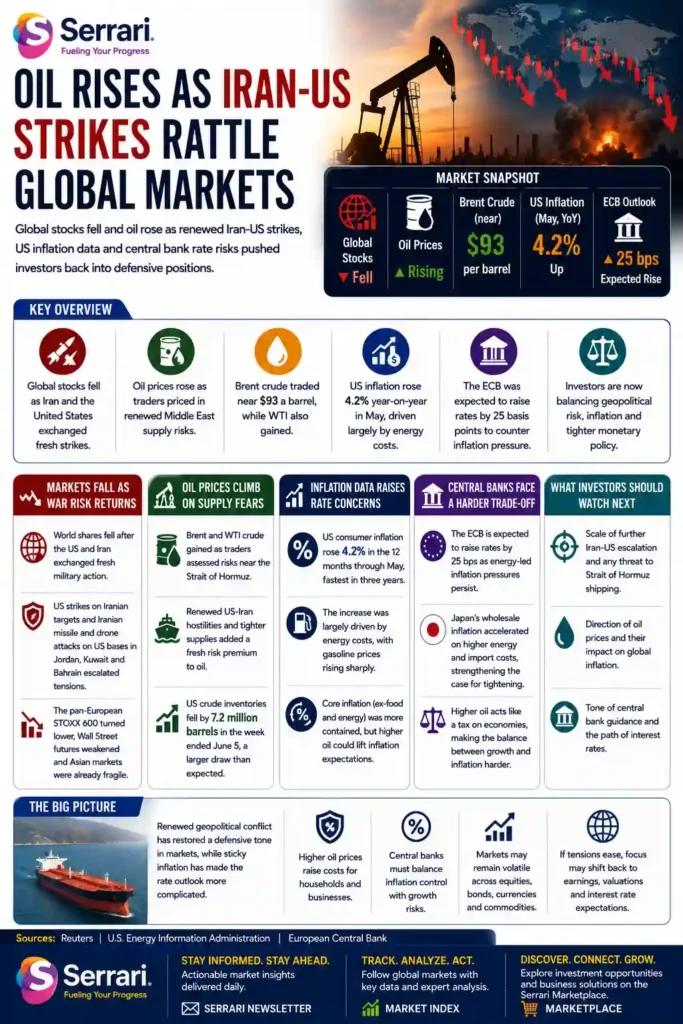
- Global stocks fell as Iran and the United States exchanged fresh strikes.
- Oil prices rose as traders priced in renewed Middle East supply risks.
- Brent crude traded near $93 a barrel, while WTI also gained.
- US inflation rose 4.2% year-on-year in May, driven largely by energy costs.
- The ECB was expected to raise rates by 25 basis points to counter inflation pressure.
- Investors are now balancing geopolitical risk, inflation and tighter monetary policy.
Markets Fall As War Risk Returns
Global equities weakened after the United States and Iran exchanged fresh military action, reversing earlier hopes that tensions in the region were easing. According to market reporting, world shares fell while oil rallied as investors moved to price in higher geopolitical risk and renewed energy supply concerns.
The latest market pressure followed US strikes on Iranian targets and Iranian missile and drone attacks on US bases in Jordan, Kuwait and Bahrain. According to regional conflict updates, a US official said there was no significant damage, but the escalation was enough to unsettle investors.
The pan-European STOXX 600 turned lower after initially showing resilience, while Wall Street futures also weakened. In Asia, investor sentiment was already fragile, with technology-heavy markets under pressure as concerns over AI valuations mixed with war-related uncertainty.
Oil Prices Climb On Supply Fears
Oil markets reacted quickly to the renewed fighting. Brent and US West Texas Intermediate crude gained as traders assessed the risk of further disruption near the Strait of Hormuz, one of the world’s most important oil transit routes.
According to energy market updates, oil prices were supported by renewed US-Iran hostilities and a sharp fall in US crude inventories. The US Energy Information Administration reported that crude stocks fell by 7.2 million barrels in the week ended June 5, a larger draw than analysts had expected.
That combination of military risk and tighter inventories added a fresh risk premium to oil. Even though markets have become more accustomed to Middle East tensions in recent months, the involvement of US bases and strikes near strategic shipping routes increases the chance of sudden price swings.
Markets move fast; don’t get left behind. We’ve paired the Serrari Group Market Index with a curated Marketplace and a comprehensive Wealth Builder Platform to ensure you have the data—and the skills—to act on it.
Inflation Data Raises Rate Concerns
The oil rebound also matters because energy prices are now feeding into inflation. US consumer inflation rose 4.2% in the 12 months through May, the fastest pace in three years, according to consumer price data. The increase was largely driven by energy costs, with gasoline prices rising sharply.
For investors, the key issue is whether inflation remains concentrated in energy or spreads into broader prices. Core inflation, which excludes food and energy, was more contained, but persistent oil strength could still influence inflation expectations.
That makes the Federal Reserve’s next message more important. A stronger-than-expected jobs report had already reduced hopes for near-term rate cuts. If inflation remains elevated, the Fed may find it difficult to sound relaxed, even if policymakers are cautious about tightening aggressively into a supply shock.
Central Banks Face A Harder Trade-Off
The European Central Bank is also under pressure. It was expected to raise interest rates by 25 basis points as energy-led inflation continued to affect the euro area. According to ECB policy expectations, the move was being viewed by some analysts as an “insurance hike” to protect inflation credibility.
The Bank of Japan is facing similar pressure. Earlier Reuters reporting showed that Japan’s wholesale inflation accelerated as higher energy and import costs widened price pressures, strengthening the case for further monetary tightening.
The challenge for central banks is that higher oil prices act like a tax on households and businesses, while also lifting inflation. Raising rates too aggressively risks hurting growth, but ignoring energy-driven inflation could damage credibility.
What Investors Should Watch Next
Markets are likely to remain sensitive to three major factors: the scale of further Iran-US escalation, the direction of oil prices and the tone of central bank guidance.
If fighting expands or threatens shipping around the Strait of Hormuz, oil could move higher and deepen inflation worries. If tensions ease, investors may shift attention back to corporate earnings, technology valuations and the path of interest rates.
For now, the market message is clear. Renewed geopolitical conflict has restored a defensive tone, while inflation data has made the rate outlook more complicated. Investors may need to prepare for continued volatility across equities, bonds, currencies and commodities.
Sources used: Reuters / U.S. Energy Information Administration / European Central Bank
Context is everything. Stay ahead of shifting trends with today’s market updates, and uncover emerging opportunities using the Serrari Group Market Index and Marketplace. Then, take control of your own financial future by exploring our Money & Life Reset Transformation Blueprint ™ to build stronger habits, create better systems, and design a path toward lasting wealth.
Your financial future isn’t something you wait for—it’s something you build.
The real question is: when do you begin?
Move beyond simply staying informed.
Navigate the markets with clarity—track trends through the Serrari Group Market Index, uncover opportunities in the Serrari Marketplace, and build practical knowledge with our Curated Wealth Builder Platform.
Stay connected to what truly matters.
Get daily insights on macro trends and financial movements across Kenya, Africa, and global markets—delivered through the Serrari Newsletter.
Growth opens doors.
Advance your career through professional programs including ACCA, HESI A2, ATI TEAS 7 , HESI EXIT , NCLEX – RN and NCLEX – PN, Financial Literacy!🌟—designed to move you forward with confidence.
See where money is flowing—clearly and in real time.
Track Money Market Funds, Treasury Bills, Treasury Bonds, Green Bonds, and Fixed Deposits, alongside global and African indexes, key economic indicators, and the evolving Crypto and stablecoin landscape—all within Serrari’s Market Index.