ECOWAS lawmakers have called for broad reforms to help more West African micro, small and medium-sized enterprises move into the formal economy, warning that widespread informality is restricting productivity, access to finance and participation in regional trade.
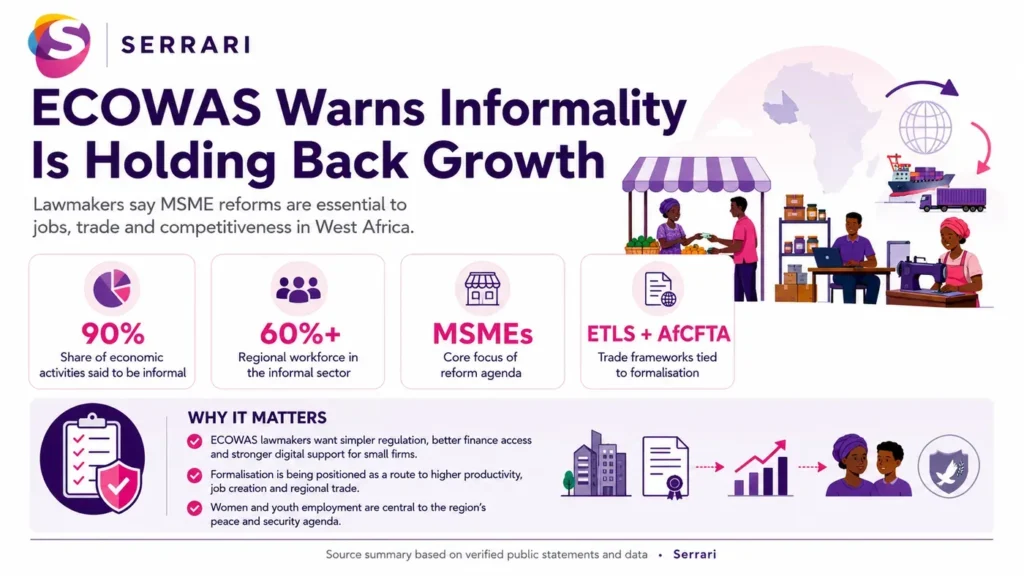
At a Joint Committee meeting held in Cotonou, Benin, on July 27, 2026, lawmakers said the informal sector accounts for nearly 90% of economic activities and employs at least 60% of the regional labour force. The figures were presented as ECOWAS Parliament estimates rather than a measure showing that 90% of West Africa’s recorded gross domestic product is informal. (News Agency of Nigeria)
Key Overview
- ECOWAS lawmakers estimate that informal businesses account for nearly 90% of economic activities in the region.
- The sector is said to employ at least 60% of West Africa’s labour force.
- Proposed reforms focus on finance, digitalisation, simpler regulation and stronger productive capacity.
- Lawmakers want MSMEs integrated into the ETLS and AfCFTA trade frameworks.
- Women and young people are central to the employment and security case for reform.
- The committee will submit recommendations to ECOWAS institutions and member governments.
Parliament Calls for a Regional Formalisation Strategy
The warning was issued during a delocalised Joint Committee meeting involving lawmakers, policy specialists, private-sector representatives and development partners.
Alhagie S. Darbo, speaking for committees covering industry, private-sector development, macroeconomic policy, finance and public accounts, said informality reflects both West Africa’s entrepreneurial energy and weaknesses in the policies intended to help businesses grow.
Many informal firms operate without registration, formal accounts, legal protections or access to organised markets. This can allow very small enterprises to avoid costly procedures, but it also limits their ability to borrow, win larger contracts, adopt new technology or participate in cross-border supply chains.
ECOWAS Parliament Speaker Hadja Memounatou Ibrahima, represented by Second Deputy Speaker Adjaratou Coulibaly, also linked business development to regional security. Their argument is that stronger enterprises can create more opportunities for women and young people, reducing unemployment and some of the economic pressures associated with instability. (News Agency of Nigeria)
The 90% Estimate Requires Careful Interpretation
The claim that informality represents nearly 90% of regional economic activities should not be interpreted as evidence that informal businesses generate 90% of West Africa’s measured GDP. Estimates vary depending on whether researchers count enterprises, jobs, transactions or economic output.
However, independent labour data confirm that informality is exceptionally widespread across Africa. The International Labour Organization estimates that 85.8% of employment across the continent is informal, including agricultural work.
The contrast between the ECOWAS figure of at least 60% of the regional labour force and the higher continent-wide estimate may reflect different definitions, countries and employment categories. Both figures nevertheless show that informal work remains a central feature of African labour markets. (International Labour Organization)
Context is everything. Stay ahead of shifting trends with today’s market updates, and uncover emerging opportunities using the Serrari Group Market Index and Marketplace. Then, take control of your own financial future by exploring our Money & Life Reset Transformation Blueprint ™ to build stronger habits, create better systems, and design a path toward lasting wealth.
Access to Finance Remains a Major Constraint
Formalisation can provide businesses with bank accounts, credit records, legal recognition and access to government or corporate procurement. Yet registration alone will not solve the structural constraints facing small firms.
Access to finance remains one of the most acute barriers for West African SMEs. Small enterprises often lack collateral, audited accounts and predictable cash flows, making them expensive and risky for commercial banks to serve.
Lawmakers therefore called for reforms that combine simpler registration and taxation with affordable finance, business-development support, digital tools, infrastructure and market access. Without these wider benefits, formalisation may be viewed by entrepreneurs only as an additional tax and compliance burden.
Digital registration, interoperable payments and electronic bookkeeping could lower costs while helping firms establish transaction histories. Governments would also gain better economic data and a wider tax base, although enforcement would need to be gradual to avoid pushing vulnerable businesses further outside official systems. (World Bank)
Regional Trade Could Reward Formal Businesses
The reform agenda is closely tied to the ECOWAS Trade Liberalisation Scheme and the African Continental Free Trade Area. Both frameworks offer larger markets, but businesses need documentation, standards compliance and reliable production capacity to benefit fully.
ECOWAS has already identified expanded finance, digital transformation and stronger MSME participation in continental trade as priorities under its 2026–2030 regional MSME strategy.
Previous regional training has similarly focused on helping enterprises use AfCFTA and ETLS opportunities. More formal, productive firms could trade across borders, join regional value chains and compete for institutional contracts that remain inaccessible to unregistered businesses. (ECOWAS)
Reform Must Offer Businesses a Clear Benefit
The formalisation push supports the broader ECOWAS Vision 2050, which seeks a more integrated, peaceful and prosperous region driven by inclusive growth.
Success will depend on whether reforms improve business conditions rather than simply expanding taxation and regulation. Entrepreneurs are more likely to register when formal status delivers visible advantages, including affordable finance, social protection, legal security, digital services and access to larger markets.
The Cotonou committee is expected to prepare recommendations for ECOWAS institutions and member states. The central challenge will be turning a regional policy commitment into practical national reforms that are simple, affordable and valuable to millions of small businesses. (ECOWAS)
Sources: News Agency of Nigeria / ECOWAS / International Labour Organization / World Bank
Your financial future isn’t something you wait for—it’s something you build.
The real question is: when do you begin?
Move beyond simply staying informed.
Navigate the markets with clarity—track trends through the Serrari Group Market Index, uncover opportunities in the Serrari Marketplace, and build practical knowledge with our Curated Wealth Builder Platform.
Stay connected to what truly matters.
Get daily insights on macro trends and financial movements across Kenya, Africa, and global markets—delivered through the Serrari Newsletter.
Growth opens doors.
Advance your career through professional programs including ACCA, HESI A2, ATI TEAS 7 , HESI EXIT , NCLEX – RN and NCLEX – PN, Financial Literacy!🌟—designed to move you forward with confidence.
See where money is flowing—clearly and in real time.
Track Money Market Funds, Treasury Bills, Treasury Bonds, Green Bonds, and Fixed Deposits, alongside global and African indexes, key economic indicators, and the evolving Crypto and stablecoin landscape—all within Serrari’s Market Index.