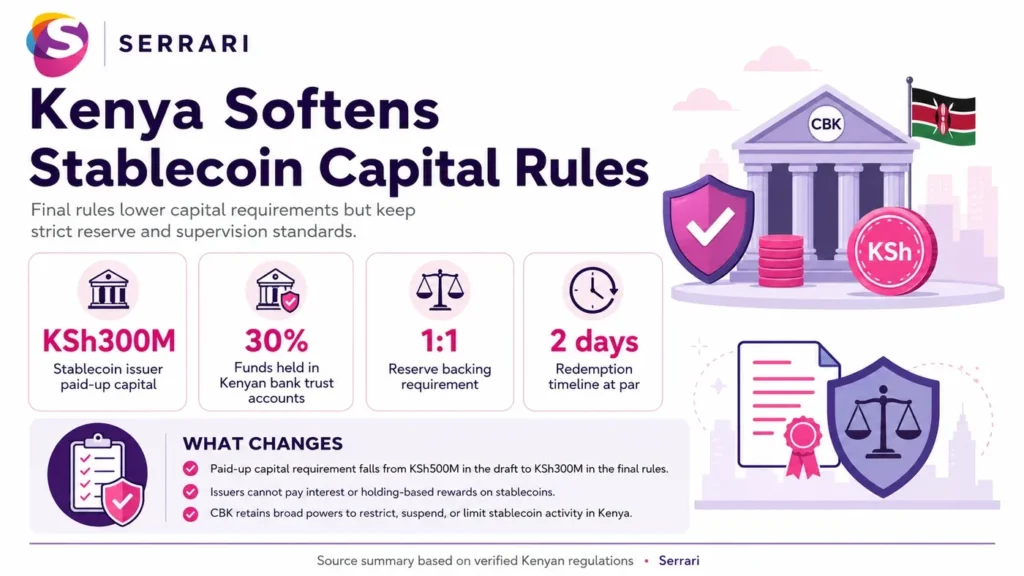
Kenya has reduced the minimum paid-up capital required for stablecoin issuers from KSh500 million in the draft framework to KSh300 million under the final Virtual Asset Service Providers Regulations, 2026.
The 40% cut lowers the largest entry threshold in the licensing regime, but the broader framework remains stringent. Issuers must maintain fully backed reserves, keep part of customer funds in Kenyan banks, provide prompt redemption and submit extensive financial and operational reports.
Key Overview
- Stablecoin issuer paid-up capital falls from KSh500 million to KSh300 million.
- Minimum liquid capital falls to KSh60 million, or 100% of current liabilities for at least 30 days, whichever is higher.
- At least 30% of funds received must remain in segregated accounts at Kenyan commercial banks.
- Stablecoins must remain backed one-to-one by eligible reserve assets.
- Interest and holding-period rewards are prohibited.
- The CBK can halt or restrict issuance, use or local distribution of a stablecoin.
Capital Relief Does Not Remove the High Entry Barrier
The gazetted regulations establish a KSh300 million paid-up capital requirement for stablecoin issuers, compared with KSh500 million in the March draft framework.
The reduction is significant, but KSh300 million still favours well-capitalised operators over smaller local start-ups. Stablecoin issuers must also maintain at least KSh60 million in liquid capital or an amount equal to 100% of current liabilities for at least 30 days, whichever is higher.
Wallet providers face lower fees and capital requirements, highlighting the difference between safeguarding digital assets and issuing a token intended to function like digital money.
| Requirement | Wallet Provider | Stablecoin Issuer |
| Application fee | KSh100,000 | KSh100,000 |
| Licence fee | KSh500,000 | KSh2 million |
| Renewal fee | KSh500,000 or 0.15% of gross turnover | KSh2 million or 0.15% of gross turnover |
| Paid-up capital | KSh150 million | KSh300 million |
| Minimum liquid capital | KSh30 million | KSh60 million |
Local Reserve Rules Remain Intact
The final rules retain the requirement that at least 30% of funds received in exchange for stablecoins be held in segregated accounts at Kenyan commercial banks. The remaining funds must be invested in Kenya in secure, low-risk and highly liquid assets.
Fiat-backed stablecoins must hold reserves denominated in the same official currency as the token’s peg. Every issued token must also be fully backed by eligible assets, including cash, bank deposits, government securities with no more than 90 days remaining to maturity and short-term repurchase agreements.
Reserve assets must be separated from the issuer’s operating assets and from reserves supporting any other stablecoin. This structure is intended to prevent creditors from claiming customer reserves if an issuer becomes insolvent.
For Kenyan banks, the 30% requirement could create a new source of institutional deposits. For international issuers, however, the localisation requirement increases the cost and complexity of establishing a licensed Kenyan operation.
Context is everything. Stay ahead of shifting trends with today’s market updates, and uncover emerging opportunities using the Serrari Group Market Index and Marketplace. Then, take control of your own financial future by exploring our Money & Life Reset Transformation Blueprint ™ to build stronger habits, create better systems, and design a path toward lasting wealth.
CBK Gains Broad Powers Over Stablecoin Access
The framework allows the relevant regulator to prohibit, limit or halt the issuance or use of a stablecoin. It can also require an issuer to delist or curtail activity where market integrity, consumer protection or financial stability is threatened.
This means the CBK does not necessarily need to regulate every foreign issuer directly. It can instead exercise control through locally licensed exchanges, wallet providers and other intermediaries offering those stablecoins to Kenyan customers.
That authority matters in a market where Kenya was placed among the leading jurisdictions in the 2025 global crypto ranking, reflecting strong demand for digital assets, remittance tools and stable-value tokens.
Consumer Protection Rules Target Reserves and Redemption
Stablecoin holders must have a right to redeem their tokens at par value, and the final framework requires redemption within two working days. Where an issuer accepts Kenyan shillings during issuance, customers must also be offered redemption in shillings.
Neither issuers nor licensed service providers may pay interest on stablecoins. The definition extends to remuneration, discounts or other benefits linked to how long a customer holds a token, effectively preventing yield-like loyalty schemes.
Issuers must conduct reserve stress tests, publish reserve information and submit monthly reports covering circulation, holders, transaction activity, reserve composition and de-pegging events. Independent reserve examinations and regular reporting give the CBK a detailed view of each licensed token’s financial position.
Directors, senior officers, significant shareholders and external auditors may also be held liable for investor losses caused by incomplete or misleading information in a stablecoin white paper. The combination of personal liability, reserve segregation and frequent reporting places disclosure and solvency at the centre of Kenya’s stablecoin regime.
The Final Rules Balance Access With Control
Kenya has responded to industry concerns by lowering the largest capital requirement, but it has not weakened the framework’s core safeguards. The rules continue to prioritise reserve quality, local liquidity, rapid redemption and direct regulatory intervention.
The result is a regime that may attract large, compliance-ready firms while remaining difficult for smaller issuers to enter. Its longer-term effect will depend on whether global stablecoin businesses seek Kenyan licences or continue serving users through offshore and decentralised channels.
Sources: Kenya Law / National Treasury / Bybit / The Kenyan Wall Street
Your financial future isn’t something you wait for—it’s something you build.
The real question is: when do you begin?
Move beyond simply staying informed.
Navigate the markets with clarity—track trends through the Serrari Group Market Index, uncover opportunities in the Serrari Marketplace, and build practical knowledge with our Curated Wealth Builder Platform.
Stay connected to what truly matters.
Get daily insights on macro trends and financial movements across Kenya, Africa, and global markets—delivered through the Serrari Newsletter.
Growth opens doors.
Advance your career through professional programs including ACCA, HESI A2, ATI TEAS 7 , HESI EXIT , NCLEX – RN and NCLEX – PN, Financial Literacy!🌟—designed to move you forward with confidence.
See where money is flowing—clearly and in real time.
Track Money Market Funds, Treasury Bills, Treasury Bonds, Green Bonds, and Fixed Deposits, alongside global and African indexes, key economic indicators, and the evolving Crypto and stablecoin landscape—all within Serrari’s Market Index.