Eighteen months into President Donald Trump’s second term, the U.S. economy has absorbed a succession of shocks without falling into recession. Higher tariffs, tighter immigration enforcement and the Middle East conflict have disrupted labour supply, trade and energy markets, yet consumer spending, business investment and financial markets have remained broadly resilient.
The stronger-than-feared performance has not, however, delivered clear progress on several central campaign promises. Prices remain well above pre-pandemic levels, manufacturing employment is below its January 2025 position, real household income has softened and homeownership remains difficult for many middle-income families.
Key Overview
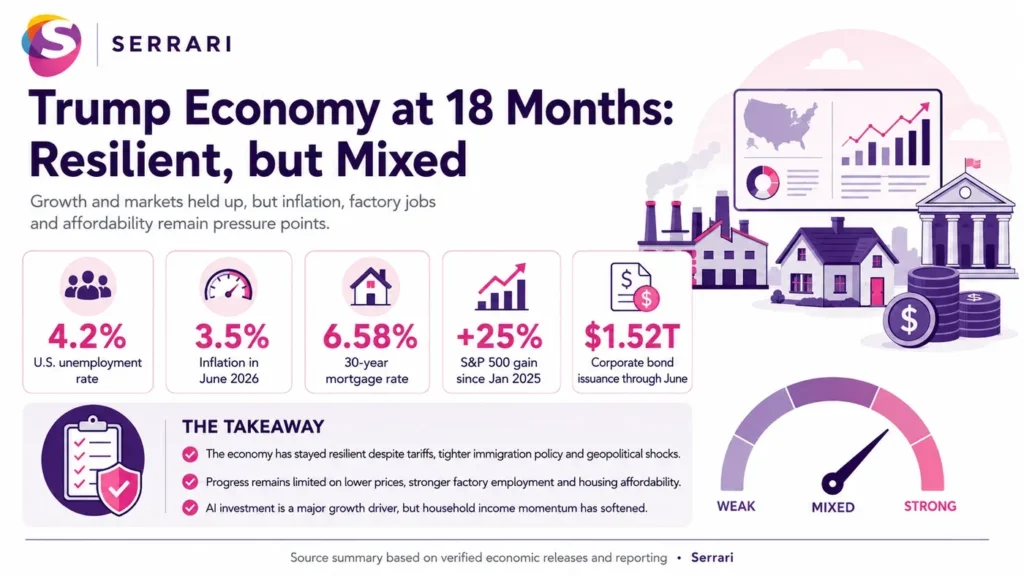
- The unemployment rate held at 4.2% in June 2026, while payrolls increased by 57,000.
- Manufacturing employment remains below the level recorded when Trump returned to office.
- Consumer inflation was 3.5% in June, still above the Federal Reserve’s 2% objective.
- Real disposable personal income in May remained below its January 2026 level.
- The average 30-year fixed mortgage rate was 6.58% on July 23.
- The S&P 500 gained about 25% during the first 18 months of Trump’s second term.
- Corporate bond issuance reached $1.52 trillion through June, partly driven by AI investment.
Labour Market Resists Shocks but Loses Momentum
The labour market has remained stable enough to avoid a sharp rise in unemployment, but its underlying momentum has weakened. The June employment report showed payroll growth of 57,000 and an unemployment rate of 4.2%, with healthcare and social assistance providing much of the hiring.
Manufacturing employment, a major focus of Trump’s economic programme, has not produced the promised revival. Payroll data show fewer factory jobs than at the end of the previous administration, while construction has benefited more directly from spending on data centres and other artificial-intelligence infrastructure.
Interpreting household employment data also requires caution. Updated population estimates introduced in January 2026 created a break in the official series. However, the experimental comparable dataset still indicates that both the labour force and employment have declined since Trump returned to office.
Tighter immigration controls may reduce competition for some jobs, but they also shrink the available workforce. Combined with an ageing population, this creates labour shortages in sectors such as healthcare, construction, hospitality and agriculture.
Inflation Improvement Remains Uneven
Trump campaigned on lowering prices, but broad price levels rarely fall outside severe downturns. The more realistic test is whether inflation slows consistently and household purchasing power improves.
The June inflation report showed consumer prices rising 3.5% over the previous year. Core inflation, excluding food and energy, was lower at 2.6%, but headline inflation remained above the Federal Reserve’s target as energy prices increased 15.7% over 12 months.
Tariffs have raised costs for selected imported products and manufacturing inputs. Oil-market disruption from the Middle East conflict has added another layer of pressure, while rapid construction of AI data centres is increasing demand for power, equipment, labour and financing.
The Federal Reserve’s July monetary policy assessment described an economy supported by AI investment but exposed to renewed inflation and geopolitical risks. That combination complicates interest-rate decisions because tighter policy could weaken employment, while easier policy could allow inflation to accelerate again.
Context is everything. Stay ahead of shifting trends with today’s market updates, and uncover emerging opportunities using the Serrari Group Market Index and Marketplace. Then, take control of your own financial future by exploring our Money & Life Reset Transformation Blueprint ™ to build stronger habits, create better systems, and design a path toward lasting wealth.
Household Spending Holds Up as Income Stalls
Consumer spending has remained an important source of economic resilience. Real personal consumption expenditure increased through May even as households dealt with higher borrowing costs and uneven wage growth.
The concern is that spending power has not improved at the same pace. Real disposable personal income stood at an annualised $17.98 trillion in May, below the $18.13 trillion recorded in January 2026.
This divergence suggests households may be maintaining consumption through reduced savings, accumulated wealth or greater use of credit. It also reinforces concerns about a divided economy in which wealthier households benefit from rising asset prices while lower- and middle-income consumers remain more exposed to food, energy, rent and debt-servicing costs.
Housing Affordability Remains a Major Weak Point
Housing continues to absorb a large share of household income. High property prices, limited supply, insurance expenses and borrowing costs have kept ownership beyond the reach of many prospective buyers.
The average 30-year fixed mortgage rate reached 6.58% on July 23, 2026. Although below the rate recorded a year earlier, it remained far above the ultra-low financing conditions that helped drive home prices higher during the pandemic.
Federal tax incentives and credit programmes may offer limited relief, but local zoning, planning and construction restrictions remain central to the supply problem. As a result, presidential policy alone cannot quickly resolve housing affordability.
Markets and AI Investment Provide the Strongest Results
Financial markets have delivered a clearer success. The 18-month economic assessment found that the S&P 500 gained about 25% during Trump’s second term, slightly above the 24% median for comparable presidential periods since 1981.
Artificial intelligence has been a major driver of both equity gains and business investment. Corporate bond issuance reached $1.52 trillion through June, placing the market on a record pace as major technology companies financed data centres, chips and power capacity.
Earlier forecasts showed that AI-related borrowing could make technology groups some of the largest issuers in the investment-grade market. Strong demand and narrow credit spreads signal confidence in corporate balance sheets, but the borrowing boom also increases the importance of proving that costly AI infrastructure can generate durable returns.
The broader economy has therefore demonstrated resilience rather than transformation. Growth, markets and consumption have held up, but progress on prices, manufacturing jobs, real incomes and affordability remains incomplete as the 2026 midterm elections approach.
Sources: Reuters / U.S. Bureau of Labor Statistics / Federal Reserve / Federal Reserve Bank of St. Louis / Freddie Mac
Your financial future isn’t something you wait for—it’s something you build.
The real question is: when do you begin?
Move beyond simply staying informed.
Navigate the markets with clarity—track trends through the Serrari Group Market Index, uncover opportunities in the Serrari Marketplace, and build practical knowledge with our Curated Wealth Builder Platform.
Stay connected to what truly matters.
Get daily insights on macro trends and financial movements across Kenya, Africa, and global markets—delivered through the Serrari Newsletter.
Growth opens doors.
Advance your career through professional programs including ACCA, HESI A2, ATI TEAS 7 , HESI EXIT , NCLEX – RN and NCLEX – PN, Financial Literacy!🌟—designed to move you forward with confidence.
See where money is flowing—clearly and in real time.
Track Money Market Funds, Treasury Bills, Treasury Bonds, Green Bonds, and Fixed Deposits, alongside global and African indexes, key economic indicators, and the evolving Crypto and stablecoin landscape—all within Serrari’s Market Index.