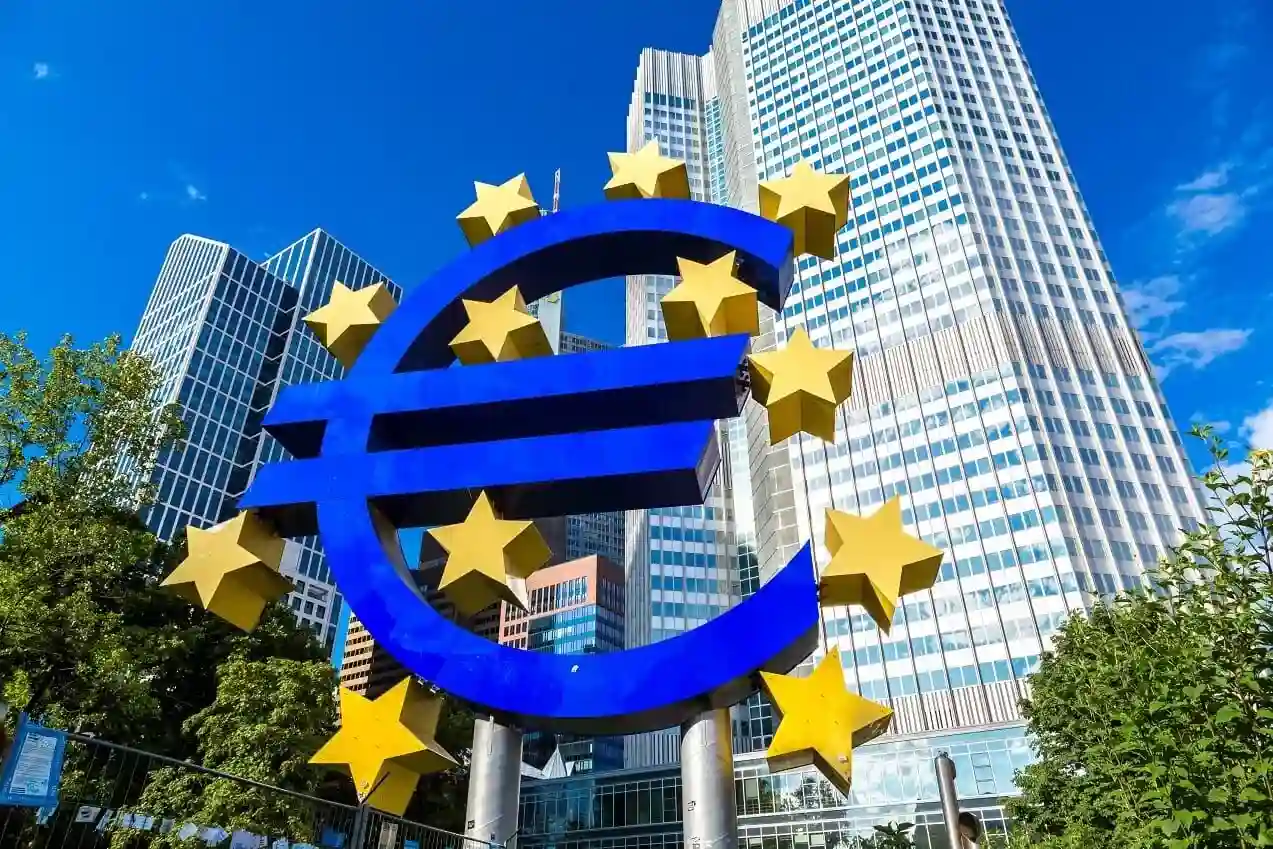
The European Central Bank kept its three key interest rates unchanged on 23 July 2026, pausing after the quarter-percentage-point increase delivered in June as policymakers assessed conflicting signals from slowing underlying inflation and renewed energy-price pressure.
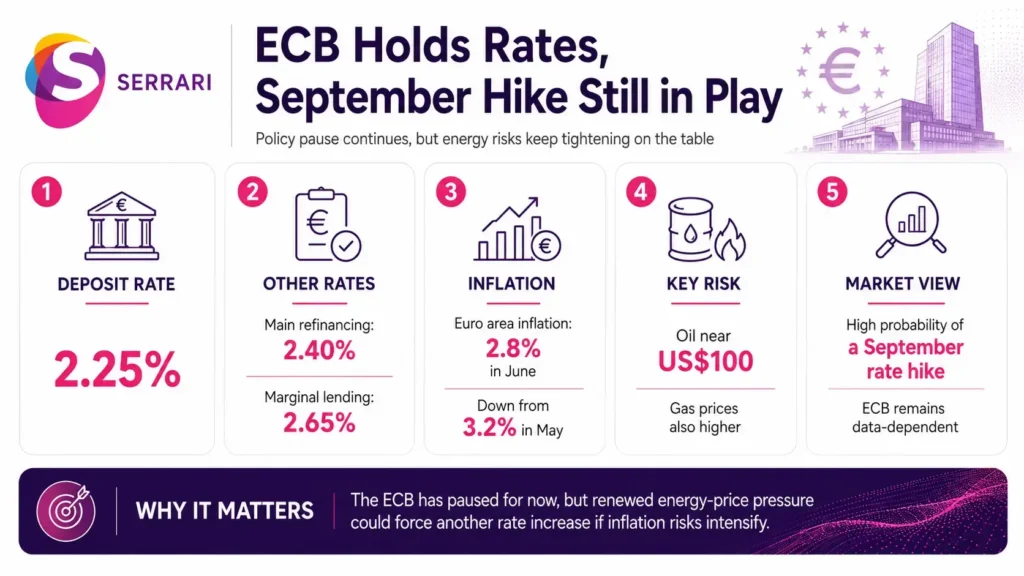
The deposit facility rate remains at 2.25%, while the main refinancing and marginal lending rates stay at 2.40% and 2.65%, respectively. Although the decision was unanimous, President Christine Lagarde revealed that some Governing Council members considered whether rates should be increased immediately.
The debate, together with oil returning to about US$100 per barrel and higher natural gas prices, strengthened expectations that the ECB could raise rates at its next meeting in September. However, the central bank maintained that it has not committed to any particular interest-rate path.
Key Overview
- The ECB left its deposit rate unchanged at 2.25%.
- The main refinancing rate remains at 2.40%, while the marginal lending rate stays at 2.65%.
- The hold was unanimous, but some policymakers considered an immediate increase.
- Euro-area inflation eased to 2.8% in June, from 3.2% in May.
- Energy prices and shipping disruptions have increased the upside risks to inflation.
- Markets placed a high probability on a 25-basis-point September hike after the meeting.
- The ECB said future decisions will remain data-dependent and made meeting by meeting.
ECB Pauses After Its June Interest-Rate Increase
The Governing Council’s 23 July monetary policy decision left the three policy rates unchanged after the ECB increased them in June to contain inflation risks linked to the Middle East energy shock.
The pause reflected improving domestic inflation indicators. Euro-area inflation declined from 3.2% in May to 2.8% in June, while inflation excluding energy and food eased from 2.6% to 2.4%. Services inflation also slowed from 3.5% to 3.2%.
According to the ECB’s July policy statement, wage trackers and corporate surveys continued to indicate moderate wage growth. Long-term inflation expectations also remained close to the central bank’s 2% target.
These trends reduced the urgency of a second consecutive rate increase and supported the decision to wait for additional data.
Energy Reversal Reopens the September Debate
The inflation outlook changed sharply as renewed conflict and disruption to oil shipping pushed international energy prices higher. Brent crude returned to approximately US$100 per barrel on the day of the ECB announcement, while natural gas prices climbed to their highest levels in more than three years.
The energy rebound weakened expectations that the shock would follow the ECB’s milder scenario. Lagarde said that scenario had become unlikely under current conditions and warned that the full inflationary effects of the energy shock had not yet passed through the economy.
Although policymakers agreed to hold rates, Lagarde confirmed that some governors considered a hike during the meeting. The Council ultimately chose to wait for more inflation, wage, growth and business-survey data before deciding whether another increase is necessary.
Traders maintained a roughly 95% probability of a quarter-point increase in September. The market reaction to the decision also reflected expectations of another increase by December, although the outlook beyond September was less certain.
Context is everything. Stay ahead of shifting trends with today’s market updates, and uncover emerging opportunities using the Serrari Group Market Index and Marketplace. Then, take control of your own financial future by exploring our Money & Life Reset Transformation Blueprint ™ to build stronger habits, create better systems, and design a path toward lasting wealth.
Second-Round Inflation Effects Remain Limited
The central issue for the ECB is whether higher energy costs spread into broader and more persistent inflation through wages, services and corporate pricing.
Lagarde said the bank was already seeing direct effects from energy prices and some indirect pressure, including more expensive transportation and business inputs. However, the ECB had not detected clear second-round effects in wage-setting or company pricing decisions.
A persistent cycle in which employees demand higher wages and companies repeatedly raise prices would create a stronger case for additional tightening.
The ECB will therefore monitor the duration, intensity and transmission of the shock. It will receive two new monthly inflation readings, second-quarter economic growth data and updated indicators covering wages, consumer expectations and business activity before its September meeting.
Growth Risks Complicate the Policy Outlook
Higher energy costs are not only inflationary; they can also weaken economic activity by reducing household purchasing power and raising companies’ operating expenses. The ECB expects near-term euro-area growth to remain modest as trade tensions, energy uncertainty and weaker labour demand constrain the economy.
Manufacturing has remained relatively resilient and services activity has partly recovered. Nevertheless, job vacancies have declined, and the labour market outlook remains weaker.
Extreme summer weather adds another risk. The ECB warned that heatwaves and wider climate disruption could increase food prices.
These competing forces complicate September’s decision. Raising rates could contain inflation expectations, but excessive tightening could weaken investment, consumption and industrial activity.
September Hike Is Possible, Not Guaranteed
The July meeting left the ECB in a deliberately flexible position. Policymakers acknowledged that inflation risks have shifted upwards, but they stopped short of promising another increase.
Lagarde emphasised that the ECB is providing a decision-making framework rather than forward guidance. September’s outcome will depend on whether energy prices remain elevated, whether broader inflation pressures emerge and how the euro-area economy performs.
Another increase is plausible if energy prices remain high. Falling energy costs or continued moderation in underlying inflation could weaken the case for tightening.
The ECB’s pause should therefore be viewed as a period of assessment rather than the end of its rate-hiking cycle. September is firmly in play, but the burden of proof remains with the incoming data.
Sources: European Central Bank / Reuters / Associated Press / Eurostat
Your financial future isn’t something you wait for—it’s something you build.
The real question is: when do you begin?
Move beyond simply staying informed.
Navigate the markets with clarity—track trends through the Serrari Group Market Index, uncover opportunities in the Serrari Marketplace, and build practical knowledge with our Curated Wealth Builder Platform.
Stay connected to what truly matters.
Get daily insights on macro trends and financial movements across Kenya, Africa, and global markets—delivered through the Serrari Newsletter.
Growth opens doors.
Advance your career through professional programs including ACCA, HESI A2, ATI TEAS 7 , HESI EXIT , NCLEX – RN and NCLEX – PN, Financial Literacy!🌟—designed to move you forward with confidence.
See where money is flowing—clearly and in real time.
Track Money Market Funds, Treasury Bills, Treasury Bonds, Green Bonds, and Fixed Deposits, alongside global and African indexes, key economic indicators, and the evolving Crypto and stablecoin landscape—all within Serrari’s Market Index.