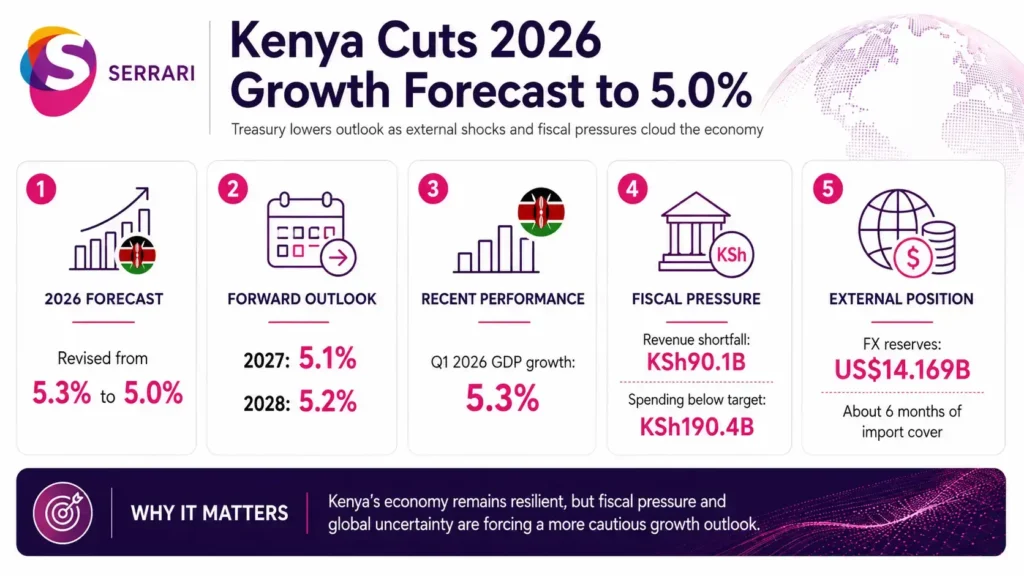
Kenya’s National Treasury has lowered its 2026 economic growth forecast to 5.0% from 5.3%, citing higher global fuel costs, disrupted supply chains and weaker external demand linked to renewed conflict in the Middle East.
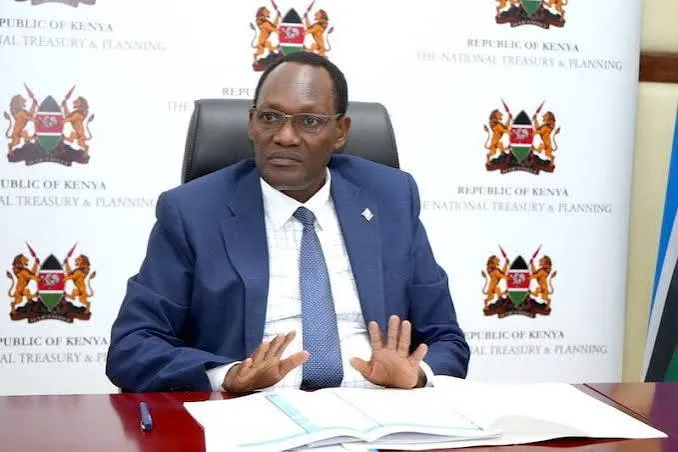
Treasury Principal Secretary Chris Kiptoo said growth is expected to improve gradually to 5.1% in 2027 and 5.2% in 2028, supported by agriculture, financial services, manufacturing, construction, tourism and stronger private-sector investment.
The downgrade comes despite solid first-quarter performance and broadly stable monetary conditions. However, weak revenue collection, rising public-sector wage costs, emergency spending and growing financing requirements remain significant risks to the fiscal outlook.
Key Overview
- Treasury reduced Kenya’s 2026 growth forecast from 5.3% to 5.0%.
- Growth is projected at 5.1% in 2027 and 5.2% in 2028.
- The economy expanded by 5.3% in the first quarter of 2026.
- Revenue collection ended FY2025/26 KSh90.1 billion below target.
- Government expenditure was KSh190.4 billion below target.
- Foreign exchange reserves stood at US$14.169 billion, equal to six months of import cover.
- The World Bank has a lower 4.3% growth forecast for 2026.
Treasury Revises Its Growth Outlook
The latest Treasury forecast reverses the 5.3% projection contained in the government’s 2026 Budget Policy Statement.
The revision reflects a less supportive global environment. Higher oil prices increase Kenya’s import bill, raise transport and production costs and can place renewed pressure on inflation. Supply-chain disruption and softer external demand could also weaken exports, investment and household purchasing power.
Treasury nevertheless expects domestic activity to remain resilient. Agriculture should benefit from improved production, while construction, tourism, financial services and manufacturing are expected to support broader growth.
First-Quarter Data Shows Economic Resilience
Kenya’s economy expanded by 5.3% during the first quarter of 2026, according to the official quarterly GDP report.
Accommodation and food services recorded the fastest growth at 14.7%, supported by stronger international tourism. Manufacturing also improved as production increased across products including cement, sugar, processed milk, soft drinks and locally assembled vehicles.
The performance gives the economy a relatively strong starting point for the year. However, maintaining that momentum will depend on whether external shocks remain contained and whether lower interest rates continue supporting business activity and household demand.
Monetary Conditions Support Credit Recovery
The Central Bank Rate has fallen from 13.0% in August 2024 to 8.75%, following a series of monetary-policy reductions intended to support lending and economic activity.
Commercial lending rates have also eased, while private-sector credit growth reportedly accelerated to 9.3%, with agriculture, trade and construction among the sectors benefiting from improved access to financing.
Kenya’s external position has remained relatively stable. According to the central bank’s July bulletin, official foreign exchange reserves reached US$14.169 billion on 16 July, equivalent to six months of import cover.
The shilling traded at approximately KSh129.34 to the US dollar on the same date, supporting lower imported inflation than Kenya experienced during earlier periods of currency pressure.
Context is everything. Stay ahead of shifting trends with today’s market updates, and uncover emerging opportunities using the Serrari Group Market Index and Marketplace. Then, take control of your own financial future by exploring our Money & Life Reset Transformation Blueprint ™ to build stronger habits, create better systems, and design a path toward lasting wealth.
Revenue Shortfalls Expose Fiscal Weakness
The stronger economic indicators have not fully translated into government revenue. Treasury said total revenue collection for FY2025/26 was KSh90.1 billion below target, including a KSh53.5 billion shortfall in ordinary revenue and KSh36.6 billion in ministerial Appropriations-in-Aid.
Total revenue still increased by 8.6% during the financial year, while ordinary revenue grew by 6.9%. However, collections remained insufficient relative to the budgeted target.
Expenditure and net lending were also KSh190.4 billion below plan because of weaker absorption of both recurrent and development budgets. As a result, the improvement in the fiscal balance was driven partly by underspending rather than stronger revenue mobilisation.
Lower development expenditure may reduce immediate borrowing requirements, but it can also delay infrastructure projects and weaken the quality of public services if under-execution persists.
Competing Forecasts Highlight Downside Risk
Treasury’s 5.0% forecast remains more optimistic than the World Bank’s outlook. The institution projects growth of 4.3% in 2026 and 4.4% in 2027, citing higher energy costs, weaker investment and reduced household purchasing power.
The difference reflects uncertainty over how severely global disruption will affect Kenya. Strong harvests, a stable exchange rate and improved credit growth could support Treasury’s projection, while persistent oil-price pressure, climate shocks or political uncertainty could pull growth closer to the lower estimate.
Fiscal Discipline Will Shape the Medium-Term Outlook
Treasury identified weak tax collection, public-sector wage pressures, drought and flood-related emergency spending and rising financing needs as key risks to future budgets.
The government is targeting a reduction in the budget deficit over the medium term, with the FY2027/28 deficit projected at 3.6% of GDP. Achieving that path will require better revenue performance, tighter expenditure control and stronger execution of development programmes.
Kenya’s economy continues to show resilience, but the revised forecast demonstrates that domestic stability cannot fully insulate it from global shocks. Growth will increasingly depend on whether the government can preserve macroeconomic stability while improving fiscal credibility and protecting productive investment.
Sources: National Treasury of Kenya / Kenya National Bureau of Statistics / Central Bank of Kenya / Reuters / Capital Business
Your financial future isn’t something you wait for—it’s something you build.
The real question is: when do you begin?
Move beyond simply staying informed.
Navigate the markets with clarity—track trends through the Serrari Group Market Index, uncover opportunities in the Serrari Marketplace, and build practical knowledge with our Curated Wealth Builder Platform.
Stay connected to what truly matters.
Get daily insights on macro trends and financial movements across Kenya, Africa, and global markets—delivered through the Serrari Newsletter.
Growth opens doors.
Advance your career through professional programs including ACCA, HESI A2, ATI TEAS 7 , HESI EXIT , NCLEX – RN and NCLEX – PN, Financial Literacy!🌟—designed to move you forward with confidence.
See where money is flowing—clearly and in real time.
Track Money Market Funds, Treasury Bills, Treasury Bonds, Green Bonds, and Fixed Deposits, alongside global and African indexes, key economic indicators, and the evolving Crypto and stablecoin landscape—all within Serrari’s Market Index.