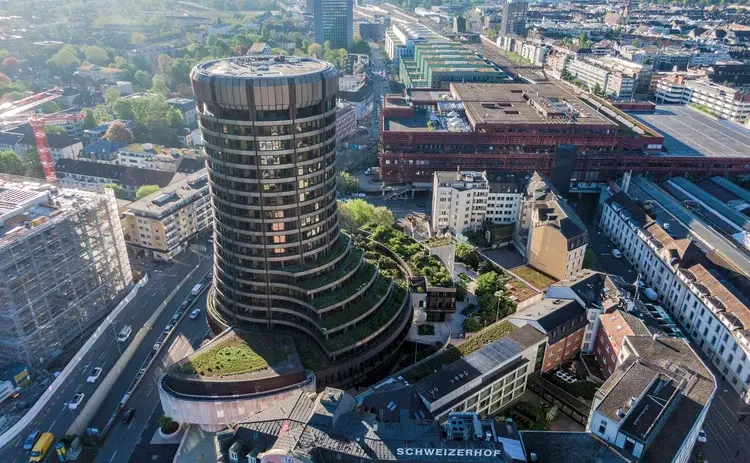
The Bank for International Settlements has warned that the artificial intelligence investment boom is becoming a major pressure point for the global economy. While AI-related spending has helped support growth, especially through data centres, semiconductors and power infrastructure, the BIS says the scale of capital expenditure, rising debt financing and elevated market valuations could become a financial stability risk if expected returns fail to materialise.
Key Overview
- The BIS named the sustainability of the AI boom as one of the main pressure points facing the global economy.
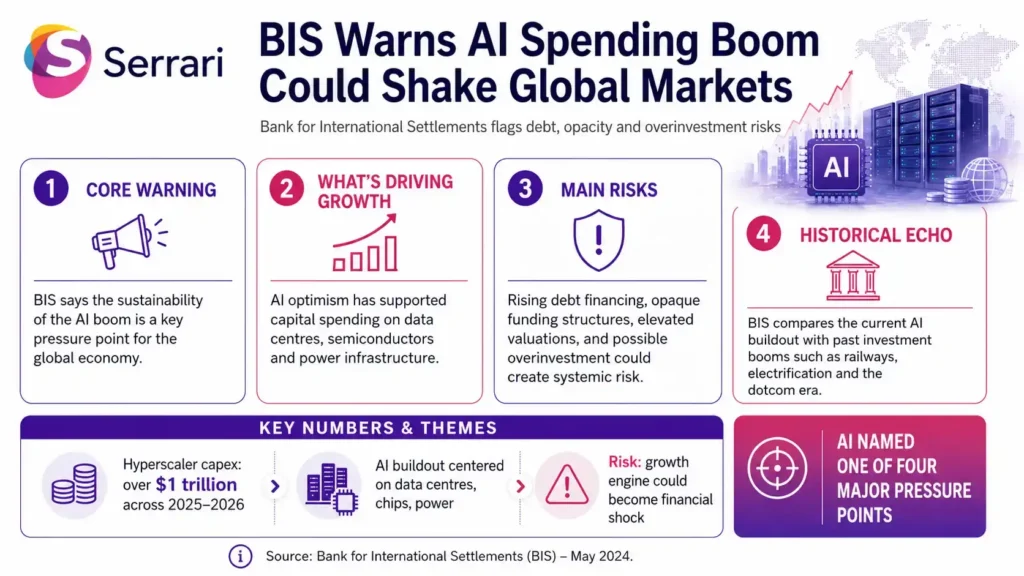
- The five largest hyperscalers are expected to spend more than $1 trillion on AI-related capital expenditure across 2025 and 2026.
- The BIS warned that AI investment is increasingly moving from internal cash-flow funding toward debt and private credit.
- Risks include overinvestment, supply bottlenecks, inflated valuations and a sudden pullback in financing.
- The BIS compared the current AI buildout with earlier technology investment booms, including canals, railways, electrification and the dotcom era.
AI Has Helped Growth, but the BIS Sees Rising Fragility
The Bank for International Settlements said in its Annual Economic Report 2026 that progress in AI helped the global economy withstand shocks during 2025, even as tariffs, geopolitical uncertainty and supply disruptions weighed on the outlook. AI optimism supported equity markets, encouraged capital expenditure and helped keep financial conditions easier than they might otherwise have been.
However, the same boom is now being treated as a source of risk. The BIS said the five largest hyperscalers are set to spend more than $1 trillion on AI-related capital expenditure from 2025 through 2026. This includes spending on data centres, semiconductors, networking hardware, cooling systems, grid connections and power infrastructure.
The concern is not that AI lacks long-term promise. The BIS acknowledges that AI could lift productivity over the next decade. The problem is timing and financing: investors are already pricing in large future gains, while companies are committing enormous sums before the commercial returns are fully proven.
Debt Financing Becomes a Bigger Part of the AI Story
The BIS has separately warned that the AI buildout is pushing firms away from funding investment mainly through cash flows and toward external financing. In its AI financing bulletin, the institution said the size of expected investment needs will require firms to rely more on debt, with private credit playing a rapidly growing role.
That shift matters because the largest technology firms have historically been low-debt, cash-rich companies. As capital expenditure rises faster than free cash flow in some cases, balance sheets could become more exposed to refinancing pressure, interest-rate changes and investor confidence.
Private credit adds another layer of complexity. Non-bank lenders can help finance long-dated AI infrastructure, but their exposures are often less transparent than traditional bank lending or public bond markets. The BIS said AI financing increasingly involves complex interactions across the supply chain, including hyperscalers, suppliers, contractors, lenders and investors.
If demand disappoints or expected AI revenues take longer to arrive, lenders and investors could reassess risk quickly. That could reduce funding availability, widen credit spreads and force companies to slow or cancel investment projects.
Context is everything. Stay ahead of shifting trends with today’s market updates, and uncover emerging opportunities using the Serrari Group Market Index and Marketplace. Then, take control of your own financial future by exploring our Money & Life Reset Transformation Blueprint ™ to build stronger habits, create better systems, and design a path toward lasting wealth.
Why the BIS Compared AI to Earlier Booms
The BIS drew comparisons between today’s AI race and past investment booms linked to major technologies. It cited canal construction in the 1830s, British railway mania in the 1840s, electrification in the late 1920s and the dotcom boom of the late 1990s.
Those episodes were not built on fake technologies. They involved real innovation, new infrastructure and long-term productivity benefits. But they also attracted more capital than near-term commercial returns could justify, eventually leading to investment reversals and broader economic weakness.
The BIS warning is therefore about overshooting. AI firms are racing to secure compute capacity, chips, electricity and data-centre space because many believe only a few winners will dominate the market. That competitive pressure can drive overinvestment, even when each individual company believes it is acting rationally.
Supply bottlenecks could intensify the problem. The BIS noted pressure around electricity, advanced semiconductors and grid equipment. If companies lock into long-term contracts to secure capacity, they may become more exposed if demand falls short.
Market Risk Could Spread Beyond Technology Stocks
The BIS also warned that a reversal in AI optimism could have wider financial consequences. Equity valuations are elevated, especially among firms most closely linked to AI development. Credit markets are also more exposed as AI-related firms issue debt and suppliers expand to meet hyperscaler demand.
According to the BIS press release, policymakers should focus on price stability, fiscal sustainability and financial stability beyond the banking system. The institution said AI optimism may not last if bottlenecks restrain production or if intense competition leads to unsustainable investment.
This means the AI boom is no longer only a technology sector story. It has become a macro-financial issue because it affects growth, stock markets, credit conditions, energy demand, infrastructure investment and investor risk appetite.
For now, AI remains one of the strongest drivers of global growth. But the BIS warning is clear: if financing becomes too leveraged, valuations become too stretched and returns disappoint, the AI buildout could shift from growth engine to financial shock.
Sources used: Bank for International Settlements / Business Standard / Reuters / Axios
Your financial future isn’t something you wait for—it’s something you build.
The real question is: when do you begin?
Move beyond simply staying informed.
Navigate the markets with clarity—track trends through the Serrari Group Market Index, uncover opportunities in the Serrari Marketplace, and build practical knowledge with our Curated Wealth Builder Platform.
Stay connected to what truly matters.
Get daily insights on macro trends and financial movements across Kenya, Africa, and global markets—delivered through the Serrari Newsletter.
Growth opens doors.
Advance your career through professional programs including ACCA, HESI A2, ATI TEAS 7 , HESI EXIT , NCLEX – RN and NCLEX – PN, Financial Literacy!🌟—designed to move you forward with confidence.
See where money is flowing—clearly and in real time.
Track Money Market Funds, Treasury Bills, Treasury Bonds, Green Bonds, and Fixed Deposits, alongside global and African indexes, key economic indicators, and the evolving Crypto and stablecoin landscape—all within Serrari’s Market Index.