Kenya has secured a $750 million World Bank budget support package aimed at easing fiscal pressure, reducing reliance on expensive domestic borrowing and supporting reforms in governance, public financial management and social protection. The approval comes as the government continues to manage heavy debt repayments, budget deficits and investor concerns over fiscal sustainability.
Key Overview
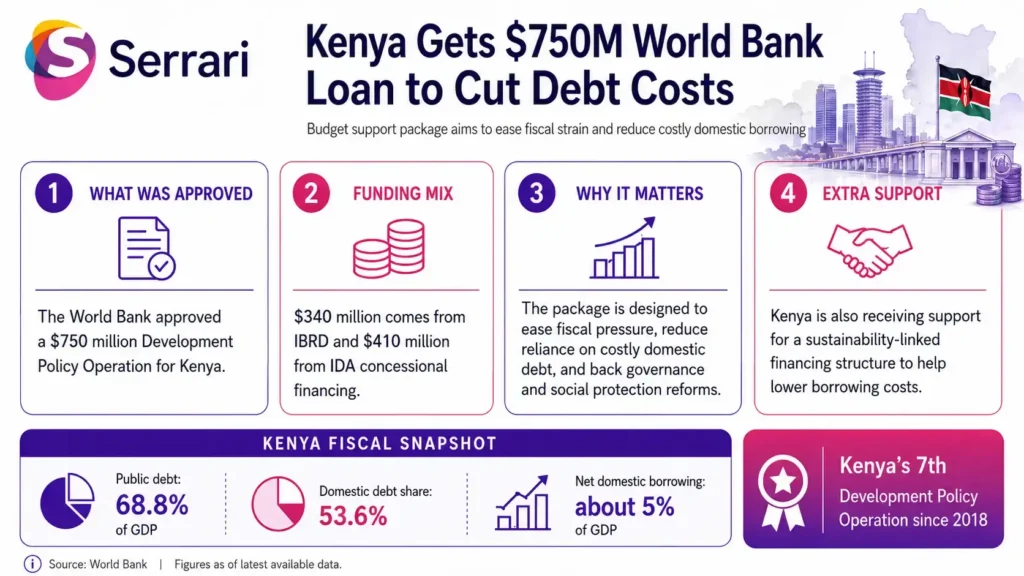
- The World Bank approved $750 million in budget support for Kenya.
- The financing includes $340 million from IBRD and $410 million from IDA.
- The package supports governance, public finance and social protection reforms.
- Kenya is also receiving support for a sustainability-linked financing structure.
- The funding is designed to reduce reliance on costly domestic debt and widen cheaper external financing options.
World Bank Backs Kenya’s Fiscal Reform Push
Kenya has received a new World Bank budget support package worth $750 million, giving the government fresh fiscal space as it works to stabilise public finances and reduce pressure from domestic borrowing.
The financing is being provided through a Development Policy Operation, with $340 million from the International Bank for Reconstruction and Development and $410 million in concessional funding from the International Development Association. According to the World Bank, the programme supports reforms intended to strengthen accountability, improve public financial management and protect vulnerable households through more structured social assistance.
The approval also reflects progress on policy actions that had delayed earlier financing. These included reforms linked to conflict of interest rules, social protection regulations and frameworks for sustainability-linked financing. The latest support follows Kenya’s wider effort to restore confidence after years of rising debt service costs and recurring fiscal deficits.
Reducing Reliance on Costly Domestic Borrowing
A key objective of the package is to reduce Kenya’s dependence on expensive domestic debt. Domestic borrowing has become a major pressure point because it can crowd out private sector credit, increase local interest costs and deepen the government’s debt service burden.
Business Insider Africa reported that Kenya’s public debt rose to 68.8% of GDP in FY2024/25, up from 67.5% a year earlier, with domestic debt accounting for more than half of the total. Net domestic borrowing also reached about 5% of GDP during the period, driven by infrastructure spending, social programmes and debt servicing obligations.
The World Bank financing gives the National Treasury a cheaper external funding source at a time when domestic borrowing remains expensive. Reuters-syndicated reporting said the package is intended to support reforms while reducing Kenya’s reliance on expensive domestic debt.
Context is everything. Stay ahead of shifting trends with today’s market updates, and uncover emerging opportunities using the Serrari Group Market Index and Marketplace. Then, take control of your own financial future by exploring our Money & Life Reset Transformation Blueprint ™ to build stronger habits, create better systems, and design a path toward lasting wealth.
Sustainability-Linked Finance Adds a New Layer
Alongside the budget support loan, Kenya is also receiving support for a sustainability-linked facility aimed at lowering borrowing costs and broadening financing options. The structure links financial incentives to selected environmental and development outcomes, including reduced deforestation and wider rural electricity access.
This is significant because Kenya has been exploring alternative debt structures to diversify away from traditional borrowing. A sustainability-linked facility can help attract investors who are willing to accept lower risk through credit enhancement while tying financing to measurable development targets.
Kenyan Wall Street reported that Kenya had cleared actions tied to the World Bank programme, including a framework for issuing sustainability-linked bonds and regulations operationalising social protection through the Enhanced Single Registry.
Governance and Social Protection Are Central to the Deal
The World Bank said the programme supports Kenya’s push for stronger accountability by backing reforms that improve public resource management and reduce leakages. These reforms are important because investor confidence depends not only on debt numbers, but also on whether public funds are managed transparently and efficiently.
The programme also supports the Social Protection Regulations 2026 and the use of Kenya’s Enhanced Single Registry as the main platform for identifying beneficiaries. This is meant to improve targeting, reduce duplication and ensure assistance reaches poorer households more effectively.
The financing comes as Kenya continues a difficult fiscal balancing act. Reuters reported that the country is seeking to maintain fiscal consolidation while managing spending demands and heavy debt repayments. The government has projected external and domestic financing needs to bridge its budget gap, while also trying to reduce the cost of servicing debt.
What the Loan Means for Kenya
The $750 million approval gives Kenya short-term budget relief and strengthens the government’s ability to finance reforms without relying as heavily on domestic markets. It may also improve investor confidence if the reforms tied to the programme are implemented effectively.
However, the loan does not remove Kenya’s deeper fiscal challenge. Debt service costs remain high, revenue mobilisation remains politically sensitive and the government must still balance social spending, infrastructure commitments and fiscal discipline.
For now, the World Bank package gives Kenya a lower-cost financing bridge and a reform signal. The bigger test will be whether the country can translate the support into sustained debt reduction, stronger accountability and more inclusive economic stability.
Sources used: World Bank / Reuters / Business Insider Africa / Kenyan Wall Street
Your financial future isn’t something you wait for—it’s something you build.
The real question is: when do you begin?
Move beyond simply staying informed.
Navigate the markets with clarity—track trends through the Serrari Group Market Index, uncover opportunities in the Serrari Marketplace, and build practical knowledge with our Curated Wealth Builder Platform.
Stay connected to what truly matters.
Get daily insights on macro trends and financial movements across Kenya, Africa, and global markets—delivered through the Serrari Newsletter.
Growth opens doors.
Advance your career through professional programs including ACCA, HESI A2, ATI TEAS 7 , HESI EXIT , NCLEX – RN and NCLEX – PN, Financial Literacy!🌟—designed to move you forward with confidence.
See where money is flowing—clearly and in real time.
Track Money Market Funds, Treasury Bills, Treasury Bonds, Green Bonds, and Fixed Deposits, alongside global and African indexes, key economic indicators, and the evolving Crypto and stablecoin landscape—all within Serrari’s Market Index.