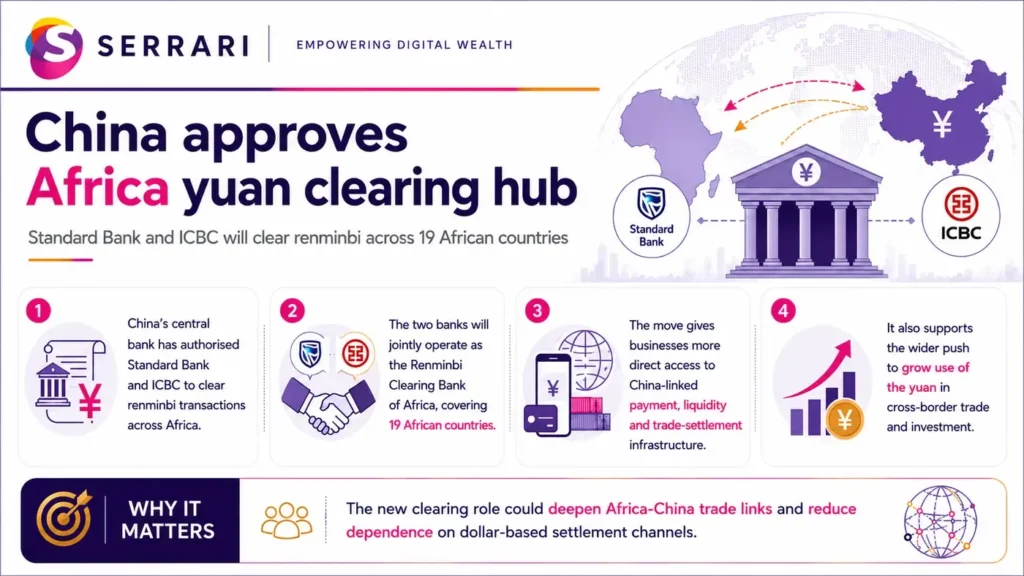
China’s central bank has authorised Standard Bank and the Industrial and Commercial Bank of China to clear renminbi transactions across Africa, creating a new financial channel for trade and investment between the continent and China.
The two banks will jointly operate as the Renminbi Clearing Bank of Africa, with capacity to clear RMB in 19 African countries. The move comes as China pushes to increase the global use of its currency and reduce reliance on dollar-dominated payment systems.
Key Overview
- China’s central bank has approved Standard Bank and ICBC to clear RMB transactions across Africa.
- The two banks will jointly operate as the Renminbi Clearing Bank of Africa.
- The clearing arrangement will cover 19 African countries through Standard Bank’s regional network.
- Standard Bank became the first African bank to join China’s Cross-Border Interbank Payment System in November 2025.
- China-Africa trade rose nearly 18% last year, while Asia is becoming a preferred trade partner for more African businesses.
New Clearing Role Gives Africa Direct RMB Access
China’s central bank has authorised Standard Bank and ICBC to clear renminbi across Africa, giving businesses and financial institutions a more direct route into China’s onshore financial system.
The arrangement is expected to improve access to Chinese capital markets, liquidity infrastructure and payment channels. It also gives African importers, exporters and financial institutions another option for settling China-linked transactions without routing every trade flow through the U.S. dollar.
Standard Bank and ICBC will jointly operate as the Renminbi Clearing Bank of Africa, with operational capacity to clear RMB in 19 African countries. The structure combines Standard Bank’s African footprint with ICBC’s renminbi capabilities and China market access.
For companies trading with China, the new clearing channel could reduce settlement friction, improve payment efficiency and support more RMB-denominated trade. It may also help African firms manage currency exposure where suppliers, lenders or investment partners increasingly accept yuan settlement.
Beijing Pushes Wider Yuan Internationalisation
The approval fits into China’s broader strategy to promote the global use of the yuan. At the 2026 Lujiazui Forum, People’s Bank of China Governor Pan Gongsheng announced measures to develop offshore renminbi business, including offshore RMB foreign-exchange trading in Shanghai’s free trade zone and a new liquidity tool for foreign and international monetary authorities.
China has been expanding yuan-based settlement systems as part of a long-term push to reduce dependence on a global payments architecture dominated by the U.S. dollar. The Africa clearing-bank approval extends that agenda into a region where trade with China is already large and still growing.
Standard Bank also became the first African bank to join China’s Cross-Border Interbank Payment System in November 2025. According to reporting on the latest approval, it processed about $500 million through CIPS in its first four months, mainly linked to physical trade.
Context is everything. Stay ahead of shifting trends with today’s market updates, and uncover emerging opportunities using the Serrari Group Market Index and Marketplace. Then, take control of your own financial future by exploring our Money & Life Reset Transformation Blueprint ™ to build stronger habits, create better systems, and design a path toward lasting wealth.
China-Africa Trade Momentum Supports the Move
The timing reflects deepening commercial links between Africa and Asia. China-Africa trade rose nearly 18% last year, according to Chinese customs data cited in the latest reporting. Beijing also removed tariffs on imports from 53 African countries on May 1, strengthening trade incentives for African exporters.
Standard Bank’s Africa Trade Barometer shows that Asian countries are now preferred by 35% of businesses across 10 African markets, up from 24% in 2024. China was also cited as the leading source of inputs by 67% of surveyed businesses.
That shift is important because payment infrastructure often follows trade flows. As more African businesses source inputs from China or sell into Chinese-linked value chains, demand for RMB settlement, liquidity and hedging tools is likely to grow.
What It Means for African Businesses
For African companies, the new clearing arrangement could make China-linked payments faster, more transparent and potentially cheaper. It may also support firms that want to diversify currency risk, especially where dollar liquidity is expensive or difficult to access.
The impact will depend on adoption. Businesses will still weigh exchange-rate risk, supplier preferences, invoicing terms and the availability of RMB liquidity in local markets. Banks will also need to build products that make RMB clearing practical for importers, exporters and institutional clients.
Still, the approval marks a significant financial infrastructure shift. It gives Africa a named RMB clearing hub, strengthens China’s trade-finance links with the continent and adds another layer to the growing financial relationship between Beijing and African markets.
Sources used: Reuters / Standard Bank / TechAfrica News / Government of China / CNBC Africa / Zawya
Your financial future isn’t something you wait for—it’s something you build.
The real question is: when do you begin?
Move beyond simply staying informed.
Navigate the markets with clarity—track trends through the Serrari Group Market Index, uncover opportunities in the Serrari Marketplace, and build practical knowledge with our Curated Wealth Builder Platform.
Stay connected to what truly matters.
Get daily insights on macro trends and financial movements across Kenya, Africa, and global markets—delivered through the Serrari Newsletter.
Growth opens doors.
Advance your career through professional programs including ACCA, HESI A2, ATI TEAS 7 , HESI EXIT , NCLEX – RN and NCLEX – PN, Financial Literacy!🌟—designed to move you forward with confidence.
See where money is flowing—clearly and in real time.
Track Money Market Funds, Treasury Bills, Treasury Bonds, Green Bonds, and Fixed Deposits, alongside global and African indexes, key economic indicators, and the evolving Crypto and stablecoin landscape—all within Serrari’s Market Index.