Ghanaian cocoa farmers are warning that the country’s 2026/27 crop could fall sharply as unusually heavy rains damage flowering trees and increase the spread of black pod disease. The concerns come from cocoa-growing districts where farmers say rain has disrupted pollination, washed out farms and caused flowers to fall before pods can form.
The threat matters beyond Ghana. Ghana and Ivory Coast supply a major share of the world’s cocoa, and earlier weather-driven harvest failures helped push cocoa prices sharply higher. If heavy rains continue and disease control is delayed, the next crop season could face another production shock.
Key Overview
- Ghanaian cocoa farmers say heavy rains are damaging flowers before they develop into pods.
- Wet conditions have increased fears of black pod disease spreading across cocoa farms.
- Ghana’s Meteorological Agency forecast wet conditions in June 2026, especially across forest and coastal zones.
- COCOBOD targeted 650,000 metric tonnes for the 2025/26 season, but farmers fear the 2026/27 crop could weaken.
- Ivory Coast farmers have also raised concerns over flooding and disease risks from above-average rains.
Heavy Rains Threaten Cocoa Flowering
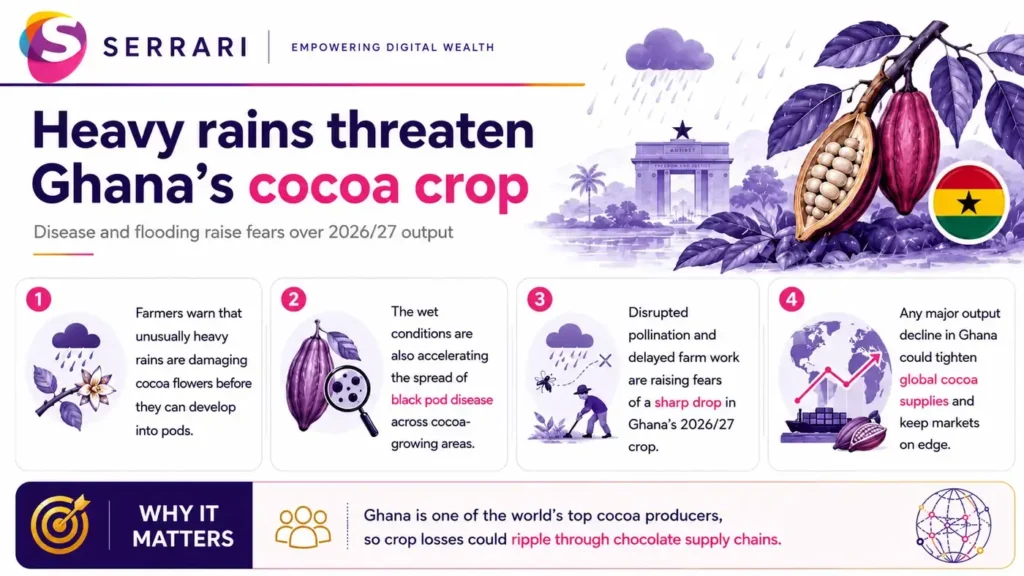
Ghanaian farmers are warning that heavy rainfall and disease could sharply reduce cocoa output in the 2026/27 season. Farmers told Reuters that rainfall has become unusually intense, flooding farms and knocking flowers off cocoa trees before they can develop into pods.
That timing is critical. Cocoa trees depend on successful flowering and pod formation before harvest volumes can recover. When repeated rains interrupt pollination or damage young flowers, farmers can lose part of the next season’s crop before pods are visible.
The Ghana Meteorological Agency’s June rainfall outlook showed predominantly wet conditions across much of the country, particularly in forest and coastal zones. Those are important cocoa-growing areas, making prolonged rainfall a direct production risk.
Farmers also say farm work has become harder because fields are too wet for pollination, spraying and other maintenance. If the rains continue through key crop-development stages, the impact could extend beyond isolated districts and affect national output.
Black Pod Disease Adds Another Layer of Risk
Wet weather is also raising the risk of black pod disease, a fungal infection that attacks cocoa pods and spreads more easily in damp conditions. Farmers are concerned that delayed access to fungicides could allow the disease to spread before control measures take effect.
Black pod is not Ghana’s only disease challenge. The country has also been battling swollen shoot disease, which weakens trees and can eventually kill them. A Reuters report on swollen shoot disease warned that Ghana’s cocoa sector faces a long-term threat if disease control does not improve.
The current heavy-rain episode therefore comes at a difficult time. Ghana has already faced pressure from adverse weather, disease and illegal gold mining, all of which have damaged farms and reduced productivity in recent seasons.
COCOBOD has targeted 650,000 metric tonnes for the 2025/26 season, but farmer warnings suggest the next season could become more difficult if disease and weather risks intensify.
Context is everything. Stay ahead of shifting trends with today’s market updates, and uncover emerging opportunities using the Serrari Group Market Index and Marketplace. Then, take control of your own financial future by exploring our Money & Life Reset Transformation Blueprint ™ to build stronger habits, create better systems, and design a path toward lasting wealth.
Global Cocoa Markets Remain Sensitive
The production warning has wider market implications because Ghana is the world’s second-largest cocoa producer after Ivory Coast. Together, the two West African countries supply a large share of global cocoa, making weather shocks in the region highly sensitive for chocolate manufacturers, traders and consumers.
A similar weather pattern contributed to failed harvests in West Africa during the 2023/24 season. Heavy rainfall was followed by heat and dry Harmattan winds, reducing supply and helping drive cocoa prices sharply higher in 2024.
Ivory Coast farmers have also warned that above-average rains and overcast weather could raise flooding and disease risks during the final stage of the current mid-crop. That means the region’s two biggest producers are both facing weather-related concerns.
Ecuador’s Rise Adds Competitive Pressure
Ghanaian farmers are also watching Ecuador, which has been steadily increasing cocoa output and strengthening its position in global supply. If Ghana’s production weakens while Ecuador continues expanding, Ghana’s standing in global cocoa rankings could come under pressure.
For Ghana, the immediate priority is disease control, timely fungicide distribution and farmer support before the rains cause deeper crop losses. The longer-term challenge is to rebuild productivity while protecting farms from climate volatility, disease and land degradation.
The next few months will be important for assessing whether the current rainfall becomes a manageable seasonal disruption or a deeper production shock. For farmers, the fear is simple: if flowers keep falling and disease spreads, the 2026/27 harvest could be significantly smaller.
Sources used: Reuters / Zawya / Ghana Meteorological Agency / GhanaWeb / CocoaIntel
Your financial future isn’t something you wait for—it’s something you build.
The real question is: when do you begin?
Move beyond simply staying informed.
Navigate the markets with clarity—track trends through the Serrari Group Market Index, uncover opportunities in the Serrari Marketplace, and build practical knowledge with our Curated Wealth Builder Platform.
Stay connected to what truly matters.
Get daily insights on macro trends and financial movements across Kenya, Africa, and global markets—delivered through the Serrari Newsletter.
Growth opens doors.
Advance your career through professional programs including ACCA, HESI A2, ATI TEAS 7 , HESI EXIT , NCLEX – RN and NCLEX – PN, Financial Literacy!🌟—designed to move you forward with confidence.
See where money is flowing—clearly and in real time.
Track Money Market Funds, Treasury Bills, Treasury Bonds, Green Bonds, and Fixed Deposits, alongside global and African indexes, key economic indicators, and the evolving Crypto and stablecoin landscape—all within Serrari’s Market Index.