Kenyan households are using most diaspora remittances to meet basic living costs, with food, education and healthcare taking the largest share of spending. A new 2025 Remittances Household Survey shows that households received KSh931.8 billion between June 2024 and May 2025, confirming the growing importance of diaspora money to family welfare.
The findings show that remittances are functioning more as a household safety net than a long-term investment pool. While the inflows are substantial, most families appear to be prioritising immediate needs over property, business expansion or other wealth-building assets.
Key Overview
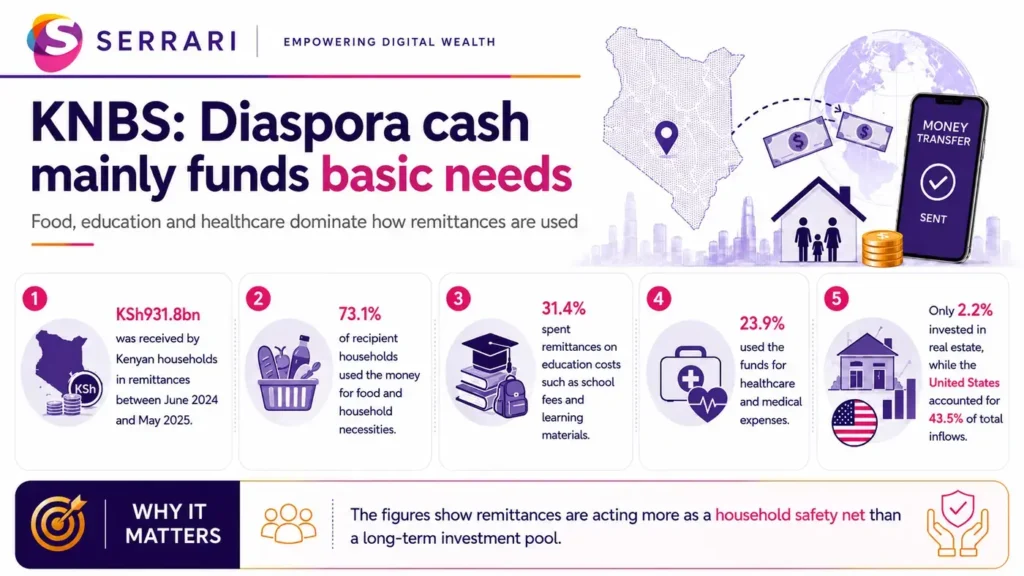
- Kenyan households received KSh931.8 billion in remittances between June 2024 and May 2025.
- Food and household goods were the top use, cited by 73.1% of recipient households.
- Education followed at 31.4%, while medical expenses accounted for 23.9%.
- Only 2.2% of households reported using remittances for real estate investment.
- The United States was the largest source of inflows, contributing 43.5% of total remittances.
Food, School Fees and Health Bills Take Priority
Kenya’s latest Remittances Household Survey shows that diaspora money is mainly going into everyday household survival rather than long-term investment. The survey, conducted by the Kenya National Bureau of Statistics with the Central Bank of Kenya and development partners, estimated that households received KSh931.8 billion in remittance inflows during the reference period from June 2024 to May 2025.
The largest share went to food and household goods. According to the survey findings, 73.1% of recipient households used remittances to buy food and basic household necessities. This suggests that money sent by relatives abroad is helping families manage the cost of living, especially where local income is unstable or insufficient.
Education was the second-biggest use of remittances, with 31.4% of households spending the funds on school fees, learning materials and other education-related costs. Healthcare was also significant, with 23.9% of households using remittances for medical expenses.
These findings show that diaspora support is directly linked to human welfare. For many families, remittances are not just additional income; they help keep children in school, pay hospital bills and cover basic household consumption.
Remittances Act as a Household Safety Net
The survey shows that remittances have become a major cushion for households facing unemployment, inflation and irregular earnings. More than one in five households receiving remittances identified them as their primary source of income, underlining how dependent some families have become on relatives abroad.
This also explains why investment levels remain low. Despite Kenya receiving hundreds of billions of shillings from abroad, only 2.2% of recipient households reported using remittances to buy or invest in real estate. Other long-term investment uses also remained limited compared with spending on basic needs.
The pattern is consistent with separate reporting that highlighted basic consumption as the dominant use of remittances, with education and medical spending also featuring prominently. For policymakers, this creates a difficult balance: diaspora funds are already supporting millions of households, but converting a larger share into savings and productive investment may require stronger household incomes, lower living costs and trusted investment channels.
Context is everything. Stay ahead of shifting trends with today’s market updates, and uncover emerging opportunities using the Serrari Group Market Index and Marketplace. Then, take control of your own financial future by exploring our Money & Life Reset Transformation Blueprint ™ to build stronger habits, create better systems, and design a path toward lasting wealth.
Formal Channels Dominate Remittance Flows
The 2025 survey also points to the growing formalisation of remittance flows. Cash transfers accounted for 91% of total inflows, while in-kind remittances made up 9%. Formal transfer channels, including banks and mobile money platforms, accounted for more than 92% of inflows.
This is important for financial inclusion because formal channels make remittance flows easier to track, regulate and integrate into savings, insurance and investment products. According to the Central Bank of Kenya’s diaspora remittances page, remittances are now recognised as an important contributor to Kenya’s growth and development because of the large sums involved.
The United States remained the largest source of remittances to Kenyan households, contributing 43.5% of total inflows. Germany and Australia followed, showing the importance of both long-established and newer diaspora corridors.
Why the Findings Matter for Kenya
Kenya is one of Africa’s major remittance recipients, and diaspora inflows have become an important support for household welfare and foreign exchange stability. The 2025 survey offers a clearer view of how the money is used at household level, beyond the aggregate monthly inflow data usually captured through banks and remittance service providers.
The key message is that diaspora remittances are doing essential social work. They are helping families eat, pay school fees and access healthcare. However, they are not yet translating strongly into household investment or asset accumulation.
For Kenya, the next opportunity is to create safer, more attractive ways for families to turn part of diaspora money into savings, insurance, education funds, housing and small-business capital. Until household pressures ease, however, food, education and healthcare are likely to remain the main destination for money sent home.
Sources used: Kenya National Bureau of Statistics / Central Bank of Kenya / Business Daily Africa / FSD Kenya / People Daily
Your financial future isn’t something you wait for—it’s something you build.
The real question is: when do you begin?
Move beyond simply staying informed.
Navigate the markets with clarity—track trends through the Serrari Group Market Index, uncover opportunities in the Serrari Marketplace, and build practical knowledge with our Curated Wealth Builder Platform.
Stay connected to what truly matters.
Get daily insights on macro trends and financial movements across Kenya, Africa, and global markets—delivered through the Serrari Newsletter.
Growth opens doors.
Advance your career through professional programs including ACCA, HESI A2, ATI TEAS 7 , HESI EXIT , NCLEX – RN and NCLEX – PN, Financial Literacy!🌟—designed to move you forward with confidence.
See where money is flowing—clearly and in real time.
Track Money Market Funds, Treasury Bills, Treasury Bonds, Green Bonds, and Fixed Deposits, alongside global and African indexes, key economic indicators, and the evolving Crypto and stablecoin landscape—all within Serrari’s Market Index.