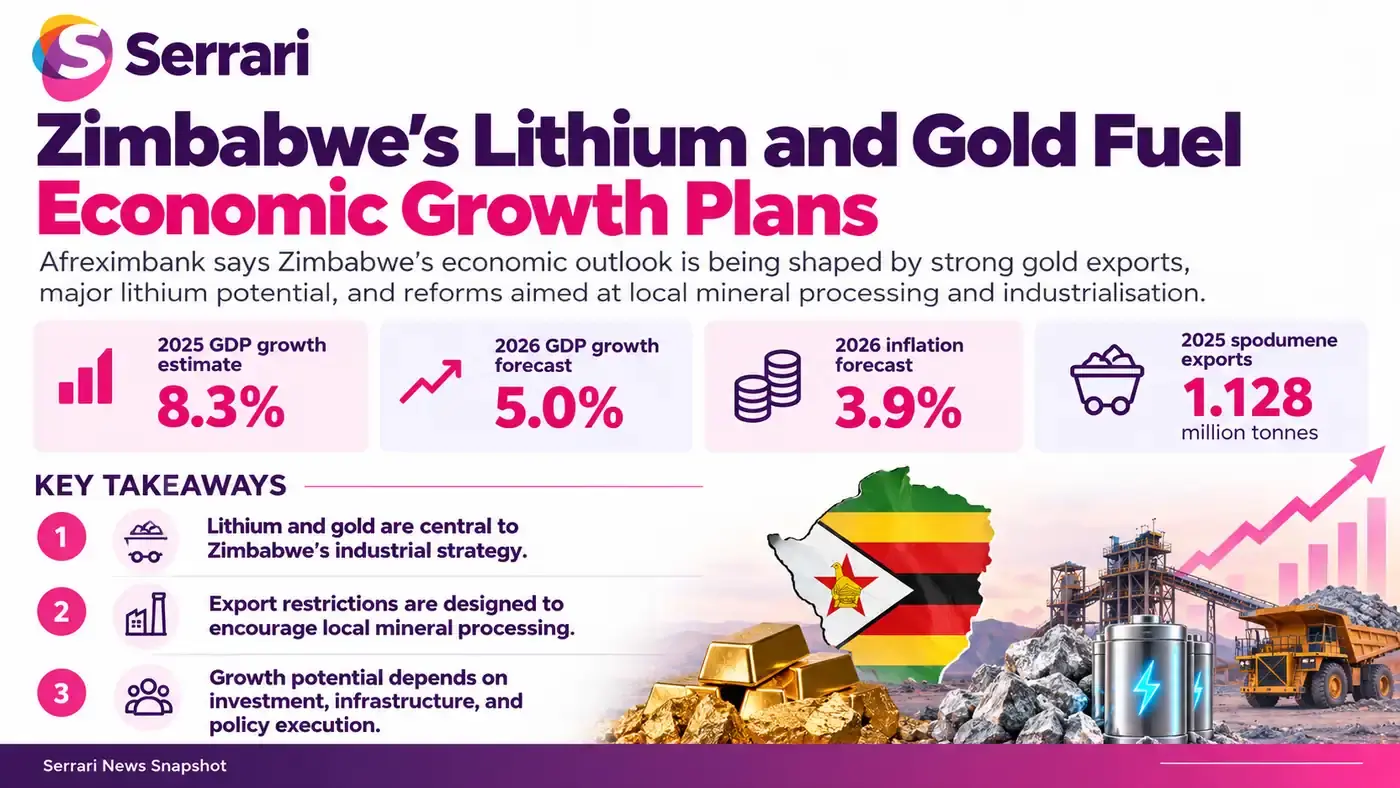
Zimbabwe’s gold industry, lithium deposits and push to process more minerals locally are central to a new economic outlook from the African Export-Import Bank (Afreximbank). The bank estimates that the economy grew 8.3% in 2025 and forecasts 5% growth in 2026, supported by recovering agriculture and strong gold production. Its assessment also highlights government restrictions on raw mineral exports, investment in battery-material processing and the importance of developing African supply chains.
Key Overview
- Economic growth: Estimated at 8.3% in 2025, with 5% forecast for 2026.
- Inflation outlook: Projected to decline to 3.9% in 2026 from an estimated 55% in 2025, according to Afreximbank.
- Mineral exports: Zimbabwe restricted raw mineral and lithium concentrate exports in February 2026, with conditional export quotas subsequently proposed.
- Industrial strategy: Local lithium processing, gold production and regional trade are priorities under the 2026–2030 development plan.
- Financial inclusion: Digital banking partnerships may broaden access to payments, savings and credit.
Afreximbank Forecasts 5% Economic Growth in 2026
Afreximbank’s latest assessment of Zimbabwe’s economy attributes its estimated 8.3% growth in 2025 to an agricultural recovery, robust gold exports and high international gold prices. The bank expects growth to moderate to 5% in 2026, supported by farm output, government expenditure and continued gold mining activity.
The bank also forecasts a sharp slowdown in inflation, from an estimated 55% in 2025 to 3.9% in 2026. It links this outlook to greater stability in the Zimbabwe Gold (ZiG) currency, improved gold production and stronger foreign-currency inflows. These figures are the bank’s estimates and forecasts, not confirmed full-year outcomes; Zimbabwe also publishes separate inflation series for domestic- and US-dollar prices.
Lithium Export Rules Push Local Mineral Processing
Zimbabwe is a leading African lithium producer, with the mineral used in batteries for electric vehicles and energy storage. In 2025, the country exported 1.128 million tonnes of spodumene concentrate, an 11% increase in volume, although export earnings were broadly flat because prices were weaker.
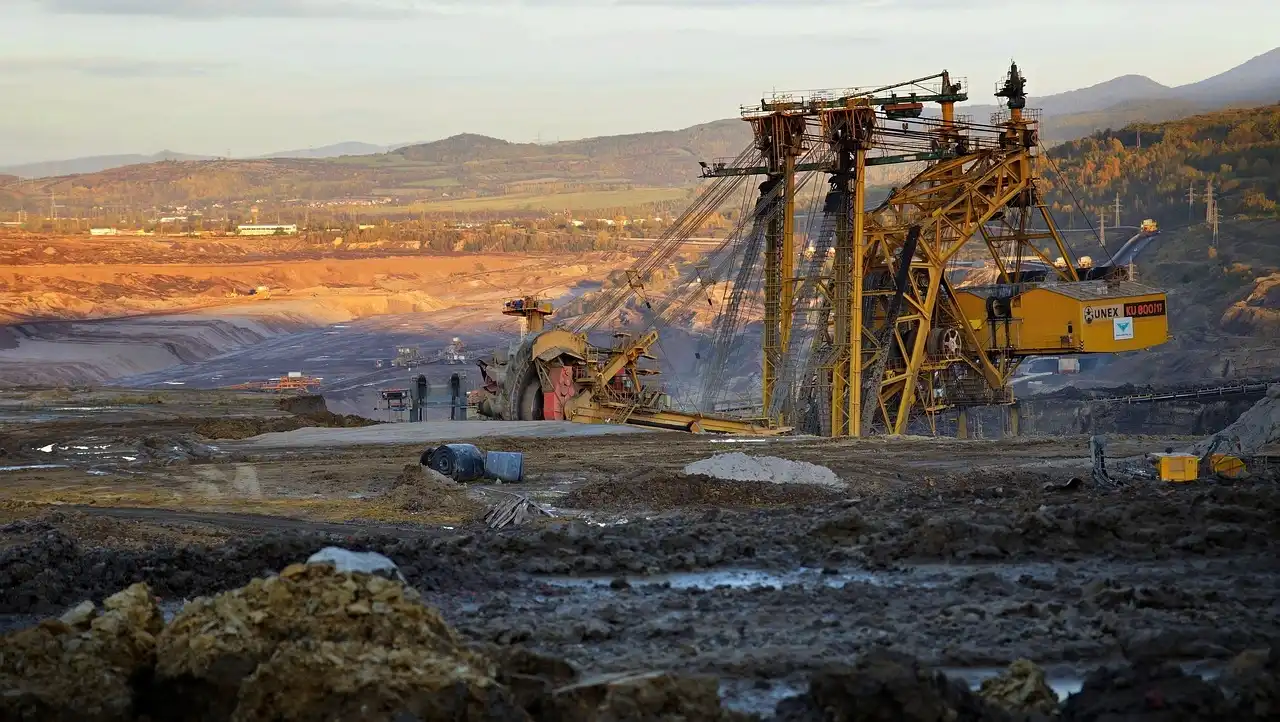
In February 2026, authorities suspended exports of raw minerals and lithium concentrates, citing concerns over leakages and aiming to encourage domestic processing. The policy subsequently developed: in April, the government outlined export quotas and new conditions for shipments to resume, including commitments to establish lithium sulphate processing capacity.
The goal is to earn more from refined materials rather than shipping mainly lower-value mineral concentrates. Processing investments are emerging, including a $400 million lithium sulphate facility developed by Huayou. However, mineral-processing projects require dependable power, transport networks, financing and buyers; export restrictions alone cannot ensure that factories are commercially competitive.
Context is everything. Stay ahead of shifting trends with today’s market updates, and uncover emerging opportunities using the Serrari Group Market Index and Marketplace. Then, take control of your own financial future by exploring our Money & Life Reset Transformation Blueprint ™ to build stronger habits, create better systems, and design a path toward lasting wealth.
Gold and Critical Minerals Anchor Industrial Development
Beyond lithium, Zimbabwe produces gold, platinum-group metals, chrome and diamonds. Afreximbank sees opportunities to connect mining with refining, component production and manufacturing, retaining more value within the country and creating specialised jobs.
The government’s National Development Strategy 2 for 2026–2030 emphasises economic diversification, mineral value addition, infrastructure investment and employment. Within the African Continental Free Trade Area (AfCFTA), stronger regional production networks could also expand markets for Zimbabwean processed minerals and manufactured products.
Digital Banking and Energy Projects Offer Further Opportunities
The country brief also points to developments outside mining. InnBucks MicroBank’s May 2025 digital-banking partnership with technology provider Mambu was designed to support a transition towards more comprehensive banking services, including payments and lending. Expanded access could help individuals and businesses participate more fully in the formal financial system.
In energy, a petroleum production-sharing agreement signed in May 2026 established a framework for exploration and potential development of the Cabora Bassa Basin project. The agreement represents a prospective investment opportunity, not proof that commercial oil or gas production has begun.
What Could Shape Zimbabwe’s Next Growth Phase?
Zimbabwe’s mineral wealth provides a foundation for industrial expansion, but the results will depend on stable policies, affordable electricity, reliable transport and sustained investment. Strong gold exports may support near-term growth, while lithium processing offers a longer-term opportunity to develop regional supply chains. Whether that opportunity produces lasting jobs and higher export earnings will depend on implementation rather than resource availability alone.
Sources
Afreximbank / Reuters / United Nations Zimbabwe / Mambu / Invictus Energy
Your financial future isn’t something you wait for—it’s something you build.
The real question is: when do you begin?
Move beyond simply staying informed.
Navigate the markets with clarity—track trends through the Serrari Group Market Index, uncover opportunities in the Serrari Marketplace, and build practical knowledge with our Curated Wealth Builder Platform.
Stay connected to what truly matters.
Get daily insights on macro trends and financial movements across Kenya, Africa, and global markets—delivered through the Serrari Newsletter.
Growth opens doors.
Advance your career through professional programs including ACCA, HESI A2, ATI TEAS 7 , HESI EXIT , NCLEX – RN and NCLEX – PN, Financial Literacy!🌟—designed to move you forward with confidence.
See where money is flowing—clearly and in real time.
Track Money Market Funds, Treasury Bills, Treasury Bonds, Green Bonds, and Fixed Deposits, alongside global and African indexes, key economic indicators, and the evolving Crypto and stablecoin landscape—all within Serrari’s Market Index.