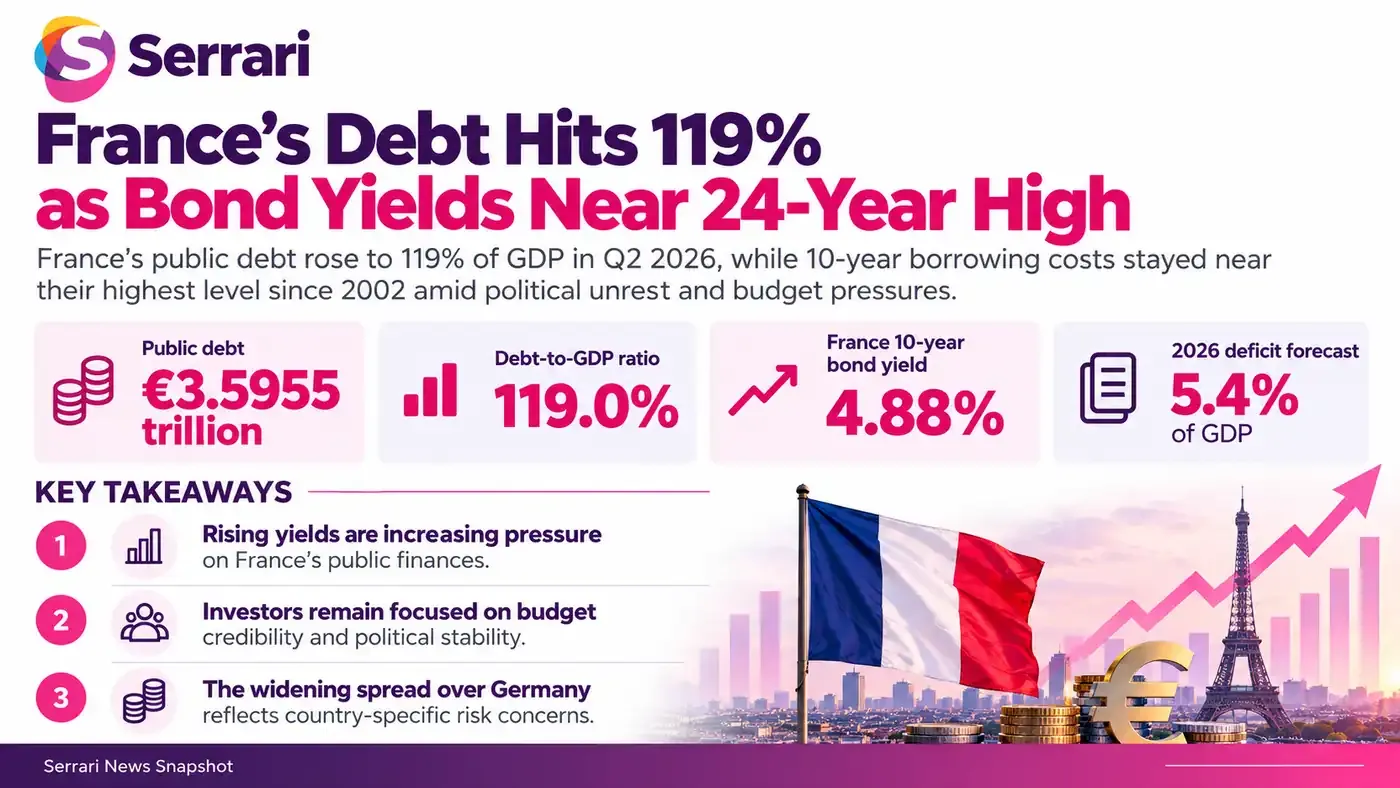
France’s public debt reached €3.60 trillion, or 119% of gross domestic product (GDP), in the second quarter of 2026, while government bond yields climbed close to their highest levels since 2002. Nationwide protests and disagreements over the 2027 budget have added to investor concerns about France’s ability to slow borrowing. The pressure matters because higher yields can gradually increase the cost of refinancing debt and leave less room for public spending.
Key Overview
- Public debt: €3.5955 trillion, equivalent to 119.0% of GDP at the end of June 2026.
- Bond yields: France’s 10-year yield eased to 4.88% on October 20, after approaching 5% earlier in the session.
- Investor risk premium: The gap between French and German 10-year yields stood near 150 basis points.
- Fiscal outlook: France’s government forecasts a 2026 deficit of 5.4% of GDP and economic growth of 0.5%.
- 2027 budget: Proposed measures seek to narrow the deficit to 5% of GDP, but face parliamentary and public opposition.
Why French Government Bond Yields Are Rising
Governments issue bonds to finance spending not covered by revenues and to refinance debts when they mature. Investors receive interest and repayment at maturity, while the bonds themselves can be bought and sold. Bond prices and yields move in opposite directions: when investors sell bonds and prices fall, their market yields rise.
France’s 10-year yield eased to 4.88% on October 20 after touching 4.9877% earlier that day. It remained close to an early-October peak of 4.9937%, the highest since July 2002. A basis point equals 0.01 percentage points.
The difference between French and German 10-year yields reached around 150 basis points, meaning investors demanded roughly 1.5 percentage points more to hold French debt. That gap reflects concerns specific to France alongside broader factors such as inflation and European interest-rate expectations.
France’s Debt and Deficit Add to Borrowing Pressure
The latest quarterly debt figures put France’s general government debt at €3,595.5 billion at the end of June, up €59.6 billion from the previous quarter. The debt ratio increased from 117.5% in March to 119.0% in June. These figures cover the public sector as a whole, rather than just the central government.
France’s government projects a 2026 deficit of 5.4% of GDP, above the European Union’s 3% fiscal reference threshold. Its latest budget assumptions put economic growth at just 0.5% for 2026, limiting the extent to which faster economic activity can ease the debt burden.
Rising borrowing costs increase pressure over time, not instantaneously across all outstanding bonds. Existing fixed-rate debt generally keeps its original interest terms until maturity, but newly issued and refinanced bonds can carry higher rates. The government estimates interest costs will rise from €79.2 billion in 2026 to €91.2 billion in 2027.
Political Unrest Complicates the 2027 Budget
Street demonstrations against proposed spending restraints and demands for better public services have intensified uncertainty over the government’s fiscal plans. Political divisions in the National Assembly make it difficult to agree on how quickly to reduce borrowing without increasing pressure on households or businesses.
The draft 2027 budget targets a deficit of 5% of GDP and describes a total €54 billion fiscal adjustment, including €43 billion of measures in the proposed budget and social-security bills. The €54 billion figure should not be understood as spending cuts alone: the proposals combine expenditure restraint and revenue measures.
Proposed changes include limits on some pension increases, efforts to slow healthcare spending growth and adjustments to tax relief. Those budget measures remain subject to parliamentary scrutiny, meaning their final scope and impact are not yet settled.
Context is everything. Stay ahead of shifting trends with today’s market updates, and uncover emerging opportunities using the Serrari Group Market Index and Marketplace. Then, take control of your own financial future by exploring our Money & Life Reset Transformation Blueprint ™ to build stronger habits, create better systems, and design a path toward lasting wealth.
Why France Faces Pressure Despite Other Countries’ Higher Debt
A country’s debt-to-GDP ratio is not the only measure of its financial strength. Investors also assess growth prospects, budget deficits, the maturity and ownership of debt, access to financing and the political capacity to implement policy.
For example, Japan’s large domestic investor base and the dollar’s international reserve-currency role help explain why debt risks differ across countries. Italy has a higher debt ratio than France, yet on October 20 its yield premium over Germany stood near 109.5 basis points, below France’s approximately 150 basis points. These comparisons illustrate why debt levels alone cannot explain borrowing costs.
Could France Face a Sovereign Debt Crisis?
The widening debate over debt sustainability does not mean a French default is imminent. The more immediate risk is a prolonged period of high financing costs, weak growth and repeated budget disputes, making deficit reduction harder.
Investors will be watching parliamentary progress on the 2027 budget, further protests and the spread between French and German bonds. A credible fiscal path could help stabilise borrowing costs, while persistent uncertainty could keep pressure on the French government bond market.
Sources
INSEE / French Ministry of Economy and Finance / Reuters / Al Jazeera
Your financial future isn’t something you wait for—it’s something you build.
The real question is: when do you begin?
Move beyond simply staying informed.
Navigate the markets with clarity—track trends through the Serrari Group Market Index, uncover opportunities in the Serrari Marketplace, and build practical knowledge with our Curated Wealth Builder Platform.
Stay connected to what truly matters.
Get daily insights on macro trends and financial movements across Kenya, Africa, and global markets—delivered through the Serrari Newsletter.
Growth opens doors.
Advance your career through professional programs including ACCA, HESI A2, ATI TEAS 7 , HESI EXIT , NCLEX – RN and NCLEX – PN, Financial Literacy!🌟—designed to move you forward with confidence.
See where money is flowing—clearly and in real time.
Track Money Market Funds, Treasury Bills, Treasury Bonds, Green Bonds, and Fixed Deposits, alongside global and African indexes, key economic indicators, and the evolving Crypto and stablecoin landscape—all within Serrari’s Market Index.