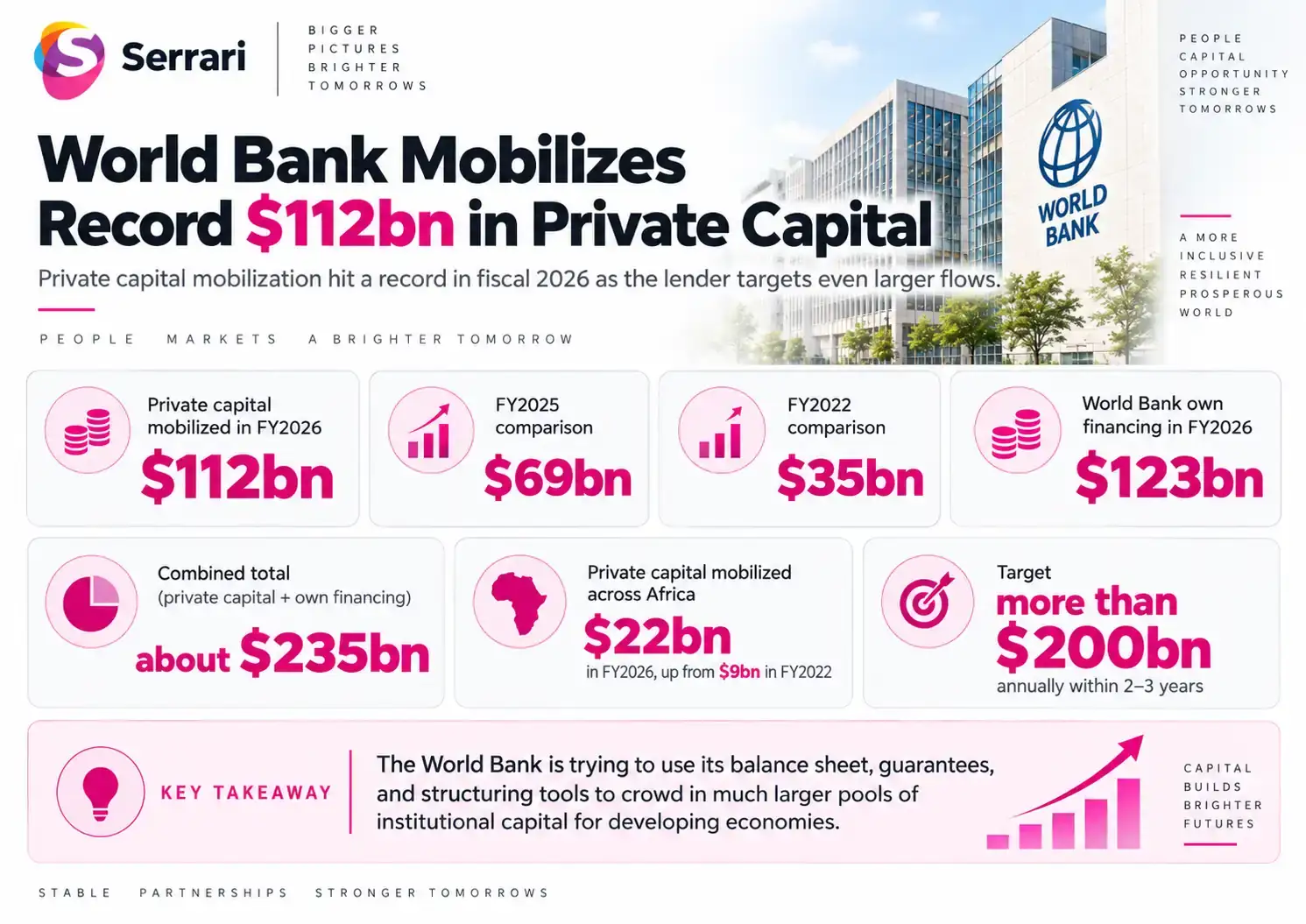
The World Bank Group mobilized a record $112 billion in private capital during the fiscal year ended June 2026, up from $69 billion a year earlier and more than three times the $35 billion recorded in fiscal 2022. The latest private-capital results show that the increase was broad-based across developing economies, including a sharp rise in Africa.
The $112 billion was mobilized alongside $123 billion from the institution’s own resources, bringing combined financing and mobilization to about $235 billion. President Ajay Banga is now seeking to lift annual private capital mobilization above $200 billion within the next two to three years.
Key Overview
- Private capital mobilization reached a record $112 billion in fiscal 2026.
- The total rose from $69 billion in fiscal 2025 and $35 billion in fiscal 2022.
- World Bank own-account financing added another $123 billion, taking the combined total to about $235 billion.
- Private capital mobilized across Africa increased from about $9 billion in FY2022 to $22 billion in FY2026.
- The institution is targeting more than $200 billion in annual private capital mobilization within two to three years.
- Institutional investors collectively manage more than $280 trillion in assets, highlighting the scale of capital potentially available.
Private Capital Mobilization Reaches a New High
The record $112 billion mobilization represents one of the clearest results of the World Bank Group’s effort to make development projects more attractive to private investors.
Flows to lower-middle-income countries rose from $14 billion in fiscal 2022 to $37 billion in fiscal 2026, while upper-middle-income countries increased from $12 billion to $50 billion. Low-income countries remained at roughly $3 billion, showing that attracting private investment into the poorest economies remains significantly more difficult.
Africa recorded particularly strong growth, with mobilized private capital rising from approximately $9 billion to $22 billion over the same four-year period.
World Bank Targets Much Larger Pools of Capital
Banga wants the institution to move beyond financing projects individually and develop structures that can attract pension funds, insurers and large asset managers. The target of more than $200 billion reflects an effort to package and standardize investments so institutional investors can deploy money at a larger scale.
The potential capital pool is enormous. A 2026 blended-finance analysis estimates that insurers, pension funds, banks, sovereign wealth funds and family offices collectively manage more than $280 trillion in assets.
However, only a relatively small share has historically flowed to developing economies. Regulatory uncertainty, political risk, currency volatility and limited liquidity remain major barriers to larger institutional allocations.
Context is everything. Stay ahead of shifting trends with today’s market updates, and uncover emerging opportunities using the Serrari Group Market Index and Marketplace. Then, take control of your own financial future by exploring our Money & Life Reset Transformation Blueprint ™ to build stronger habits, create better systems, and design a path toward lasting wealth.
Reforms Aim to Reduce Investment Barriers
The World Bank Group has introduced several changes intended to make projects easier and faster for investors to evaluate. These include a single country-level point of contact across its public and private arms, greater use of guarantees, more local-currency financing and efforts to address foreign-exchange risks.
The institution has also been developing an originate-to-distribute model that pools emerging-market loans into investment products suitable for large institutional investors. Its first securitization transaction in 2025 packaged $510 million of assets, creating a model that can potentially be repeated at greater scale.
Guarantees have become another major tool. The Group issued more than $25 billion in guarantees during fiscal 2026, surpassing a target of $20 billion in annual issuance four years earlier than planned.
Argentina Project Shows How Private Capital Can Be Crowded In
A major example is Rio Tinto’s Rincón lithium development in Argentina. The project carries a total investment cost of about $2.5 billion, while an IFC financing package included a $400 million direct loan and helped mobilize another $775 million from parallel lenders.
Once fully operational, the project is expected to produce around 53,000 tonnes of battery-grade lithium carbonate annually over a projected 40-year life. Financing from development institutions helped address risks that might otherwise have limited the scale of commercial participation.
Guatemala Deal Broadens Investor Participation
Another example involves Guatemala’s Banco Industrial. A capital-markets financing structure combined a $100 million subordinated loan with $750 million raised through an international notes placement.
Investor orders exceeded $2.8 billion, demonstrating demand for emerging-market assets when transactions are structured in a way that meets institutional requirements. The proceeds are intended to support lending to smaller businesses, including women-owned enterprises, while expanding access to long-term capital.
The wider strategy is therefore not simply to increase the World Bank Group’s own lending. It is to use its financing, guarantees and risk-management tools to attract substantially larger pools of private capital into projects that might otherwise struggle to secure investment.
Sources
World Bank Group / International Finance Corporation / Reuters / Boston Consulting Group
Your financial future isn’t something you wait for—it’s something you build.
The real question is: when do you begin?
Move beyond simply staying informed.
Navigate the markets with clarity—track trends through the Serrari Group Market Index, uncover opportunities in the Serrari Marketplace, and build practical knowledge with our Curated Wealth Builder Platform.
Stay connected to what truly matters.
Get daily insights on macro trends and financial movements across Kenya, Africa, and global markets—delivered through the Serrari Newsletter.
Growth opens doors.
Advance your career through professional programs including ACCA, HESI A2, ATI TEAS 7 , HESI EXIT , NCLEX – RN and NCLEX – PN, Financial Literacy!🌟—designed to move you forward with confidence.
See where money is flowing—clearly and in real time.
Track Money Market Funds, Treasury Bills, Treasury Bonds, Green Bonds, and Fixed Deposits, alongside global and African indexes, key economic indicators, and the evolving Crypto and stablecoin landscape—all within Serrari’s Market Index.