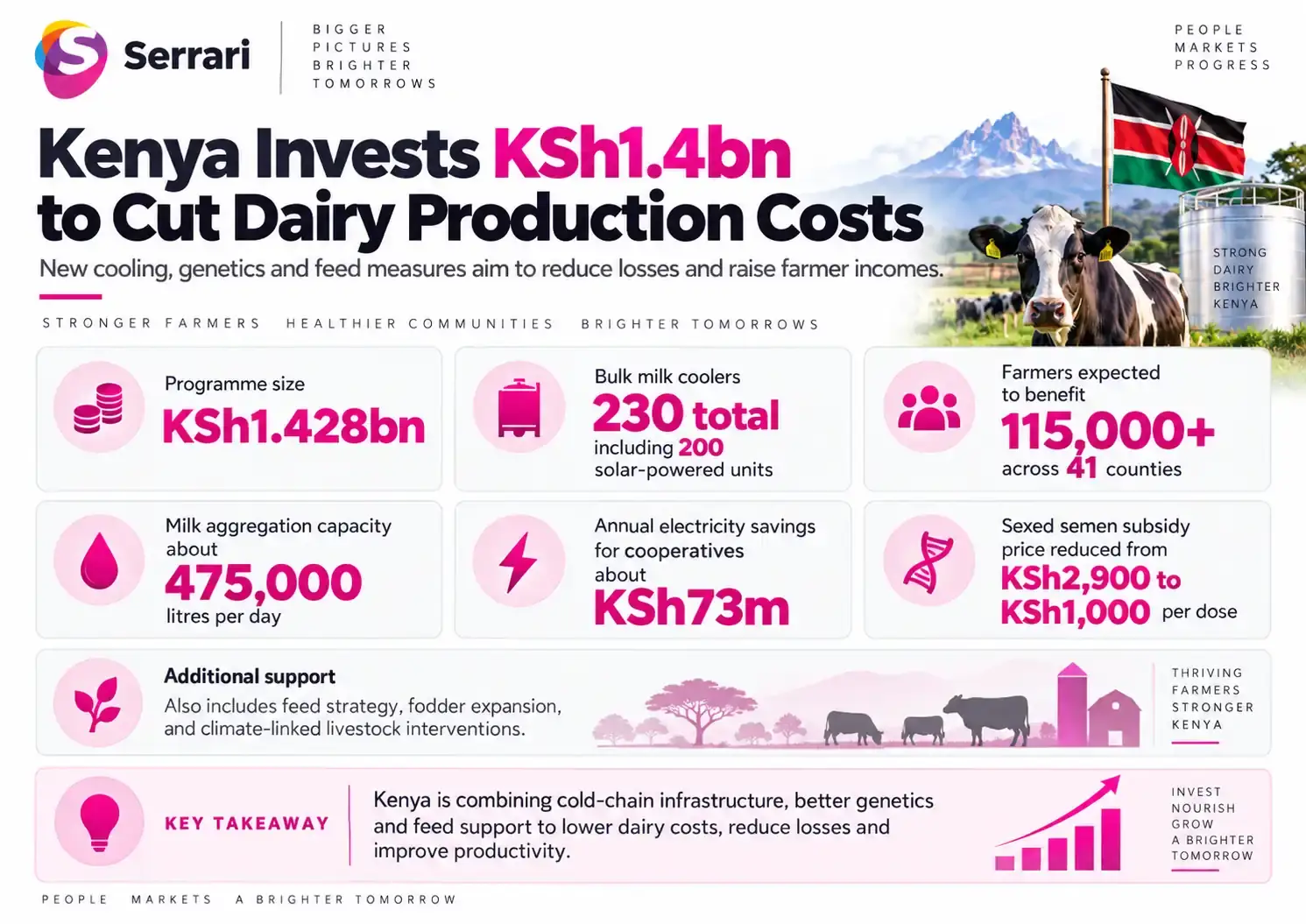
Kenya is rolling out a KSh1.428 billion dairy-cooling programme built around 230 bulk milk coolers, including 200 solar-powered units, as part of efforts to reduce post-production losses and lower operating costs for dairy cooperatives. The cooler procurement programme was undertaken through the State Department for Livestock Development and targets organised dairy farmers across the country.
The equipment is expected to support more than 115,000 farmers in 41 counties and provide capacity to aggregate about 475,000 litres of milk per day. Solar-powered units are also projected to reduce electricity expenses for cooperatives, improving the economics of milk collection and cold storage.
Key Overview
- The dairy-cooling programme is valued at KSh1.428 billion.
- It covers 230 bulk milk coolers, including 200 solar-powered units.
- More than 115,000 dairy farmers in 41 counties are expected to benefit.
- Aggregation capacity is estimated at about 475,000 litres of milk daily.
- Sexed semen has been subsidised from KSh2,900 to KSh1,000 per dose.
- Kenya is also expanding feed production, dairy genetics and climate-resilient livestock programmes.
Cooling Investment Targets Milk Losses and Energy Costs
The new equipment is intended to strengthen milk collection at cooperative and producer-organisation level, where delayed cooling can lead to spoilage and lower-quality milk. The latest programme details show that the solar-powered coolers are expected to save dairy organisations about KSh73 million annually in electricity costs.
The coolers are projected to support daily milk aggregation of around 475,000 litres, improving the ability of farmers to preserve milk before collection or processing. This is especially important as the sector shifts toward stronger quality controls and value-added dairy products.
Kenya’s dairy sector currently produces about 5.4 billion litres of milk annually, with recent policy efforts focusing increasingly on milk quality, cold-chain infrastructure and cooperative marketing rather than volume alone.
Genetics Subsidy Aims to Raise Herd Productivity
The government is also reducing the cost of improved dairy genetics. Under the current subsidy programme, the price of sexed semen has been cut from KSh2,900 to KSh1,000 per dose, a reduction of roughly 65%.
The objective is to make higher-quality breeding material more affordable to small and medium-sized farmers and accelerate improvements in herd productivity. Recent dairy interventions have also included distribution of sexed-semen doses alongside milk-cooling equipment and improved herd-management support.
Higher-yielding animals can increase output per cow, but genetics alone is not sufficient. Feed availability, animal health, water, housing and farm management remain important determinants of productivity and production costs.
Context is everything. Stay ahead of shifting trends with today’s market updates, and uncover emerging opportunities using the Serrari Group Market Index and Marketplace. Then, take control of your own financial future by exploring our Money & Life Reset Transformation Blueprint ™ to build stronger habits, create better systems, and design a path toward lasting wealth.
Feed Costs Remain a Major Challenge
Animal feed remains one of the largest expenses in livestock production. Kenya’s agricultural investment planning estimates that feeds account for more than 70% of animal-production costs, while available feed supply remains well below national requirements. The national agricultural investment plan estimates a feed requirement of 55 million tonnes of dry matter against available supply of about 25 million tonnes.
To address the gap, the government is pursuing commercial fodder production, feed reserves and private-sector investment. Under the Land Commercialisation Initiative, underutilised public land is being considered for larger-scale agricultural and fodder production.
One major private investment is the De Heus animal-feed plant in Athi River. The facility represents a KSh3 billion investment and has annual production capacity of about 240,000 metric tonnes, substantially higher than the KSh300 million figure reported in some earlier coverage.
At Galana-Kulalu, the government has also allocated land for large-scale commercial agriculture and animal-feed production. The official project allocation assigns 180,000 acres to UAE-based Al Dahra, alongside other private participants, as part of plans to expand irrigated production.
Climate Finance Adds Another Layer of Dairy Investment
Kenya is also using climate finance to improve livestock productivity while reducing methane emissions. The country’s participation in the Dairy Interventions for Mitigation and Adaptation programme has been linked to about $42 million in financing for interventions across 12 counties.
The wider East African dairy programme covers Kenya, Rwanda, Tanzania and Uganda and has a total project value of about $358 million. Green Climate Fund financing totals $150 million, with the remainder coming through co-financing.
The programme focuses on improved genetics, feed management, veterinary support, manure handling and climate resilience. The strategy is designed to reduce emissions intensity while helping farmers produce more efficiently rather than simply reducing livestock numbers.
Together, the cooling programme, genetics subsidies, feed investments and climate-finance initiatives show a broader attempt to lower dairy production costs while improving productivity, milk quality and farmer incomes. The impact will ultimately depend on how quickly the equipment and programmes translate into lower losses, stronger cooperative performance and better farm-level margins.
Sources
Parliament of Kenya / Ministry of Agriculture and Livestock Development / Kenya News Agency / Green Climate Fund / De Heus Animal Nutrition / Office of the President of Kenya / The Star
Your financial future isn’t something you wait for—it’s something you build.
The real question is: when do you begin?
Move beyond simply staying informed.
Navigate the markets with clarity—track trends through the Serrari Group Market Index, uncover opportunities in the Serrari Marketplace, and build practical knowledge with our Curated Wealth Builder Platform.
Stay connected to what truly matters.
Get daily insights on macro trends and financial movements across Kenya, Africa, and global markets—delivered through the Serrari Newsletter.
Growth opens doors.
Advance your career through professional programs including ACCA, HESI A2, ATI TEAS 7 , HESI EXIT , NCLEX – RN and NCLEX – PN, Financial Literacy!🌟—designed to move you forward with confidence.
See where money is flowing—clearly and in real time.
Track Money Market Funds, Treasury Bills, Treasury Bonds, Green Bonds, and Fixed Deposits, alongside global and African indexes, key economic indicators, and the evolving Crypto and stablecoin landscape—all within Serrari’s Market Index.