WeLight has unveiled a $650 million expansion strategy to accelerate electricity access across Africa through solar mini-grids. The investment will support expansion into Nigeria and the Democratic Republic of Congo (DRC) while growing operations in existing markets. The initiative aims to increase the company’s customer base from around 800,000 people to eight million by 2030, supporting off-grid electrification, renewable energy adoption, and economic development across some of Africa’s largest electricity access markets.
Key Overview
- WeLight plans to invest $650 million to expand its solar mini-grid network across Africa.
- The company will enter Nigeria and the Democratic Republic of Congo.
- The expansion aims to increase electricity access from 800,000 to eight million people.
- Nigeria and the DRC account for around 170 million people without electricity.
- The investment supports Africa’s broader clean energy and rural electrification goals.
WeLight Plans $650 Million Solar Mini-Grid Expansion Across Africa
WeLight, the company operating more solar mini-grids in Africa than any other provider, has announced plans to invest $650 million to significantly expand electricity access across the continent as demand for off-grid renewable energy continues to grow.
The expansion will see the company enter Nigeria and the Democratic Republic of Congo (DRC)—two countries with the world’s largest electricity access deficits—while strengthening operations in its existing markets of Madagascar and Mali and expanding into a fifth African country yet to be announced.
The investment aligns with wider efforts to accelerate rural electrification through renewable energy technologies as governments and development finance institutions increasingly support decentralized power solutions.
Expansion Targets Africa’s Largest Electricity Access Gaps
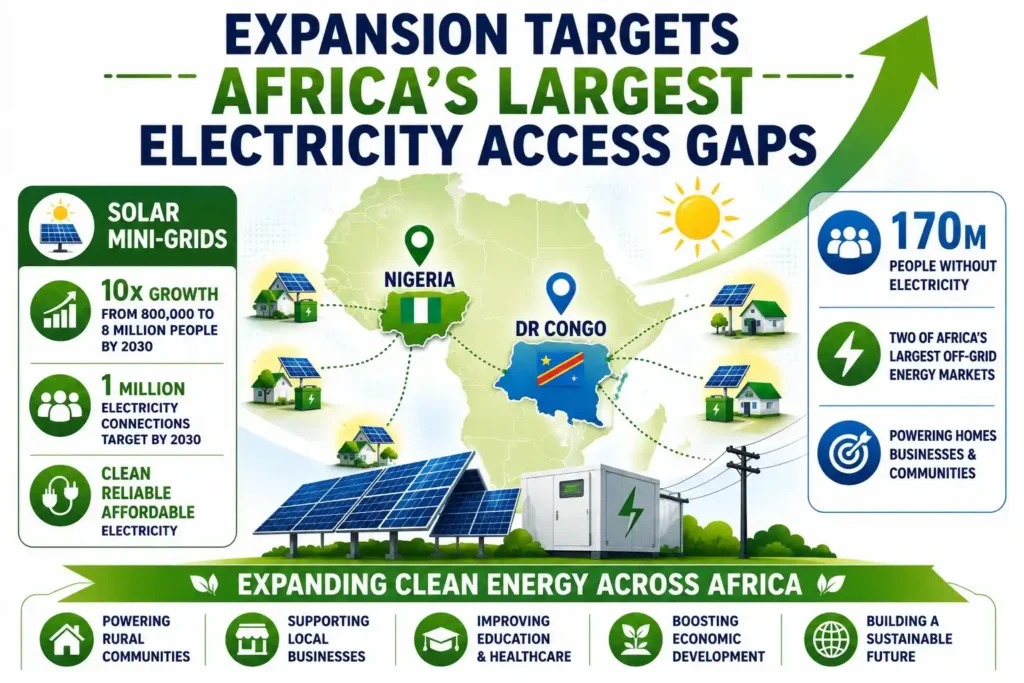
Founded in 2018, WeLight currently operates nearly 190 solar mini-grids across Madagascar and Mali, providing electricity to more than 800,000 people.
Under its new growth strategy, the company plans to increase the number of people it serves tenfold, reaching approximately eight million people through expanded mini-grid deployment by 2030.
Chief Executive Officer Romain de Villeneuve said the company aims to achieve one million electricity connections by 2030, with ambitions to reach that milestone even earlier.
At present, WeLight has approximately 65,000 connections, primarily in Madagascar, and is already expanding that figure to around 90,000 connections before launching its next phase of growth.
Nigeria and DRC Drive Expansion Strategy
Nigeria and the Democratic Republic of Congo have become central to WeLight’s expansion because they represent the largest electricity access opportunities on the continent.
Together, the two countries account for approximately 170 million people among the more than 560 million people living without electricity across sub-Saharan Africa.
Nigeria continues to face widespread electricity shortages despite decades of investment in its national grid, leaving millions of households and businesses dependent on costly diesel generators due to frequent power outages.
Meanwhile, the Democratic Republic of Congo possesses vast hydropower resources but continues to experience low electrification rates because of limited transmission infrastructure and the country’s vast geographical distances.
For WeLight, both markets present significant commercial opportunities while supporting broader development objectives through expanded access to reliable, affordable and clean electricity.
Funding Strategy Combines Public and Private Capital
Of the planned $650 million investment, approximately $450 million will be allocated to projects in Nigeria and the Democratic Republic of Congo.
The remaining $200 million will support continued expansion in Madagascar, Mali and an additional African market.
According to the company, roughly half of the required financing is expected to come from dedicated distributed renewable energy programmes, including the World Bank-backed Dares programme in Nigeria and the Mwinda Fund in the Democratic Republic of Congo.
The balance will be financed through equity investments, including contributions from existing shareholders, alongside concessional debt financing.
De Villeneuve noted that large-scale rural electrification requires blended finance, stating that private capital alone cannot finance the continent’s growing electricity needs.
Growing Support for Off-Grid Renewable Energy
WeLight’s expansion comes as international development institutions intensify efforts to close Africa’s electricity access gap.
The World Bank and the African Development Bank are jointly leading initiatives aimed at connecting 300 million Africans to electricity by 2030, with off-grid technologies expected to play a major role in reaching remote and underserved communities.
Solar mini-grids have emerged as one of the fastest and most cost-effective solutions where extending national transmission networks remains economically challenging.
The World Bank has also increased support for distributed renewable energy programmes designed to accelerate private sector investment in mini-grid infrastructure across several African countries.
Shareholders Continue Supporting Growth
WeLight’s expansion follows the International Finance Corporation (IFC) acquiring a stake in the company last month, becoming its first new shareholder since its establishment.
The company’s founding shareholders include:
- Axian Group
- Sagemcom
- Norfund
The addition of IFC strengthens WeLight’s access to international climate finance while reinforcing investor confidence in decentralized renewable energy infrastructure across Africa.
Off-Grid Energy Supports Economic Development
Beyond expanding electricity access, solar mini-grids are increasingly viewed as critical infrastructure for supporting local economic development.
Reliable electricity enables businesses to extend operating hours, supports agricultural processing, improves healthcare delivery, enhances educational services and reduces reliance on expensive diesel generators.
For rural communities where national grid expansion remains years away, decentralized renewable energy systems provide faster access to modern electricity while contributing to emissions reductions and improved energy security.
As demand for electricity continues to rise across Africa, mini-grid developers are expected to play an increasingly important role in supporting inclusive economic growth alongside national electrification programmes.
Outlook
WeLight’s planned $650 million expansion highlights growing investor confidence in decentralized renewable energy as a practical solution to Africa’s electricity access challenge. With support from development finance institutions and blended financing mechanisms, solar mini-grids are expected to play an increasingly important role in connecting underserved communities, reducing dependence on fossil fuels, and supporting sustainable economic development. As countries accelerate efforts to achieve universal electricity access, investments in off-grid renewable infrastructure are likely to become an increasingly significant component of Africa’s clean energy transition.
FAQs
1. What is WeLight planning to invest?
WeLight plans to invest $650 million to expand its solar mini-grid operations across Africa.
2. Which countries will WeLight expand into?
The company plans to enter Nigeria and the Democratic Republic of Congo, while expanding operations in Madagascar, Mali and another African country.
3. How many people does WeLight aim to serve?
The company plans to increase the number of people served from about 800,000 to approximately eight million by 2030.
4. Why are Nigeria and the DRC important for the expansion?
Together, Nigeria and the Democratic Republic of Congo account for around 170 million people without access to electricity, making them two of Africa’s largest off-grid energy markets.
Sources: Innovation Village, Energy Connects, Business Insider Africa, Engineering News, Businessfront
Your financial future isn’t something you wait for—it’s something you build.
The real question is: when do you begin?
Move beyond simply staying informed.
Navigate the markets with clarity—track trends through the Serrari Group Market Index, uncover opportunities in the Serrari Marketplace, and build practical knowledge with our Curated Wealth Builder Platform.
Stay connected to what truly matters.
Get daily insights on macro trends and financial movements across Kenya, Africa, and global markets—delivered through the Serrari Newsletter.
Growth opens doors.
Advance your career through professional programs including ACCA, HESI A2, ATI TEAS 7 , HESI EXIT , NCLEX – RN and NCLEX – PN, Financial Literacy!🌟—designed to move you forward with confidence.
See where money is flowing—clearly and in real time.
Track Money Market Funds, Treasury Bills, Treasury Bonds, Green Bonds, and Fixed Deposits, alongside global and African indexes, key economic indicators, and the evolving Crypto and stablecoin landscape—all within Serrari’s Market Index.