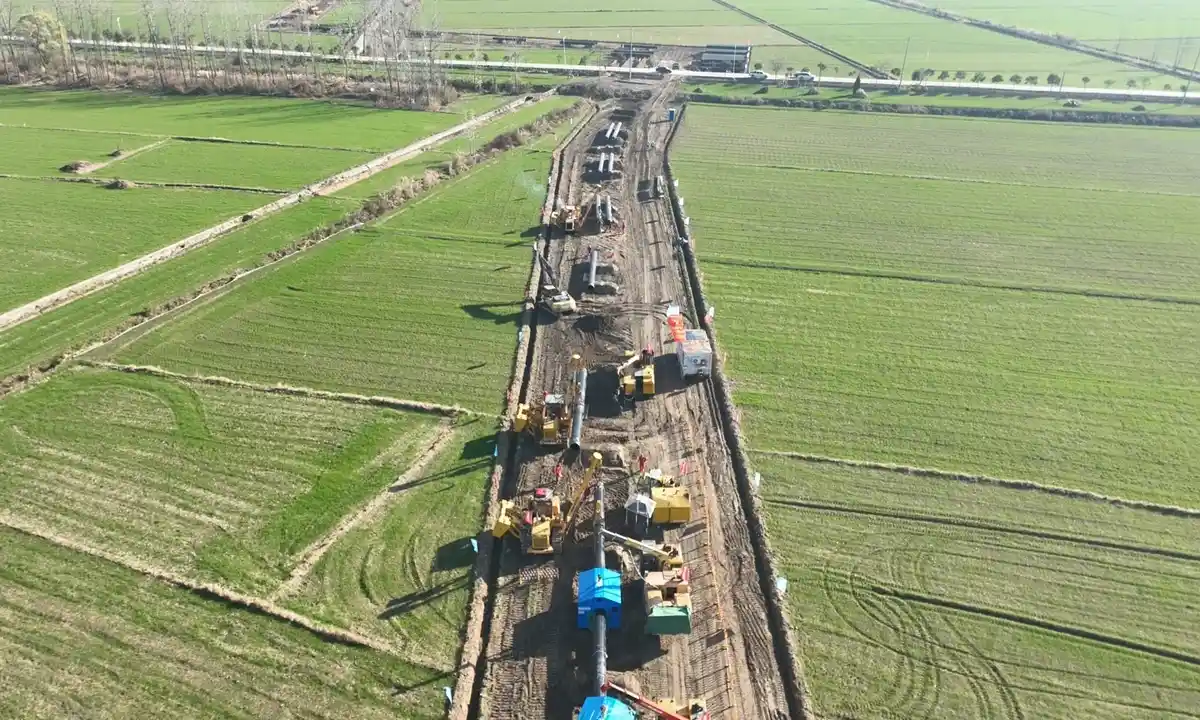
China has commissioned the Lianyungang-Huai’an section of the Lianyungang-Yizheng crude oil pipeline, a major energy infrastructure project with a designed annual transportation capacity of 18.5 million tons. Developed by PipeChina, the 143.8-kilometre section connects seaborne crude supplies with Yizheng, an important oil distribution hub in East China. The pipeline can transport up to 70,000 tons of crude oil per day and will serve refineries and petrochemical enterprises in Jiangsu Province and areas along the Yangtze River. The project is expected to strengthen China’s oil and gas pipeline network, improve the allocation of imported crude resources and enhance energy supply security.
Key Overview
- China has commenced operations on the Lianyungang-Huai’an section of the Lianyungang-Yizheng crude oil pipeline.
- The pipeline has a designed annual transportation capacity of 18.5 million tons.
- The operational section stretches 143.8 kilometres.
- The pipeline can transport up to 70,000 tons of crude oil daily to Yizheng.
- Construction began in October 2024 and was completed in June 2026.
- The project will serve refineries and petrochemical enterprises in Jiangsu Province and along the Yangtze River.
- The pipeline is expected to strengthen energy supply security and improve the allocation of imported crude resources.
- It is the first 10-million-ton-level crude oil pipeline commissioned since the beginning of China’s 15th Five-Year Plan (2026-30).
China Commissions Major Crude Oil Pipeline
The Lianyungang-Huai’an section of China’s Lianyungang-Yizheng crude oil pipeline has commenced operations, marking a significant addition to the country’s oil and gas infrastructure network.
The project developer, PipeChina, confirmed that the section began operations on Thursday.
The pipeline has a designed annual transportation capacity of 18.5 million metric tons of crude oil, making it the first 10-million-ton-level crude oil pipeline to be put into operation since the beginning of China’s 15th Five-Year Plan (2026-30) period.
According to PipeChina, the project is important for optimizing China’s energy supply structure in the central and eastern regions and improving the nationwide layout of oil and gas infrastructure.
143.8-Kilometre Pipeline Connects Crude Supplies to Yizheng
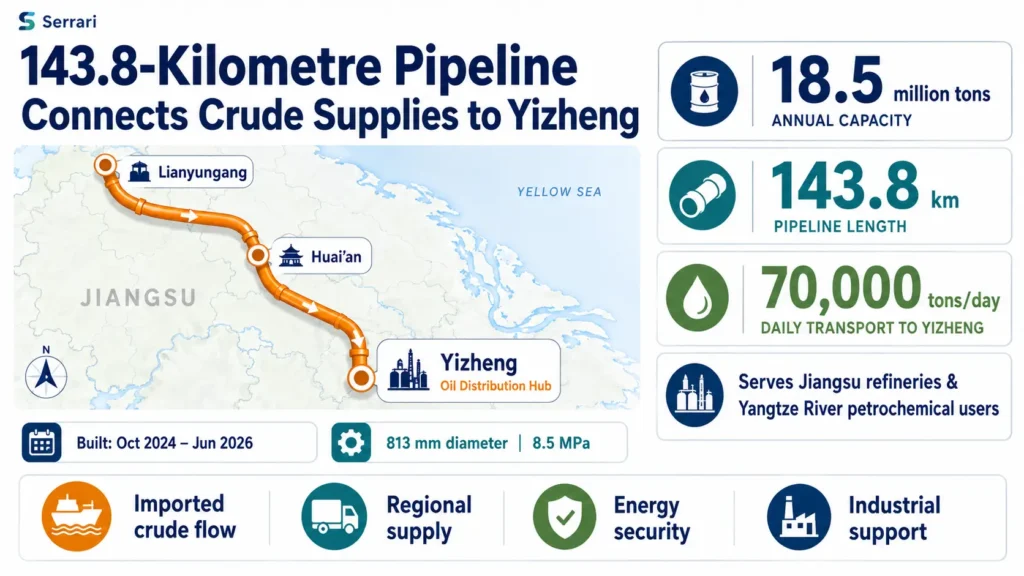
The Lianyungang-Huai’an section has a total length of 143.8 kilometers and a designed annual transportation capacity of 18.5 million tons.
Construction began in October 2024 and was completed in June 2026.
The pipeline has a diameter of 813 millimeters and a design pressure of 8.5 megapascals.
It can transport up to 70,000 tons of crude daily to Yizheng, an important oil distribution hub in East China.
The pipeline will serve refineries in Jiangsu Province and along the Yangtze River, strengthening the supply of crude oil to downstream industries.
Following its launch, the new section will connect with the existing Rizhao-Yizheng pipeline to transport crude oil to Yizheng station.
Strengthening Energy Supply Security
The commissioning of the new pipeline is expected to strengthen China’s energy supply security by improving connectivity between seaborne crude supplies and inland oil infrastructure.
PipeChina said the project will further optimize the oil and natural gas pipeline network in the Yangtze River Delta region and improve the coordinated allocation of imported crude resources.
Sun Chuanwang, a professor at the School of Economics at Xiamen University, described the launch of the Lianyungang-Huai’an section as an important step in strengthening China’s oil pipeline network.
He said the new pipeline would improve connectivity and stability in central and eastern China while reducing reliance on overland transportation and mitigating the impact of bad weather.
The pipeline’s access to seaborne crude and connection with inland pipelines is also expected to improve the layout of China’s nationwide oil and gas network and support the production security of downstream petrochemical industries.
Supporting Jiangsu’s Refining and Chemical Industry
The infrastructure will serve refining and chemical enterprises in Jiangsu Province as well as regions along the Yangtze River.
PipeChina said the pipeline will enhance multi-channel resource security for users in the region.
Its connection to existing infrastructure will allow imported crude oil to move more efficiently toward inland refining and petrochemical facilities.
The project is therefore expected to strengthen the connection between China’s coastal crude oil supply channels and its inland industrial demand.
This is particularly important for the Yangtze River Delta, where the pipeline network plays a role in supporting energy supply for industrial activity.
Context is everything. Stay ahead of shifting trends with today’s market updates, and uncover emerging opportunities using the Serrari Group Market Index and Marketplace. Then, take control of your own financial future by exploring our Money & Life Reset Transformation Blueprint ™ to build stronger habits, create better systems, and design a path toward lasting wealth.
Expanding China’s Nationwide Oil and Gas Network
The new pipeline forms part of China’s broader efforts to build an interconnected nationwide oil and gas network.
During the 14th Five-Year Plan (2021-25) period, China completed approximately 19,000 kilometers of pipelines, according to the Xinhua News Agency.
The country’s natural gas transportation capacity also increased to 420 billion cubic meters per year in 2025, compared with 260 billion cubic metres per year in 2020.
PipeChina is currently managing the construction of nearly 40 major oil and gas pipelines across the country, with a combined length of more than 9,000 kilometers.
The continued expansion of the network is intended to strengthen connectivity between different energy supply sources and demand centres.
Importance for China’s Energy Infrastructure
The launch of the Lianyungang-Huai’an pipeline comes as China continues to strengthen the resilience of its energy infrastructure.
The project’s ability to connect seaborne crude supplies with inland pipelines and refining centres provides additional transportation capacity for crude oil entering the country.
Its integration with existing infrastructure also supports the development of a more interconnected oil and gas network.
For Jiangsu and neighbouring regions, the pipeline is expected to improve access to crude oil while supporting refining and petrochemical production.
Outlook
The commissioning of the 143.8-kilometre Lianyungang-Huai’an crude oil pipeline section strengthens China’s oil transportation infrastructure and adds 18.5 million tons of annual crude oil transportation capacity. Its connection to the existing Rizhao-Yizheng pipeline will improve the movement of imported crude resources toward Yizheng and downstream refining and petrochemical facilities.
As China continues expanding its nationwide oil and gas network, the new pipeline is expected to contribute to energy supply security, improve resource allocation and strengthen connectivity across central and eastern China.
FAQs
1. What is the capacity of the Lianyungang-Huai’an crude oil pipeline?
The pipeline has a designed annual transportation capacity of 18.5 million tons and can transport up to 70,000 tons of crude oil per day.
2. How long is the Lianyungang-Huai’an pipeline section?
The section has a total length of 143.8 kilometres.
3. What areas will the pipeline serve?
The pipeline will serve refineries and petrochemical enterprises in Jiangsu Province and along the Yangtze River, with crude transported to Yizheng.
4. Why is the pipeline important for China?
The pipeline will strengthen energy supply security, improve the allocation of imported crude resources and further optimize China’s nationwide oil and gas pipeline network.
Sources: Global Times, China Daily, Streamline Feed
Your financial future isn’t something you wait for—it’s something you build.
The real question is: when do you begin?
Move beyond simply staying informed.
Navigate the markets with clarity—track trends through the Serrari Group Market Index, uncover opportunities in the Serrari Marketplace, and build practical knowledge with our Curated Wealth Builder Platform.
Stay connected to what truly matters.
Get daily insights on macro trends and financial movements across Kenya, Africa, and global markets—delivered through the Serrari Newsletter.
Growth opens doors.
Advance your career through professional programs including ACCA, HESI A2, ATI TEAS 7 , HESI EXIT , NCLEX – RN and NCLEX – PN, Financial Literacy!🌟—designed to move you forward with confidence.
See where money is flowing—clearly and in real time.
Track Money Market Funds, Treasury Bills, Treasury Bonds, Green Bonds, and Fixed Deposits, alongside global and African indexes, key economic indicators, and the evolving Crypto and stablecoin landscape—all within Serrari’s Market Index.