US Treasury yields rose to their highest levels in nearly two months as investors reacted to rising oil prices, renewed inflation concerns and expectations surrounding the upcoming Federal Reserve policy meeting. The increase in both the 10-year Treasury yield and 30-year Treasury yield highlights growing caution across the U.S. debt market.
Key Overview
- Treasury yields reached two-month highs.
- Rising oil prices fueled inflation concerns.
- Investors reassessed Federal Reserve policy.
- Bond market volatility increased.
- Long-term government bonds came under pressure.
- Rate hike expectations edged higher.
- Thin trading amplified market moves.
- Treasury Inflation-Protected Securities also climbed.
US Treasury Yields Reach Two-Month High Ahead of Federal Reserve Meeting
US Treasury yields climbed to their highest levels in approximately two months as investors sold long-term government bonds ahead of the upcoming Federal Reserve policy meeting. Rising energy prices and renewed inflation concerns pushed both the 10-year Treasury yield and 30-year Treasury yield higher, reversing much of the rally that followed last week’s encouraging U.S. inflation data.
The move reflects growing uncertainty within the bond market as traders weigh geopolitical risks, inflationary pressures and the possibility that the Federal Reserve could maintain a tighter monetary policy for longer than previously expected. With the July policy meeting approaching, investors are closely monitoring economic data and market signals for clues about the future path of interest rates.
Long-Term Treasury Yields Continue Rising
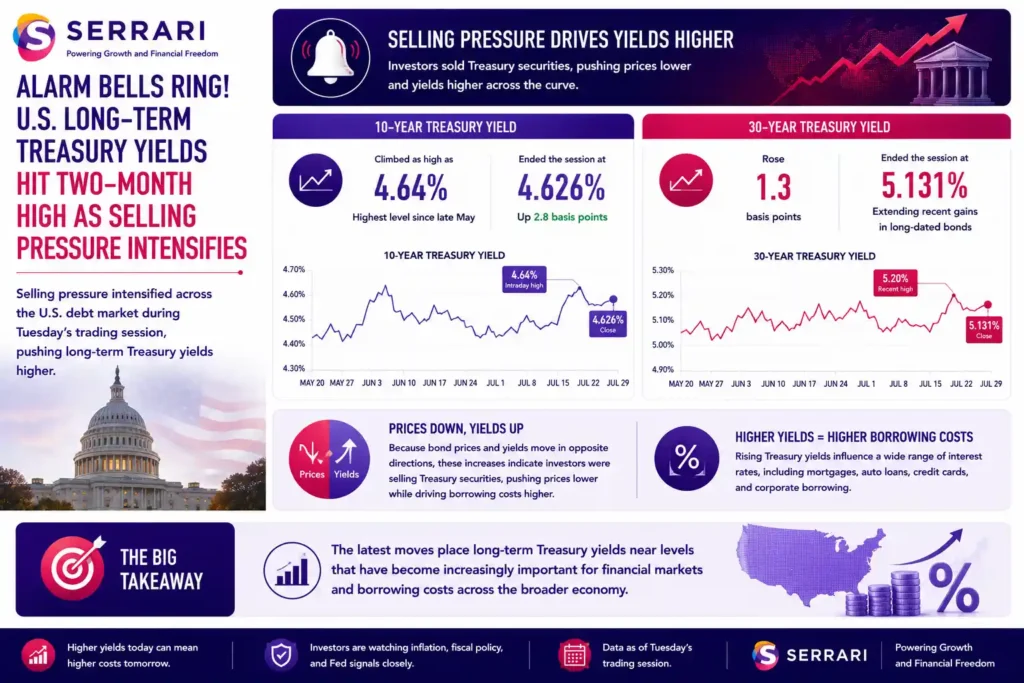
Selling pressure intensified across the U.S. debt market during Tuesday’s trading session.
The 10-year Treasury yield climbed as high as 4.64%, reaching its highest level since late May before ending the session at approximately 4.626%, an increase of 2.8 basis points.
Meanwhile, the 30-year Treasury yield rose 1.3 basis points to approximately 5.131%, extending recent gains in long-dated government bonds.
Because bond prices and yields move in opposite directions, the increase indicates investors were selling Treasury securities, pushing prices lower while driving borrowing costs higher.
The latest moves place long-term Treasury yields near levels that have become increasingly important for financial markets and borrowing costs across the broader economy.
Oil Prices Renew Inflation Concerns
One of the primary drivers behind the latest increase in US Treasury yields has been the sharp rise in global energy prices.
Benchmark Brent crude oil climbed to around US$91 per barrel amid escalating tensions affecting shipping routes in the Red Sea.
Higher oil prices can contribute to broader inflation by increasing transportation, manufacturing and production costs throughout the economy.
As inflation expectations rise, investors often demand higher yields to compensate for the reduced purchasing power of future bond payments.
The renewed concerns have therefore increased pressure on long-term government bonds while reinforcing expectations that inflation may remain above the Federal Reserve’s target for longer than previously anticipated.
Federal Reserve Policy Remains in Focus
Investor attention remains firmly fixed on the upcoming Federal Reserve policy meeting.
Interest rate futures currently imply that financial markets assign approximately a 22% to 26% probability of a rate increase at the July meeting.
Although this represents a lower probability than earlier this month, expectations for additional tightening later in the year remain elevated.
Market pricing indicates:
- Around 71% probability of a rate increase by September.
- Approximately 88% probability of at least one additional increase before year-end.
These expectations have contributed to upward pressure on Treasury yields as investors adjust portfolios in anticipation of potentially higher borrowing costs.
Context is everything. Stay ahead of shifting trends with today’s market updates and uncover emerging opportunities using the Serrari Group Market Index and Marketplace. Then, take control of your own financial future by exploring our Money & Life Reset Transformation Blueprint ™ to build stronger habits, create better systems, and design a path toward lasting wealth.
Technical Levels Amplify Bond Market Volatility
Market strategists noted that several closely watched technical thresholds were breached during the latest sell-off.
According to analysts at Royal Bank of Canada Capital Markets, the 10-year Treasury yield moved above 4.60%, while the two-year Treasury yield exceeded 4.20%.
Crossing these technical levels triggered additional selling activity within the fixed income market, particularly as trading volumes remained relatively light during the summer period.
Lower trading activity can amplify market volatility because relatively modest transactions have a greater impact on prices when fewer participants are active.
The combination of rising energy prices, technical selling and reduced liquidity therefore contributed to the stronger-than-usual movement in Treasury yields.
Real Yields Reach Highest Levels in Years
Another notable development occurred within the market for inflation-protected government securities.
The yield on the 30-year Treasury Inflation-Protected Security (TIPS) climbed to approximately 2.95%, reaching its highest level since 2008.
Real yields measure investor returns after adjusting for inflation expectations and are widely monitored as indicators of financial conditions.
Higher real yields generally increase financing costs across the economy while influencing valuations for equities, real estate and other risk assets.
The rise therefore extends beyond the government bond market, potentially affecting investment decisions across multiple asset classes.
Thin Trading Conditions Increase Market Swings
Trading volumes have also contributed to recent volatility.
According to CME Group data, activity in Secured Overnight Financing Rate (SOFR) futures and options remained well below recent averages.
SOFR futures trading reached only approximately 74% of its 20-day average volume, while options activity fell to roughly 54% of normal levels.
Reduced participation often results in larger price swings because fewer buyers and sellers are available to absorb market movements.
Consequently, technical factors may have magnified the underlying impact of inflation concerns on Treasury prices.
Investors Monitor Long-Term Yield Trends
Market participants are increasingly watching long-term technical trends within government bonds.
The 50-day moving average for the 30-year Treasury yield has already moved above the psychologically significant 5% level.
Analysts have suggested that if yields continue rising, the next major technical target could approach 5.5%.
Some strategists believe long-term Treasury yields may now be transitioning toward a higher trading range after several years of historically low borrowing costs.
Such a shift could have important implications for mortgage rates, corporate borrowing, government financing costs and investment valuations across global financial markets.
Outlook for US Treasury Yields
The recent rise in US Treasury yields reflects a combination of inflation concerns, geopolitical uncertainty and shifting expectations for Federal Reserve policy. While markets had previously responded positively to improving inflation data, higher energy prices and stronger expectations for future interest rates have quickly reversed that optimism.
As investors await the Federal Reserve’s upcoming policy decision, movements in the 10-year Treasury yield, 30-year Treasury yield and broader bond market are likely to remain closely watched. Future yield direction will depend largely on incoming inflation data, economic growth and the central bank’s assessment of whether additional policy tightening is required to achieve its long-term inflation objective.
FAQs
Why did US Treasury yields rise?
US Treasury yields increased because investors became concerned that rising oil prices could keep inflation elevated, raising the possibility that the Federal Reserve may maintain higher interest rates for longer. Selling pressure in long-term government bonds pushed yields to their highest levels in nearly two months.
What is the significance of the 10-year Treasury yield?
The 10-year Treasury yield is one of the most closely watched interest rates in global financial markets. It influences borrowing costs for mortgages, corporate loans and government financing while serving as an important benchmark for investment decisions across multiple asset classes.
How do higher Treasury yields affect investors?
Higher Treasury yields generally increase returns for new bond buyers but reduce the market value of existing bonds. Rising yields can also increase borrowing costs for consumers, businesses and governments while affecting valuations in stock and real estate markets.
Why is the Federal Reserve important for the Treasury market?
The Federal Reserve sets short-term monetary policy, influencing expectations for future interest rates. Changes in Fed policy or investor expectations about future rate decisions often have a significant impact on Treasury yields, government bond prices and the broader fixed income market.
Sources: Yahoo Finance, Futubull, Investing
Your financial future isn’t something you wait for—it’s something you build.
The real question is: when do you begin?
Move beyond simply staying informed.
Navigate the markets with clarity—track trends through the Serrari Group Market Index, uncover opportunities in the Serrari Marketplace, and build practical knowledge with our Curated Wealth Builder Platform.
Stay connected to what truly matters.
Get daily insights on macro trends and financial movements across Kenya, Africa, and global markets—delivered through the Serrari Newsletter.
Growth opens doors.
Advance your career through professional programs including ACCA, HESI A2, ATI TEAS 7 , HESI EXIT , NCLEX – RN and NCLEX – PN, Financial Literacy!🌟—designed to move you forward with confidence.
See where money is flowing—clearly and in real time.
Track Money Market Funds, Treasury Bills, Treasury Bonds, Green Bonds, and Fixed Deposits, alongside global and African indexes, key economic indicators, and the evolving Crypto and stablecoin landscape—all within Serrari’s Market Index.